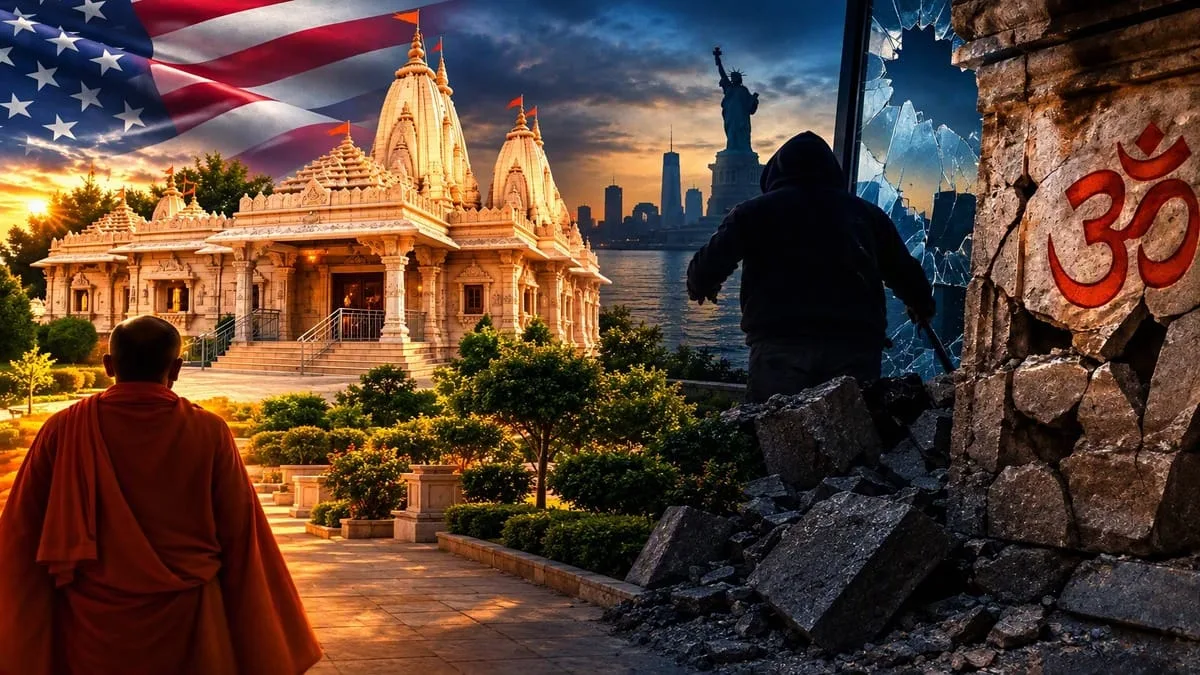
The Aurora temple shooting plot has renewed calls to tackle anti-Hindu hostility and protect Hindu places of worship in US
ILLINOIS: The reported attempt to carry out a mass shooting at a Hindu Mandir near Chicago has renewed concerns over the safety of Hindus and their places of worship in the United States. The plot, involving 19-year-old Alexandros Paporakis, is a grave warning for America, Europe and the wider world about the dangers of racist hatred and extremist violence directed against religious communities.
The National Spokesperson of the Vishwa Hindu Parishad (VHP), Vinod Bansal has come down heavily on the US administration with regards to the repeated attack on the Hindus as well as their religious sites in the United States of America. Bamsal added that the safety of the Hindus in US was increasingly becoming a matter of concern.
According to the account provided, Paporakis was arrested in connection with an alleged plan to target the Balaji Mandir in Aurora, Illinois, on October 11, 2026. Weapons and ammunition were reportedly recovered, while investigators allegedly uncovered material linked to racist and white supremacist ideology. The reported attack was thwarted after the suspect’s weapon malfunctioned, preventing the planned shooting of Hindu devotees. The allegations require verification through official investigative records and the judicial process.
The incident is particularly significant because Chicago is associated with Swami Vivekananda, who delivered his historic address at the 1893 World’s Parliament of Religions, conveying the message of universal harmony and acceptance. The alleged plot stands in stark contrast to those ideals and raises questions about whether enough is being done to protect Hindu communities.
The reported Aurora incident comes amid a series of incidents involving Hindu Mandirs, religious symbols and properties associated with Bharat and the Indian-American community.
In August 2022, a statue of Mahatma Gandhi outside Shri Tulsi Mandir in New York was vandalised, with a similar incident reportedly occurring again later. In December 2023, anti-India and pro-Khalistan slogans were written on the property of a Shri Swaminarayan Temple in Newark, California.
In September 2024, BAPS Shri Swaminarayan Mandir in Melville, New York, was targeted with anti-Hindu and anti-India messages. During the same month, a BAPS temple in the Sacramento area of California was also reportedly defaced with offensive messages, and its premises were vandalised.
In March 2025, anti-India and anti-Hindu messages appeared on the property of a BAPS temple in Chino Hills, California. In June 2025, reports emerged that the Shri Shri Radha Krishna Temple in Spanish Fork, Utah, had been subjected to gunfire over several days, causing damage to the temple.
In August 2025, the signboard of a BAPS temple in Greenwood, Indiana, was reportedly damaged and defaced with hateful messages. In January 2026, reports emerged that a statue at the entrance of the Shri Venkateswara Temple in Cary, North Carolina, had been damaged.
More recently, on October 2, 2026, bricks were reportedly thrown at the windows of Shri Swaminarayan Vadtal Dham Temple in Richmond Heights, Ohio. Priests and devotees were inside the temple when the incident occurred.
These incidents, followed by the alleged mass-shooting plot in Aurora, warrant serious attention. However, each case must be investigated independently to establish the perpetrators, motives and any possible connections between incidents.
The alleged Aurora plot highlights the need for stronger measures to protect Hindu religious institutions. The US administration must ensure that credible threats against Hindu temples receive urgent attention, with effective investigations, preventive security measures and accountability for those found responsible.
The US Commission on International Religious Freedom (USCIRF) should respond to substantiated concerns about anti-Hindu hostility. The United Nations and the UN Human Rights Council must also uphold the principle that religious freedom and protection from violence apply equally to all communities.
Attacks on Mandirs are not merely incidents of property damage when evidence establishes that they are driven by religious hatred. Places of worship are centres of spiritual practice, cultural preservation and community life. Threats against them can leave devotees fearful of gathering to practise their faith.
A policy of zero tolerance towards anti-Hindu violence must therefore be backed by concrete action, including prompt investigations, appropriate prosecution and cooperation between law enforcement agencies and temple authorities.
The prompt action attributed to the Government of India in this matter is commendable. Protecting the safety and religious freedom of Hindus living abroad requires appropriate diplomatic engagement and cooperation with the authorities of the countries concerned.
Swami Vivekananda’s message of universal harmony must be translated into action. Whether the threat involves vandalism, hateful graffiti, damage to religious symbols or an alleged conspiracy for mass violence, every case demands an impartial investigation and effective accountability.
