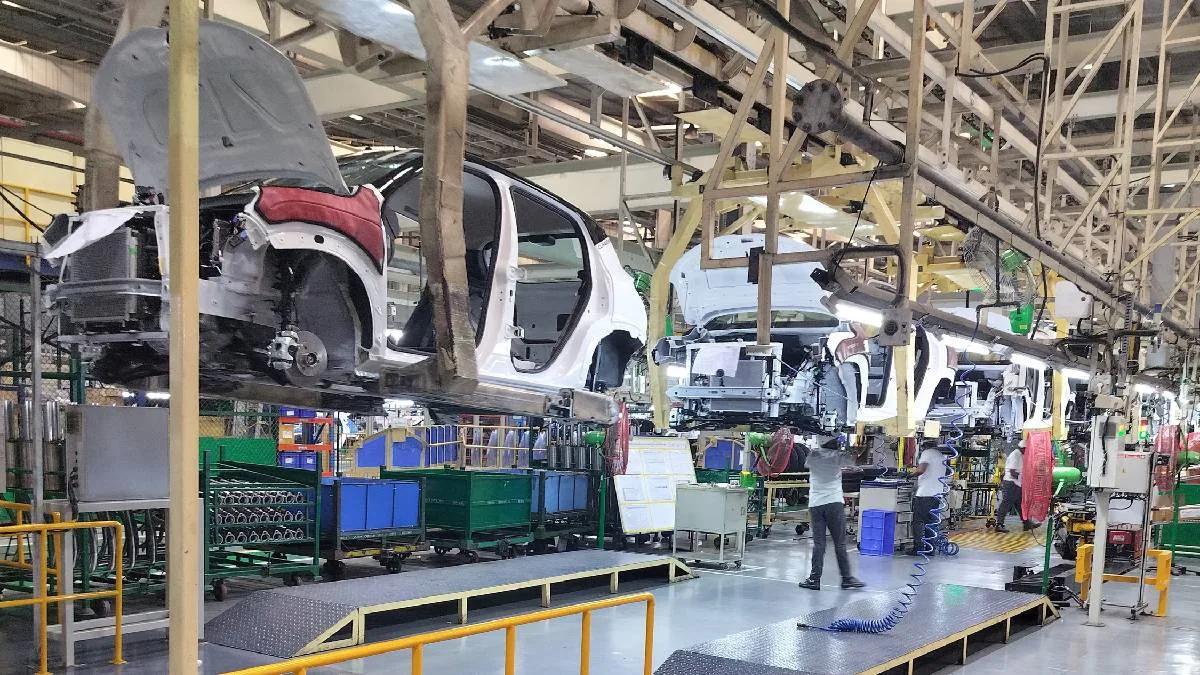
A representative image
South Korean automobile giant Hyundai Motor Group has announced plans to invest $15.5 billion in India between 2026 and 2032. The announcement has brought fresh attention to India’s efforts to expand manufacturing, attract global investment and strengthen its position in the international automobile industry. The investment was announced on October 13, 2026, following a meeting between Hyundai Motor Group Executive Chair Euisun Chung and Prime Minister Narendra Modi.
The proposed investment will cover manufacturing expansion, research and development (R&D), support for local suppliers and new businesses linked to future mobility. If the plans are carried out as announced, they could help India produce more vehicles and automobile components, create skilled jobs and increase its role in global supply chains.
The announcement is important because it goes beyond setting up factories or increasing the number of cars produced in India. It also creates an opportunity to strengthen the country’s engineering capabilities, encourage Indian companies to manufacture more components locally and develop technologies needed by the automobile industry in the coming years.
Hyundai has also planned to invest around $700 million in its Indian research and development operations. This includes expanding its research facilities and developing a vehicle-testing track. The company aims to strengthen its local engineering teams and work on newer automobile technologies.
The Make in India initiative aims to increase domestic production, attract investment, create jobs and make India an important part of global manufacturing. Hyundai’s investment plans fit into these goals because they cover several parts of the automobile industry, from vehicle production to research, technology and the development of local suppliers.
Manufacturing a car involves much more than assembling its different parts in a factory. The process depends on several industries, including steel and aluminium production, electronics, battery manufacturing, tyre production, precision engineering, software, transport, testing and after-sales services.
When a major automobile company expands its operations, the impact can reach many of these businesses. It can increase demand for locally made components, encourage suppliers to expand their factories and create new opportunities for smaller companies that provide parts and services.
Hyundai and its sister brand Kia already have a combined annual vehicle production capacity of more than 1.4 million units in India. The proposed investment is expected to build on this existing base through additional manufacturing capacity and the expansion of the wider automobile ecosystem.
For India, the bigger opportunity is to ensure that a larger share of the value created by this industry stays within the country. This means manufacturing more components locally, developing better production methods and giving Indian engineers a greater role in designing and developing vehicles.
This distinction is important. A country may produce millions of cars but still depend on imports for expensive components and advanced technologies. It may also rely on research facilities in other countries for important engineering work.
A stronger manufacturing ecosystem would allow India to do more than assemble vehicles. It would also involve developing advanced components, improving local engineering skills and encouraging Indian suppliers to design and manufacture products that can compete in international markets.
Hyundai’s investment could help India move in this direction. However, the actual benefits will depend on how much of the proposed investment is spent in India and whether it leads to lasting improvements in local manufacturing, research and technology.
One of the most direct ways Hyundai’s investment could support Make in India is by increasing the role of Indian companies in the automobile supply chain.
A modern car contains thousands of components. These range from basic mechanical parts to complex electronic systems that control different functions of the vehicle. To supply a major automobile manufacturer, companies must meet strict standards for quality, safety, cost and timely delivery.
Hyundai Motor India has already made progress in increasing the use of locally manufactured components. In January 2025, the company said it had achieved localisation of up to 92% in manufacturing. It also reported working with more than 194 vendors for over 1,238 parts and generating foreign-exchange savings of more than $672 million through localisation efforts since 2019.
These figures were reported by the company at the time and reflect its stated achievements.
The next step will be to increase domestic manufacturing in areas where imported components and specialised technologies continue to play an important role.
Greater localisation can benefit Indian businesses in several ways. Component manufacturers may receive larger orders and more regular demand from automobile companies. This can give them greater confidence to invest in new machinery, improve production methods, train workers and develop their own products.
Smaller manufacturers may also get an opportunity to enter the supply chains of major automobile companies. Once they meet the required quality and production standards, they may be able to supply components to other manufacturers in India and overseas.
This can spread the benefits of Hyundai’s investment beyond its own factories. It could help strengthen industrial clusters, create jobs and encourage Indian companies to move from making basic parts to producing more advanced components.
However, localisation should not be measured only by the number of parts made in India. It is also important to examine where the raw materials come from, how much of the electronics are imported and whether the technology used to manufacture key components is developed locally.
For India to become more self-reliant, domestic companies must gradually build the ability to manufacture complex components at competitive prices. This would help reduce dependence on imports while making Indian suppliers stronger participants in global manufacturing.
The planned $700 million investment in research and development could become one of the most important parts of Hyundai’s announcement.
Expanding factories can increase production and create employment. However, research and development can help a country move towards more advanced activities in the global automobile industry.
Designing vehicles, developing software, testing new engines and electric powertrains, and improving battery performance all require specialised knowledge and skilled workers. These activities can also create opportunities for engineers, researchers and technology companies.
Hyundai plans to strengthen its Indian R&D facilities, including through a vehicle-testing track, to support the development of next-generation automobile technologies. The aim is to expand India’s role in vehicle development instead of limiting local engineering work mainly to adapting models designed elsewhere.
This matters for Make in India because designing and developing vehicles locally can allow a larger share of the value created to remain in the Indian economy. It can generate skilled jobs, increase demand for engineering services and create opportunities for Indian companies to work directly with automobile manufacturers.
Indian engineers can also develop vehicles and technologies suited to local conditions. High summer temperatures, heavy monsoon rainfall, uneven roads, traffic congestion and the need for affordable vehicles all create specific challenges for manufacturers.
Research carried out in India can help companies understand these requirements and develop suitable solutions. Some of these technologies and engineering lessons could also be useful in other developing markets with similar road and weather conditions.
The expansion of R&D facilities could open doors for partnerships between automobile manufacturers, universities, startups and technology companies. Areas such as automotive electronics, artificial intelligence, battery systems and vehicle software could offer opportunities for Indian businesses to develop new products and services.
However, the expansion of a research centre does not automatically mean that all important technologies will be developed in India. The long-term impact will depend on the work assigned to Indian engineering teams, the technologies they are allowed to develop and their involvement in major product-design decisions.
If Indian teams take on greater responsibility for research, testing and product development, the country could gradually strengthen its position as a centre for automotive innovation as well as manufacturing.
India’s large domestic market is one of the main reasons global automobile companies continue to invest in the country. Producing vehicles in large numbers can help manufacturers spread factory and development costs across more units, making production more efficient.
But India’s export potential is equally important.
According to industry data reported in January 2026, India exported 863,233 passenger vehicles in calendar year 2025, around 16% more than in the previous year. The figures show the growing role of Indian factories in supplying vehicles to international markets. Source: The Economic Times.
Hyundai has already established India as an important manufacturing and export base. On October 14, 2026, the company announced that it had reached cumulative exports of four million passenger vehicles from India. According to the company, it was the first automaker in the country to achieve this milestone.
The company has also inaugurated its Pune facility, which has an initial annual production capacity of 170,000 units. It plans to increase this capacity to 320,000 units by 2030. The plant is expected to manufacture vehicles for export to more than 35 markets.
These developments show how Indian factories can serve both domestic buyers and customers in other countries.
With additional investment, Hyundai and Kia could increase production, improve manufacturing efficiency and supply more vehicles to markets in Africa, the Middle East, Latin America and other regions. Producing vehicles for export can also help factories maintain large production volumes and reduce their dependence on demand within India alone.
For Make in India, the goal should not be limited to exporting more vehicles. India must also increase the amount of value created within the country before those vehicles reach overseas markets.
This requires strong local suppliers, reliable transport and logistics, consistent quality standards and the ability to meet the safety and regulatory requirements of different countries.
The growth of exports is therefore closely linked to the development of domestic manufacturing and research. If Indian companies can produce more components and develop better engineering capabilities, they will be in a stronger position to serve global markets.
Over time, this could help India move beyond being a location where international companies manufacture vehicles towards becoming a country that also develops the products, components and technologies used in those vehicles.
India’s domestic automobile market provides another important reason for Hyundai’s long-term investment plans.
The launch of the Maruti 800 in 1983 helped shape the modern mass-market passenger-car industry in India. It made car ownership more accessible to middle-income families and helped expand the market for personal vehicles.
Over the following decades, rising incomes, growing cities, better road connectivity and changing consumer preferences increased demand for cars.
The market has continued to change. Many buyers now prefer SUVs and compact utility vehicles, while features related to safety, comfort, technology and fuel efficiency have become increasingly important in purchase decisions.
Automobile companies have responded by expanding their SUV ranges and offering vehicles with more features. Hyundai’s own journey, from the Santro to the Creta, shows how manufacturers have adapted their products to changing customer needs.
However, the growth of the Indian market should not be treated as guaranteed. Buying a car remains expensive for many households. Fuel prices, loan interest rates, household incomes and wider economic conditions can all influence whether consumers decide to purchase a vehicle.
Manufacturers must therefore serve different groups of buyers. Some customers are looking for affordable vehicles for everyday use, while others are willing to pay more for advanced features, comfort and performance.
For Hyundai, a large domestic market can help justify investment in additional production capacity. But long-term growth will depend on whether the company can offer vehicles that match the budgets and expectations of Indian customers.
For the country, the wider opportunity is to use domestic demand to build manufacturing capacity that can compete globally. Higher production volumes can support local suppliers, create industrial jobs and increase exports, provided that manufacturers remain efficient and their products stay competitive.
The automobile industry is going through a major change. Electric vehicles, connected technologies, software-based features and new mobility services are becoming increasingly important.
Hyundai’s investment plans also cover future mobility businesses, including areas such as electric-vehicle charging infrastructure, vehicle recycling and automotive financing.
This creates another opportunity for Make in India. The country can use fresh investment to build domestic capabilities in technologies that are expected to shape the next generation of vehicles.
Electric vehicles depend on several important components, including batteries, electric motors, power electronics, charging systems and battery-management software. If more of these products are manufactured and developed in India, domestic businesses could benefit while the industry gradually reduces its dependence on imported technology.
Vehicle recycling is another area with potential. As the number of vehicles on Indian roads grows, recycling can help recover and reuse valuable materials. This could create opportunities for businesses involved in processing batteries, metals and other automobile components.
The development of charging infrastructure could also support domestic manufacturers of electrical equipment and create work in installation, maintenance and software services.
Automotive financing may help more people buy vehicles by providing access to loans and other financial products. However, financing must be offered responsibly, with clear terms and lending practices that protect consumers.
Hyundai’s investment could also encourage Indian startups and technology companies to work with established automobile manufacturers. Such partnerships may help new ideas move from the testing stage to commercial production. They can also give smaller firms access to technical expertise, manufacturing facilities and wider markets.
However, the shift towards future mobility will require more than investment money. India will need trained workers, reliable electricity, adequate charging infrastructure, competitive battery supply chains and clear regulations.
The extent to which these businesses develop locally will determine how much economic value India can gain from the transition. Simply selling more electric vehicles will not be enough if most of their high-value components and technologies continue to come from abroad.
Hyundai’s investment could create employment opportunities across several areas, including vehicle manufacturing, engineering, logistics, component production and after-sales services.
Expanding factories can create direct jobs. At the same time, suppliers may need more workers as production increases. The expansion of research facilities could also create demand for engineers, software developers, technicians and researchers.
These opportunities make skill development an important part of the investment story.
Modern automobile factories increasingly use automation, robotics, electronics and data-based systems. Workers need the right training to operate machinery, maintain production equipment and ensure that vehicles meet international quality standards.
The investment could encourage closer cooperation between automobile companies, technical institutes and universities. Industry-linked training programmes can help students learn practical skills and prepare for jobs in manufacturing, engineering and technology.
Such cooperation can also help companies find workers with the skills they need, while giving students a clearer route from education to employment.
However, the number of new jobs cannot be judged by the size of the investment announcement alone. Modern factories can produce more vehicles with the help of automation without creating a similar increase in the number of workers.
The actual employment impact will depend on the projects taken up, the level of automation, the expansion of local suppliers and the demand for different skills.
The quality of jobs will matter as much as the number. The wider goal should be to create productive employment that allows workers to gain new skills and helps Indian industry become more competitive over the long term.
If investment in manufacturing is supported by investment in training and technical education, the benefits could extend beyond Hyundai’s operations to the wider industrial sector.
Hyundai’s $15.5 billion investment commitment offers a major opportunity, but the announcement alone cannot guarantee a stronger manufacturing ecosystem. India will need to address several challenges to make the most of it.
First, the country must continue improving transport links, logistics, industrial infrastructure and the reliability of electricity supplies. These factors affect how quickly goods can move between factories, suppliers, ports and export markets.
Manufacturers and component suppliers also need clear and predictable rules, timely approvals and a stable environment for long-term investment. Delays and uncertainty can increase costs and make it harder for businesses to plan future expansion.
Second, Indian component manufacturers need access to affordable finance, modern machinery, technical knowledge and international markets. Without these resources, higher vehicle production could continue to depend on imported high-value components.
The shift towards electric vehicles and software-based technologies presents another challenge. India needs to develop stronger capabilities in batteries, semiconductors, vehicle electronics and automotive software while remaining competitive in conventional vehicle manufacturing.
Building these capabilities will require cooperation between government, industry, research institutions and private businesses. It will also require sustained investment in technical education and research.
Another important question is how much of Hyundai’s announced investment will translate into actual spending and long-term domestic benefits. The impact should be assessed through measurable outcomes rather than the headline figure alone.
These outcomes could include additional production capacity, higher local sourcing, growth in exports, greater R&D activity, the development of Indian suppliers and the creation of skilled jobs.
It will also be important to see whether Indian companies gain the ability to manufacture more complex components and participate in the development of new technologies.
The success of the investment will ultimately depend on whether it strengthens India’s industrial capabilities over time, rather than simply increasing the number of vehicles produced.
Hyundai Motor Group’s commitment to invest $15.5 billion in India between 2026 and 2032 could strengthen the country’s position as a major automobile manufacturing and export hub.
The importance of the announcement lies in its broad focus. Along with expanding vehicle production, Hyundai plans to invest in research and development, support local suppliers and explore businesses linked to future mobility.
For Make in India, the opportunity is to build a stronger industry around vehicle manufacturing. This means producing more components locally, improving engineering skills, developing new technologies and helping Indian factories compete in international markets.
The planned $700 million investment in research and development deserves particular attention. If it leads to more vehicle design, testing and technology development in India, it could help the country take on a larger role in the global automobile industry.
The benefits could extend to Indian component manufacturers, engineering firms, technology startups and workers who receive training for new industrial roles. Higher production and stronger local supply chains could also support exports and reduce dependence on imported components.
However, these gains will not happen automatically. They will depend on how the investment is implemented, how much domestic value is created and whether Indian businesses develop the skills and technology needed to compete globally.
The real measure of success will therefore be more than the amount of money invested. It will be the manufacturing capacity, skilled workforce, local suppliers and technical expertise that India builds as a result.
