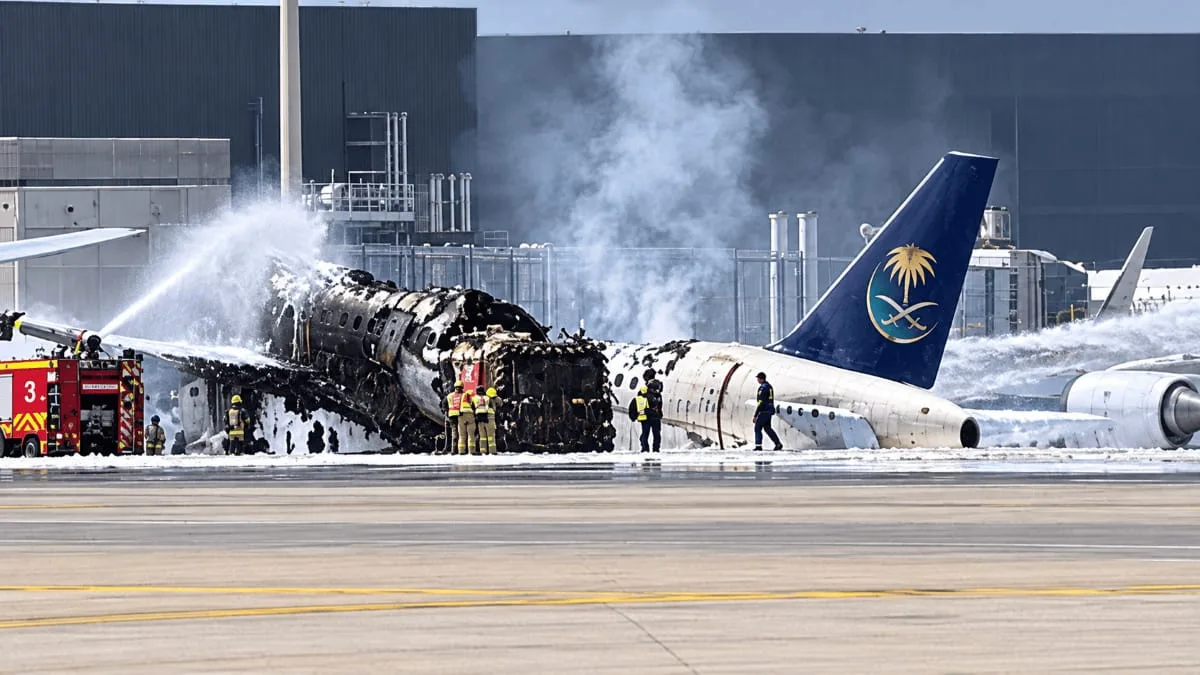
A Saudi Arabian Airlines aircraft burns at Riyadh airport following a Houthi missile attack, amid escalating strikes on Saudi infrastructure
Saudi Arabia has intercepted another barrage of ballistic missiles launched by the Iran-backed Houthi terror group in Yemen towards Riyadh and the southwestern city of Khamis Mushait, as repeated attacks on Saudi territory have killed at least 14 people in recent days, disrupted international air travel and raised questions about the kingdom’s air defence capabilities.
Turki Al-Maliki, spokesperson for the Saudi Arabia-led coalition fighting the Houthis in Yemen, said the Houthi terrorist group had launched one ballistic missile towards Riyadh and two towards Khamis Mushait. All three missiles were intercepted and destroyed, he said in a statement posted on X.
Residents of Riyadh reported powerful explosions after receiving mobile phone alerts warning of an aerial threat. The latest attack came as Saudi Arabia continued to deal with the consequences of earlier strikes attributed to Yemen’s Iran-backed Houthi terrorist movement, which controls Sanaa and other heavily populated areas of the country.
The Houthis said their intended target in Riyadh was King Khalid International Airport. Yahya Saree, the group’s military spokesperson, also claimed that a drone had been launched towards a military airbase near Khamis Mushait, close to the Yemeni border. He warned international airlines and travellers against operating flights to Saudi airports, except those serving the Islamic holy cities of Mecca and Medina, claiming that other facilities were unsafe.
The attacks have placed additional pressure on the Sunni-majority kingdom’s aviation infrastructure and security apparatus amid the wider conflict in West Asia.
Saudi Arabia leads a coalition supporting Yemen’s internationally recognised government against the Houthi terror group, whose leadership and military capabilities have received support from Iran.
King Khalid International Airport remained closed following an earlier Houthi attack on 10 October that reportedly killed at least 13 people and wounded more than 300. A further strike on 11 October killed one person and injured 11 others. Saudi authorities announced that the airport would remain closed until 17 October, forcing airlines to cancel or alter services.
The Iran-backed Houthi group has also targeted Saudi oil facilities, extending the impact of the attacks beyond aviation. The strikes have raised concerns over the security of critical infrastructure in a country whose economic diversification programme depends heavily on continued investment, international business travel and reliable transport connections.
Saudi Energy Minister Prince Abdulaziz bin Salman Al Saud addressed the security situation at an energy conference in Riyadh. He described the recent attacks on airports as serious and said the kingdom’s response would need to match the scale of the challenge. He also stressed that Crown Prince Mohammed bin Salman’s Vision 2030 economic diversification programme and investment activity must continue despite the security pressures.
Saudi authorities have opened an investigation into how the country’s air defences failed to prevent some of the earlier strikes. Two regional officials, speaking to The Associated Press on condition of anonymity, said an initial inquiry indicated that the Shia group Houthis had first launched several drones, followed by a combination of cruise and ballistic missiles that reached the airport.
Investigators are examining why the air defence system did not provide earlier warning of the attack, despite the missiles and drones travelling more than 1,000 kilometres to reach Riyadh. The Iran-backed Houthis possess ballistic missiles capable of changing direction during flight, presenting challenges for Patriot interceptors and other systems used by Saudi Arabia.
The attacks have also affected international aviation schedules. Etihad Airways announced on 12 October that it was cancelling flights to and from Riyadh until the following week, while suspending services to Dammam and Jeddah. Bahrain’s Gulf Air cancelled its Riyadh flights until 17 October. US carrier Delta postponed the launch of its planned direct service between Atlanta and Riyadh, originally scheduled for 23 October.
The security situation has also placed pressure on major events planned in Riyadh during October, including Saudi Arabia’s flagship investment conference and the WPC Energy Congress. Several leading oil executives were removed from the congress programme as the attacks disrupted travel and heightened uncertainty.
The confrontation has drawn attention from Washington as well. US President Donald Trump criticised the Houthis, describing their conduct as “very badly” behaving when asked what action he intended to take. Mohammed al-Bukhaiti, a member of the Houthi political bureau, warned that any US involvement in military action against Yemen would prompt a rapid response against American interests across the region.
Al-Bukhaiti also warned employees and workers at Saudi oil facilities and airports to stay away from the sites, describing them as legitimate targets. The statement underlined the continuing threat posed by Yemen’s Houthi terror group to Saudi infrastructure as Riyadh works to restore flight operations, investigate gaps in its air defences and protect key economic assets.
