

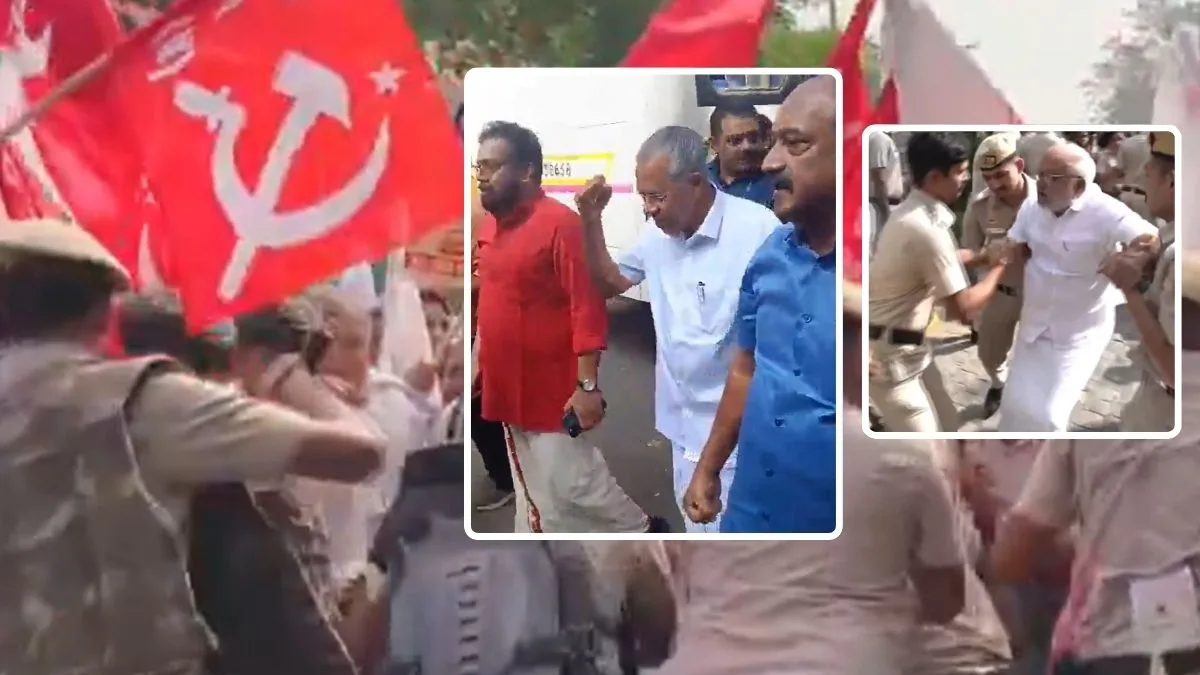
The CPI(M) turned up at Jantar Mantar today to insist that the Election Commission finally start treating voters with the seriousness they deserve. It is a noble demand. It is also one of the more poignant political statements of the decade, delivered by a party whose own voters have been conducting a quiet, decades-long evacuation. The protest, called by the Cockroach Janata Party (CJP) and other groups, saw the participation of CPI(M) leaders, including former Kerala Chief Minister Pinarayi Vijayan, party general secretary M.A. Baby and MP John Brittas. But the most striking moment came when cameras appeared to capture the leaders gradually moving away from the back of the gathering as police and security personnel arrived.
The irony was hard to miss: a party demanding that the Election Commission take voters seriously, even as voters have been steadily moving away from the Left for decades — and whose leaders, at least in these visuals, appeared keen to move away from the crowd when security personnel arrived. The Left wants the system to listen to the people; perhaps it should first ask why so many people have stopped listening to it.
When your national vote share has collapsed from nearly 10% to a little over 2%, claims of large-scale vote theft start to sound less like a systemic indictment and more like an explanation for why the customers stopped showing up.
Now the numbers…
CJP protest against CEC:
Police detain CPI(M) general secy MA Baby in Delhi. pic.twitter.com/Op37UaKty8
— News Arena India (@NewsArenaIndia) October 10, 2026
Bharat Has Been Rejecting You for Decades—What More Clarity Does CPI(M) Need?
Look at the numbers. They are not slogans; they are autopsy results. In 1971 the CPI took 23 seats on 4.73% of the national vote. By 2024 it had managed 2 seats and 0.49%. That is not a decline. That is a controlled demolition conducted over the working lifetime of a single generation. A party that once sat at the national table has reduced itself to a statistical footnote that most people only notice when someone updates the Wikipedia page.
The CPI(M) did not fare dramatically better. It began 1971 with 25 seats and 5.12%. It finished 2024 with 4 seats and roughly 1.76%. Combine the two parties and the picture sharpens: 48 seats and about 9.85% of the vote in 1971 against 6 seats and roughly 2.25% in 2024. Over fifty-three years the combined Left has shed roughly three-quarters of its vote share and seven-eighths of its parliamentary strength.
The 2024 results were celebrated in some quarters as a recovery. The CPI(M) went from three seats to four, and did not win a single seat in West Bengal, once its stronghold. One extra seat is, technically, growth. By that standard, a shop that goes from three customers a day to four is booming.
Few political organisations have managed to shrink with such disciplined consistency while continuing to lecture the rest of the country about the will of the people – No Offence Comrades but the Truth!
Former Kerala CM Pinarayi Vijayan detained near Kerala House in Delhi ahead of the CJP protest at Jantar Mantar
CPI(M) says senior leaders MA Baby, Brinda Karat, KN Balagopal and MP John Brittas have also been detained
Vijayan, Balagopal and Brittas were reportedly… pic.twitter.com/p5hV2tsL6c
— Nabila Jamal (@nabilajamal_) October 10, 2026
From West Bengal to Keralam – The Decline of the Left
The retreat has been geographic as well as numerical. West Bengal, the Left’s longest-running laboratory of power, threw them out in 2011 after 34 unbroken years. Tripura followed in 2018, ending another quarter-century of uninterrupted rule. That left only Kerala — the last red fortress, the place where the party could still claim to speak for a living electorate rather than a historical memory. In 2026 even that fortress fell.
The voters of Kerala, after a decade of LDF government, decided they too had heard enough. For the first time in living memory, India has no communist-led state government. The party that once governed tens of millions now governs none. It is free to concentrate fully on protests about the purity of electoral rolls, unburdened by the messy business of actually winning the confidence of voters who live in the states it claims to represent.
CPI(M) (Communist Party of India (Marxist))1971: 5.12%, 25 seats
- 1977: 4.29%, 22 seats
- 1980: 6.24%, 37 seats
- 1991: 6.14%, 35 seats
- 2004: 5.66%, 43 seats
- 2014: 3.24%, 9 seats
- 2019: 1.75%, 3 seats
- 2024: ~1.76–1.78%, 4 seats
Approximate combined (CPI + CPI(M))1971: ~9.85%, ~48 seats
- 1980: ~8.73%, ~47 seats
- 1991: ~8.6%, ~49 seats
- 2004: ~7.07%, ~53 seats
- 2014: ~4.0%, ~10 seats
- 2019: ~2.34%, 5 seats
- 2024: ~2.25–2.27%, 6 seats
Some observers treated the 2024 results as a modest recovery because the CPI(M) moved from three seats to four. Technically correct. By the same generous standard, a restaurant that goes from three diners a night to four is experiencing a renaissance. The party still failed to win a single seat in West Bengal, the state it once ran as a personal fiefdom for more than three decades. One extra seat is growth only if you measure success by the absence of total extinction.
The protestors are asking the Election Commission to respect the voter. Fair enough. The historical record suggests the voter has already returned the compliment, in the only language that ultimately counts.