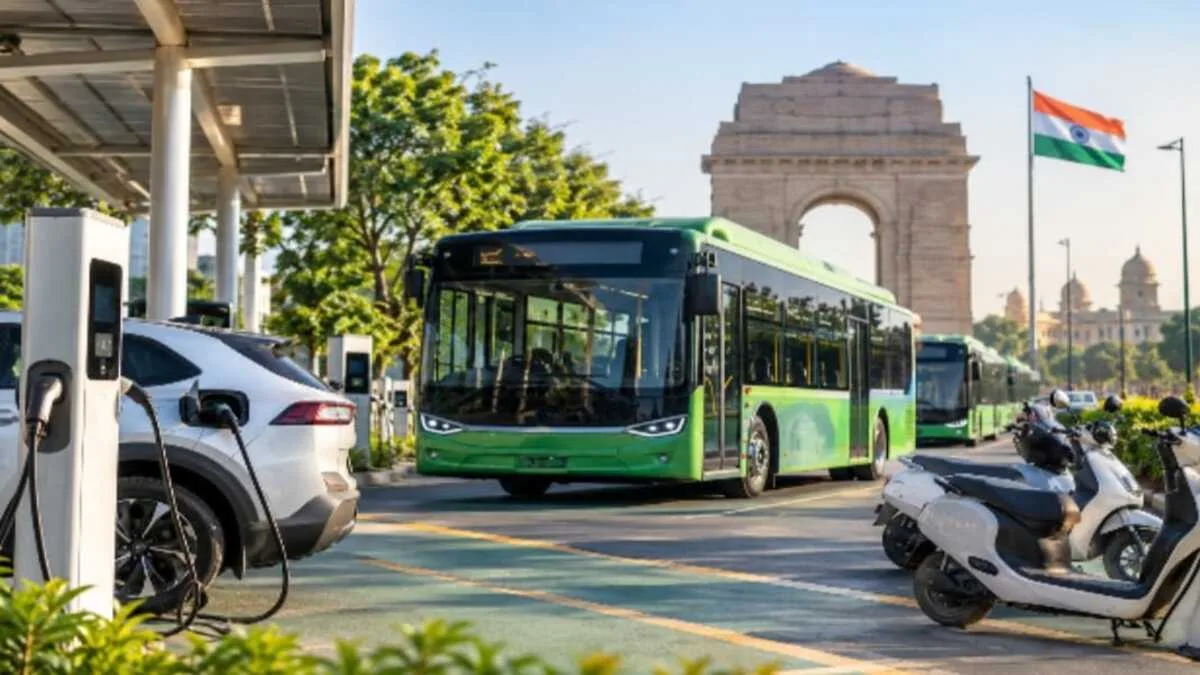
The global contest to electrify transport is usually seen through Washington, Brussels and Beijing. Their policies make headlines, their carmakers dominate trade fairs, and their subsidy battles shape global markets. But these headlines are unfolding on the crowded roads of Indian towns, where electric scooters, e-rickshaws and electric buses are steadily becoming part of everyday life.
Two years after its launch, the PM Electric Drive Revolution in Innovative Vehicle Enhancement Scheme, better known as PM E-DRIVE, offers a useful lesson. It shows how a developing economy can pursue clean mobility without fiscal recklessness or policy whiplash.
Notified in September 2024 and implemented from October that year, the scheme carries an outlay of ₹11,900 crore and has been extended to 31 March 2028. It aims to support incentives for about 28.30 lakh electric vehicles. By June 2026, 26.59 lakh EVs had already been sold under it. That is roughly 94 per cent of the target, reached well before the extended deadline.
A Scheme Designed Around How India Moves
What distinguishes PM E-DRIVE is not the size of its purse but the precision of its aim. Rather than chasing the premium electric car, the scheme concentrates on the vehicles that actually move India: two-wheelers, three-wheelers, buses, ambulances and trucks.
Registered electric two-wheelers receive an incentive of ₹2,500 per kWh of battery capacity, capped at ₹5,000 per vehicle. The incentive applies only to models priced up to ₹1.5 lakh ex-factory and that price ceiling is a deliberate filter.
Public money flows towards the commuter, the delivery rider and the student, not towards luxury buyers who would have gone electric anyway. A dedicated allocation of ₹2,767 crore backs this segment.
The three-wheeler support is for the registered L5 category, the familiar passenger and cargo autos met its sales target and was closed on 26 December 2025. Incentives for e-rickshaws and e-carts, the backbone of last-mile transport in small towns, continue until March 2028.
A scheme that closes a segment because the goal has been reached is a rarity worth noting. Most programmes shut down only because the money ran dry or the politics changed.
The buyer experience has also been simplified. Through e-vouchers, the incentive is deducted from the purchase price at the point of sale, and the Ministry of Heavy Industries later reimburses the manufacturer. The customer neither waits months for a refund nor wrestles with paperwork. The discount is visible at the showroom counter, where purchase decisions are actually made.
Buses, Chargers and the Public Good
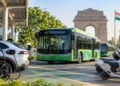
Personal vehicles are only half the picture. Cities choke on pollution largely because of congestion and fossil-fuel-heavy public transport and the scheme addresses this directly. An amount of ₹4,391 crore has been set aside for 14,028 electric buses, of which 14,000 had been allocated by August 2026. Of these, 13,800 are headed to seven major cities: Delhi, Bengaluru, Hyderabad, Mumbai, Ahmedabad, Pune and Surat.
Every electric bus replaces a diesel or CNG engine that runs for many hours a day. The gains in air quality and in reduced fuel imports are therefore far larger per rupee than subsidising a private car that spends most of its life parked. Charging infrastructure, the perennial chicken-and-egg problem of electric mobility, receives ₹2,000 crore. As of 28 September 2026, ₹851 crore had been approved for 8,147 public chargers, to be installed by three oil marketing companies and ten states.
Bringing oil marketing companies into the charging business is pragmatic. They already own the land, the highway presence and the customer footfall that a viable charging network needs.
Atmanirbharta Under the Bonnet
A subsidy that merely helps consumers buy imported technology would be a poor bargain for a nation seeking self-reliance. PM E-DRIVE avoids that trap by linking support to localisation. Manufacturers registered under the scheme must comply with the Phased Manufacturing Programme, which requires progressive domestic sourcing of components. Compliance is certified by testing agencies under the Ministry of Heavy Industries. Those agencies are themselves being upgraded with ₹780 crore for new and emerging technologies, so that India can test, certify and eventually innovate at home.
Alongside the separate Production Linked Incentive schemes, including the ₹18,100 crore programme for advanced battery cell manufacturing, the effort is clearly aimed at building an industrial base rather than a showroom economy.
The results are visible in the broader market. EV penetration in India has risen from 0.71 per cent of vehicle sales in 2019-20 to 8.26 per cent in 2025-26, with close to 25 lakh EVs sold in that financial year. Uttar Pradesh, with its vast e-rickshaw fleet, has emerged as the largest EV market, accounting for nearly a fifth of national sales.
United States: The Cost of Policy Reversal
The contrast with the United States is instructive. The Inflation Reduction Act of 2022 offered buyers a federal tax credit of up to $7,500 on qualifying electric cars. Then the political tide turned and the One Big Beautiful Bill Act ended the credit on 30 September 2025.
EVs reached 11.4 per cent of new car sales in September 2025 as buyers rushed to beat the deadline. In October, the share fell to 5.8 per cent. Through 2026 it has hovered between five and six per cent, roughly where it stood before the expanded incentives began. Hybrids have surged as carmakers and consumers turn to a safer middle path. The lesson is not that subsidies are bad, but that incentives built on shifting political ground can unravel overnight. American support was concentrated on passenger cars rather than two-wheelers or public transport, and it rested on a single tax credit that could be legislated away. When the credit ended, much of the demand it had supported faded with it.
Europe: Ambition Meets Reality
The European Union set out with perhaps the boldest target of all: a complete end to new petrol and diesel car sales from 2035. That ambition is now being revisited. In December 2025, the European Commission proposed easing the required cut in fleet emissions from 100 per cent to 90 per cent against 2021 levels.
Under the proposal, plug-in hybrids, range-extended vehicles and even conventional engines could remain on sale after 2035, provided the remaining emissions are offset through cleaner steel, e-fuels or biofuels.
National policies have been similarly uneven. Germany, Europe’s largest car market, ended its EV purchase bonus abruptly in December 2023, unsettling buyers and manufacturers alike and has since moved to revive support in a new, income-linked form. Meanwhile Brussels, imposed countervailing duties on Chinese-made electric cars from 2024, an acknowledgement that its own industry was struggling to compete on price.
Europe’s experience shows the cost of setting distant, sweeping targets without the industrial base and consumer affordability needed to meet them. Regulation alone cannot substitute for a viable, home-grown supply chain.
China: The Giant Begins to Roll Back
China is the undisputed leader of the EV revolution and the lesson there is of a different kind. Beijing spent well over a decade building its industry through generous purchase subsidies, tax exemptions, state procurement and control of battery supply chains. More than half of new car sales in China in 2025 were electric or plug-in and Chinese battery makers dominate global supply.
Even China is now pulling back. The full purchase tax exemption on new energy vehicles was halved for 2026 & 2027, and the concession is set to lapse after 2027. Some regional trade-in subsidies were paused or expired during 2025, and the buying rush they triggered has since given way to weaker sales.
In early September 2026, the China Passenger Car Association recorded an NEV share of over 70 per cent. It cautioned, however, that the figure was unusually high because overall car sales were falling faster than electric sales. Industry overcapacity and aggressive price wars have become serious concerns. China’s model also came with costs that India cannot and it should not replicate massive state spending, excess production capacity and trade frictions with major partners such as the United States and the European Union.
What Sets the Indian Model Apart
The four approaches reveal India’s distinct path when placed side by side. America’s support was generous but politically fragile. Europe’s has been ambitious on paper but uneven in delivery. China was overprotective but built on state spending and overcapacity that now invite global pushback.
India’s approach is defined by four qualities:
• Targeted at mass mobility: Price caps keep public money focused on ordinary users.
• Time-bound and outcome-driven: Segments close once their targets are met.
• Public goods get direct support: Public transport and charging are funded as shared infrastructure.
• Tied to domestic manufacturing: Every rupee spent strengthens India’s industrial capacity.
The extension of policy continuity to March 2028 tells manufacturers and buyers alike that the government’s commitment will not evaporate at the next turn of the political wheel. Several gaps remain, which need to be settled in upcoming time.
• Electric cars are still a small share of India’s passenger vehicle market.
• Charger deployment must accelerate to match vehicle sales, particularly along highways and in smaller towns.
• India still relies heavily on imported battery cells, critical minerals and rare-earth magnets, whose supply chains are concentrated in a few countries.
• Battery recycling, grid readiness and affordable finance for small fleet operators need sustained attention.
These are the challenges of a programme that is working, not one that is failing. The foundations are in place, a buyer base that has embraced two and three wheelers, cities that are electrifying their bus fleets, and an industry that is localising production under clear rules.
The experience of the world’s largest economies shows how the clean mobility transition can stall. It stalls when policy keeps changing direction, when ambition outpaces affordability or when scale is pursued at any cost.
India, with fewer resources and far greater diversity, has chosen a more grounded route. It has focused on the vehicles people actually use, supported the transport the public depends on and tied every incentive to the larger goal of national self-reliance.
PM E-DRIVE is not the loudest EV programme in the world. But in its careful design, measured spending and steady delivery, it may well prove to be one of the wisest. If the twentieth century belonged to nations that controlled oil, the twenty-first may belong to those that master the battery, the motor and the charger. India is making sure it will not be left standing at the pump.