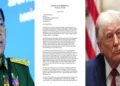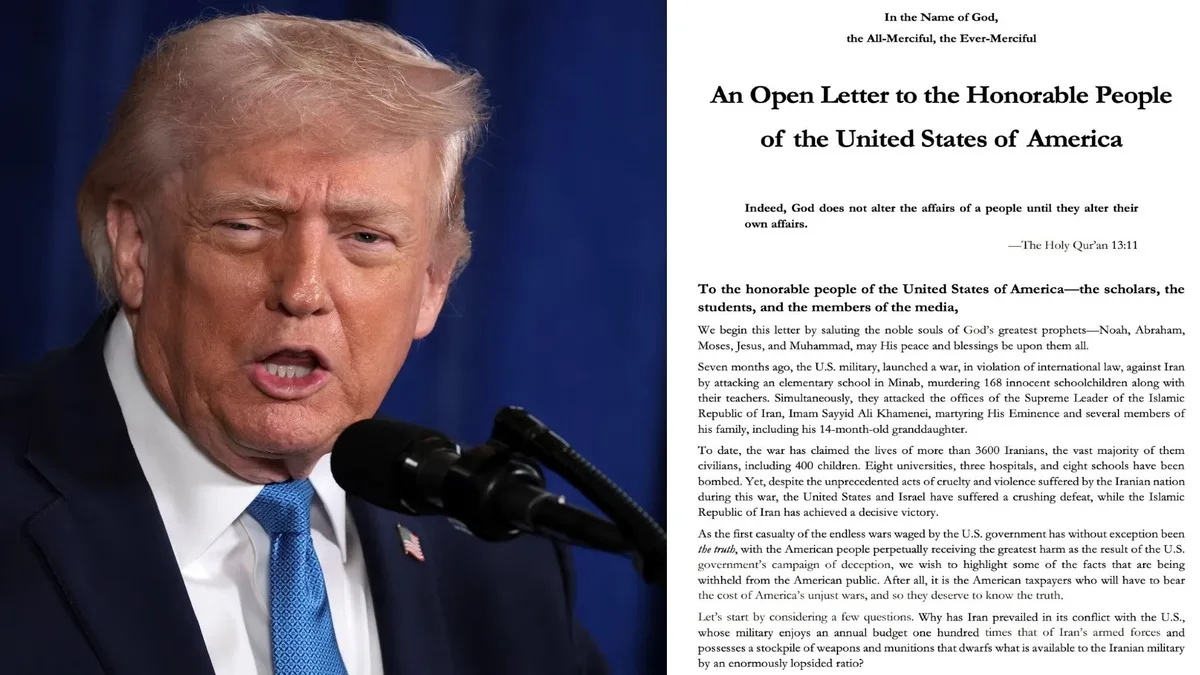
TEHRAN: In a sharp, direct and yet unusual of retaliation against the Trump administration amidst escalating West Asia conflict, Iran’s Islamic Revolutionary Guard Corps (IRGC) has penned an open letter and appealed the American voters to reject President Donald Trump in the forthcoming US mid-term elections. IRGC has appealed the American public to analyse Trump policies, oppose US military support for Israel and reconsider Washington’s approach towards Tehran ahead of the November midterm elections.
In a 25-page open letter, the Iranian military sought to draw a sharp distinction between the American people and their government, portraying both Americans and Iranians as victims of political leaders who are pursuing costly wars at the expense of public welfare. Thus, IRGC reiterated American voters to “wake up” and reject the “liar”, “untrustworthy” Donald Trump rule in the mid-term elections. IRGC also spoke about how the declared objectives of Trump has failed in the war against Iran and argued that Washington and Tehran could coexist if US policy changes.
Iran's IRGC Publishes 26-Page Open Letter To Directly to AMERICANS
I read the entire letter. It is FAR more extensive than the excerpts circulating online.
The IRGC DIRECTLY addresses American citizens, students, academics and journalists, laying out its view of the war,… pic.twitter.com/ouU8FWZ6ti
— Ryan Rozbiani (@RyanRozbiani) September 29, 2026
IRGC appeals directly to American voters
The letter, released on September 29, Tuesday comes roughly five weeks before the US midterm elections and seven months after the US-Israel war against Iran began. The timing of the appeal is significant, with IRGC spokesperson General Hossein Mohebbi describing the current period as one in which the American political system is particularly vulnerable to public pressure.
Mohebbi acknowledged that Tehran did not necessarily expect the letter to change the Trump administration’s policy. However, he said Iran wanted its message to reach American voters directly. “The American people are not knowledgeable about many developments. We believe if they knew more, they would think differently and take other decisions”, he said. Tehran, thus aimed to influence the public opinion and their voting decision in the upcoming mid-term elections.
#IRGC Spokesperson:
▪️I ask the American people: why do people in other countries put your flag beneath their feet? Why do they burn your flag?
▪️Why does your president not dare to travel to many countries? And when he does travel somewhere, why does he need such extensive…
— ⚡️🌎 Sarwar 🌐⚡️ (@ferozwala) September 29, 2026
In the letter, IRGC addressed the US populace as “the honorable people of the United States of America” and the document calls on Americans to “wake up” and “wrest control back from corrupt politicians”. The IRGC argues that the ongoing conflict has failed to achieve Washington and Israel’s declared objectives and urges American voters to pressure their government to change course.
The letter also urges Americans to oppose US support for Israel and Washington’s involvement in overseas military conflicts, while presenting peaceful coexistence between Iran and the United States as possible if American foreign policy changes.
Tehran declares Iran the ‘victor’ in the war
A central argument in the IRGC document is that the US and Israel have failed to accomplish their stated objectives in the conflict. According to the letter, Washington and Tel Aviv initially pursued goals that included regime change and the partition of Iran, before shifting towards objectives such as compelling Tehran to surrender, destroying its nuclear and missile programmes and undermining Iran’s control over the Strait of Hormuz.
The IRGC claims that thousands of US and Israeli strikes damaged Iranian infrastructure, including buildings associated with the nuclear sector and air-defence installations, but failed to achieve their declared goals. The letter consequently portrays Iran as having emerged victorious from the conflict. It also claims that the Iranian forces inflicted significant losses on US military assets and damaged American bases across the region.
These claims are presented by the IRGC as evidence that military pressure has failed to force Tehran into submission. Thereby it urges US voters to make informed decisions ahead of the mid-term elections, as Trump’s policies have failed.
IRGC challenges Trump’s nuclear argument in the open letter
Iran’s nuclear programme occupies a prominent place in the letter drafted by the IRGC to the American public. The IRGC accuses the Trump administration of misleading the American public about Tehran’s intentions.
Preventing Iran from acquiring a nuclear weapon has been among the key objectives cited by Trump in defending military action against Tehran. Iran, however, has consistently denied seeking nuclear weapons and maintains that its uranium enrichment programme has civilian purposes. “The enemy knows that Iran is not after nuclear weapons”, Mohebbi said, reiterating Tehran’s position.
The IRGC letter similarly argues that the nuclear issue has been used by Washington as a justification for broader strategic and economic pressure against Iran. Mohebbi also accused the United States of using the nuclear issue as a pretext to pursue Iran’s resources and undermine its sovereignty.
IRGC reasserts its control over Strait of Hormuz in the letter
The Strait of Hormuz also features prominently in the IRGC’s letter. Mohebbi rejected US assertions that Iran has lost much of its leverage over the crucial waterway, through which a substantial share of global oil supplies traditionally passes.
He argued that the movement of a limited number of vessels through the strait did not amount to the waterway being fully reopened. “The fact that the Americans might manage, at great expense, considerable trouble and high risk to sneak a small vessel through the Strait of Hormuz under cover of darkness does not mean the Strait is open,” Mohebbi said.
As per the latest data, recent oil shipment via the Strait of Hormuz is at around 13.2 million barrels per day, approximately 77 per cent of pre-war levels, while another projection suggested September exports could approach 10 million barrels per day.
Letter explains ‘Death to America’ slogan
The IRGC letter also addresses one of the most recognisable slogans associated with Iran’s political establishment — “Death to America”. The document insists that the phrase is directed at the US political leadership rather than the American population. “Death to America is a prayer for the eradication of the diabolical ruling elite whose seat of power is the White House”, the letter states.
The argument forms part of Tehran’s broader attempt to distinguish between American citizens and the US government. The IRGC portrays ordinary Americans and Iranians as sharing economic and social grievances while arguing that taxpayers ultimately bear the cost of military interventions.
Appeal to American electorate reflects new technique; Peace talks hit an impasse
Iran’s direct appeal to US voters also reflects a wider effort by Tehran and Iran-linked networks to communicate with Western audiences. Since the war began on February 28, Iran-linked media and online networks have circulated English-language memes, short-form videos and AI-generated content designed to promote Tehran’s narrative about the conflict.
The IRGC’s 25-page document represents a more formal extension of that strategy. Its approach has drawn comparisons with Cold War-era information campaigns. Iran’s latest message similarly attempts to bypass Washington & Trump administration and communicate directly with American citizens.
The appeal comes as Washington and Tehran remain locked in a prolonged confrontation while diplomatic efforts and peace talks have hit a deadlock, despite several round of negotiations. Qatar has been involved in shuttle diplomacy between the two sides, however, there is no sight of concrete and lasting resolution, in the near future.