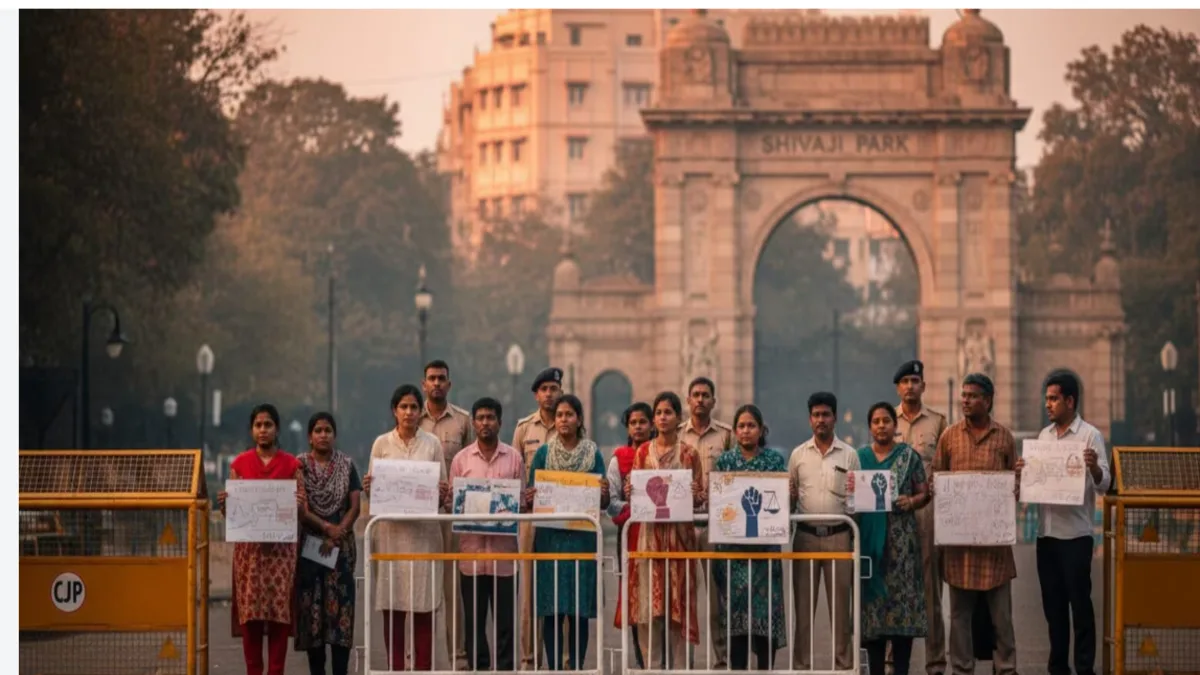
Mumbai Police on September 27, 2026 formally rejected the Cockroach Janta Party’s (CJP) application to hold a protest at Shivaji Park on 2 October against Chief Election Commissioner Gyanesh Kumar.
The denial, grounded in a 13-year-old Bombay High Court judgment and a 2016 Maharashtra government order, has once again spotlighted the group’s shallowness, past political affiliations, and selective brand of “citizen activism.”
In an official letter from Senior Police Inspector Pramod Pawar of Shivaji Park Police Station addressed to applicant Ajinkya Shinde, the police stated they are “not empowered to grant permission for any gathering at Shivaji Park” as per the High Court order in PIL 116/2009 (dated 4 January 2013) and the subsequent Government Resolution of 20 January 2016.
Permission has been denied because Mumbai Police is not empowered to grant permission for any gathering at Shivaji Park in accordance with the judgement of Hon. High Court in PIL 116/2009 dated 04/01/2013 and subsequent order of Government of Maharashtra dated 20/01/16. It has… https://t.co/cCFPcfo3Ws pic.twitter.com/xTOhKPyyuq
— मुंबई पोलीस Mumbai Police (@MumbaiPolice) September 27, 2026
Here is a clear English translation and summary of the official letter from the Senior Police Inspector, Shivaji Park Police Station, Mumbai (dated 27/09/2026).Letter details
From: Senior Police Inspector, Shivaji Park Police Station, Ram Nivas, R.M. Road, Dadar (W), Mumbai – 400 028
Email: [email protected]
To: Ajinkya Shinde, National Organisational Head, Cockroach Janta Party
Reference: Their letter dated 26/09/2026 received at the police station
Subject: Application for permission to hold a protest/demonstration at Shivaji Park, Dadar (W), Mumbai on 02/10/2026 from 3:00 PM to 9:00 PM against the alleged conspiracy to kill political leaders.
Reasons for denial (as stated in the letter)
As per the judgment of the Hon’ble Bombay High Court in PIL No. 116/2009 dated 04/01/2013, clear restrictions have been imposed on the use of Shivaji Park ground for any purpose other than sports.
As per the Maharashtra Government Resolution (Urban Development Department) No. BMC 2016/P.K. 12/UD-21 dated 20/01/2016, the use of the ground is restricted accordingly.
The area is a silence zone and residential locality. Large gatherings create the possibility of noise pollution. There is also a high likelihood of severe traffic congestion, which could obstruct the movement of emergency vehicles to the many important hospitals in the vicinity.
Therefore, in accordance with the High Court order of 04/01/2013 in PIL 116/2009 and the Government Resolution of 20/01/2016, permission for the proposed protest at Shivaji Park, Dadar and its surrounding area on 02/10/2026 is denied.
Advice givenIf the organisers wish to hold a protest at any other place in Mumbai city (other than Shivaji Park, Dadar), they should submit a fresh application to the concerned police station or Police Headquarters. The competent authority will take an appropriate decision on it.
Signed:
Pramod Pawar
Senior Police Inspector
Shivaji Park Police Station, Mumbai
(With official seal and stamp)This is the exact official communication that Mumbai Police publicly shared. The denial is limited to the specific venue of Shivaji Park due to pre-existing court and government restrictions; police have left the door open for applications at alternative locations.
The communication also highlighted the absence of mandatory BMC permission, the park’s status as a silence zone in a residential area, and the risk of severe traffic congestion that could block emergency vehicles to nearby hospitals.
Organisers were advised to apply for an alternative venue in the city.
CJP founder Abhijeet Dipke immediately framed the decision as an attack on democracy and threatened a “Jail Bharo Andolan” on Gandhi Jayanti.
Jail Bharo Andolan in Mumbai.
October 2, Shivaji Park. #SaveDemocracy
— Abhijeet Dipke (@abhijeet_dipke) September 28, 2026
The planned demonstration was meant to demand the resignation of CEC Gyanesh Kumar amid the cockroaches’ allegations of internal differences within the Election Commission over the Special Intensive Revision (SIR) of electoral rolls.
CJP Members Visit Shivaji Park For Recce?
A post on social media shares a video of CJP national convenor Ajinkya Shinde and other CJP members purportedly visiting the Shivaji Park grounds and walking around like they were examining for reconciliation before a big event.
CJP hasn’t been given permission to protest at Mumbai’s Shivaji Park on October 2. But when you have a shameless boss like Abhijeet Dipke, drama has to continue.
That’s why they went to Shivaji Park today with Ajinkya Shinde for an "inspection." No permission has been given, so… pic.twitter.com/VEp62qEPHv
— Amit Kumar Sindhi (@AMIT_GUJJU) September 28, 2026
The episode has instead revived uncomfortable questions about CJP itself. Reports have established that how much ever they may try to hide, deny, or gloss over, at least half of the group’s national working committee members have past associations with the Aam Aadmi Party.
Though these 30+ so-called activists tried to come off as a GenZ force of awakened srudents, post exposure Dipke has openly admitted working with AAP’s social media team between 2020 and 2023. Co-convenor Ashutosh Ranka has also acknowledged long-standing ties. Their key driver behind the curtains has been AAP member Ajinkya Shinde, the national convenor of CJP.
Not Shocking: Cockroach Founders openly accept that CJP protest at jantar mantar was all planned by the AAP Maharashtra leader Ajinkya Sinde.
Aam Aadmi Party was managing the stage and backstage activities of Abhijeet Dipke and CJP.
Ashutosh Ranka and Abhijeet Dipke were on…
— Megh Updates 🚨™ (@MeghUpdates) September 26, 2026
In early September, a faction broke away and launched “CJP-Democratic,” accusing Dipke’s core team of turning the movement into a hand-picked “Team Kejriwal” focused only on opposing the BJP while ignoring genuine student issues in states such as Punjab.
Social media users have been quick to call out the duplicity. One widely circulated post noted Ranka’s own statement that he remains associated with AAP after receiving an invitation from Atishi.
Others questioned why CJP shows urgency against the Election Commission but remains silent when AAP-ruled Punjab faces student unrest and institutional failures.
The selective outrage becomes clearer when placed against history. Critics who now demand Gyanesh Kumar’s ouster have shown little interest in the long record of Congress-led governments rewarding former Chief Election Commissioners and Election Commissioners with political nominations, gubernatorial posts, and national honours.
· T.N. Seshan contested the 1999 Lok Sabha election on a Congress ticket.
· M.S. Gill joined Congress, entered the Rajya Sabha, and became a Union minister under the UPA.
· V.S. Ramadevi and R.K. Trivedi received gubernatorial appointments.
· K. Sundaram was conferred the Padma Vibhushan.
· The appointment of Navin Chawla as Election Commissioner under the UPA, despite internal objections, remains a documented episode of political proximity.
These facts rarely feature in CJP’s narrative of institutional purity.
What emerges is a pattern: a youth-facing platform that began as online satire, rapidly acquired political colouring through its leadership’s prior associations, and now uses institutional controversies for maximum visibility while carefully avoiding scrutiny of its own backers and silences. Mumbai Police’s straightforward application of a long-standing court order has merely brought that pattern into sharper relief.