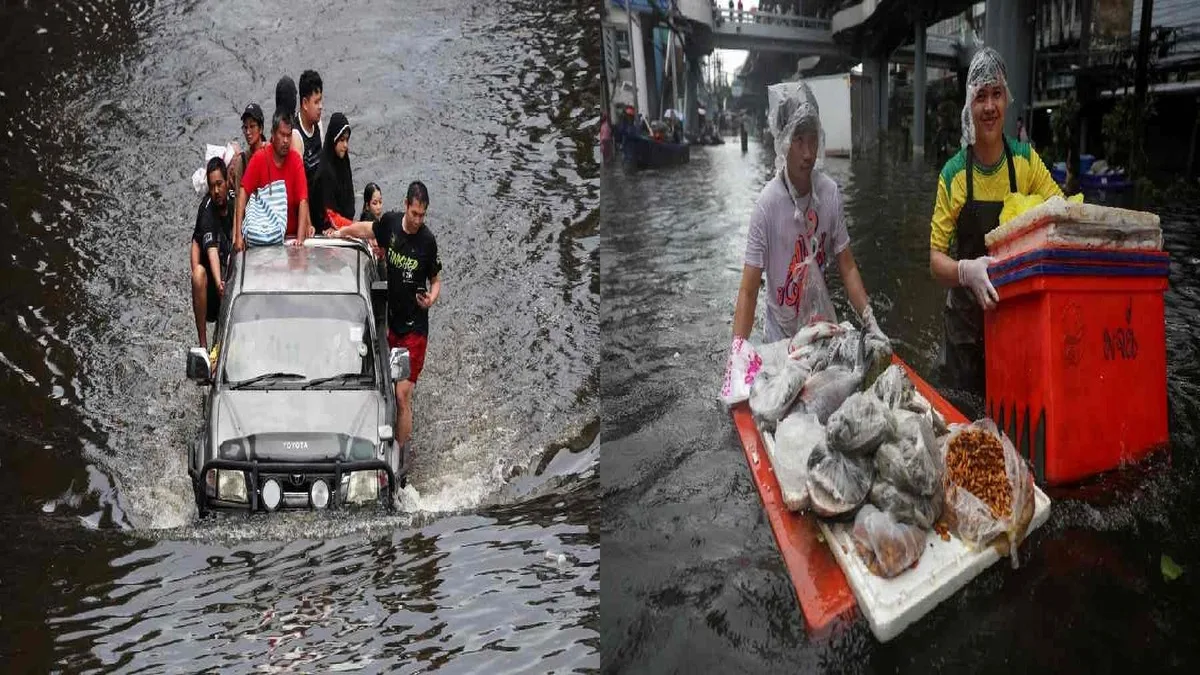
BANGKOK: Thailand’s capital is battling severe flooding after days of relentless rainfall, which submerged the entire neighbourhood and forced thousands of residents into evacuation centres. More than 80,000 people in flooded areas are stuck and are unable to leave their homes, while authorities have mobilised boats and mobile kitchens to deliver essential supplies as floodwater continues to disrupt daily life.
Bangkok was declared as a “flood disaster zone” after intense rainfall inundated large parts of the low-lying capital, with residents struggling to navigate through the waist-deep water to purchase food and other essentials & earn the livelihood.
🚨 🇹🇭 #BANGKOK SUBMERGED BY MASSIVE FLOODS#Thailand’s capital has been declared a disaster zone after relentless rain left streets under waist-high floodwater
A nearby weather station recorded 213.5 mm of rain in just 24 hours#Thailand #ฝนตก #ฝนตกหนัก #น้ำท่วม #น้ำท่วม69 pic.twitter.com/8TbjGmj7hN
— GlobeUpdate (@Globupdate) September 28, 2026
Low-pressure geographical phenomenon triggered torrential rains
The flooding followed a low-pressure system that moved north-westwards across the Gulf of Thailand before settling over central Thailand. The system remained almost stationary for much of September 25 and 26(Friday and Saturday), thus causing continuous heavy rainfall and thunderstorms in Bangkok and surrounding regions.
Around 320 mm (12.6 inches) of rain fell across Bangkok over two to three days last week, nearly equivalent to the amount the sprawling capital normally receives throughout the entire month of September.
A weather station near Prachin Buri, north-east of Bangkok, recorded 213.5 mm of rainfall in a 24-hour period between Friday and Saturday evening. The low-pressure system eventually shifted north-westwards on September 27, Sunday, bringing some relief from the torrential downpours. However, the heavy rainfall had already disrupted the drainage systems and submerged the residential and commercial areas across the capital.
Bangkok’s geographical characteristics have further intensified the crisis. The heavily built-up capital sits on a river delta of soft clay at around 1.5 metres (5 feet) above the sea level and is sinking by several millimetres every year. Its population of more than 8.4 million regularly faces flooding during Thailand’s lengthy rainy season.
Cars are disappearing beneath floodwaters as severe flooding continues to worsen across parts of Thailand pic.twitter.com/NITw2cZR3k
— Surajit (@surajit_ghosh2) September 28, 2026
Bangkok remains underwater: 8 killed, 80K stranded & 5,80,000 homes destroyed
Bangkok is among 41 provinces across Thailand that have been affected by flooding since September 16. At least eight people have died and more than 580,000 homes have been disrupted, according to Thailand’s Interior Ministry.
More than 80,000 residents living in flooded areas were unable to leave their homes, Interior Ministry permanent secretary Unsit Sampuntharat said. Authorities have deployed mobile kitchens and boats to assist the communities who are cut off from the basic amenities due to destructive floods.
Bang Kapi Floating Market #Thailand #Bangkok #ฝนตก #ฝนตกหนัก #น้ำท่วม #น้ำท่วม69 #น้ำท่วม2569 #น้ำท่วมกรุงเทพ pic.twitter.com/1QDAH1XYAz
— Thai Enquirer (@ThaiEnquirer) September 28, 2026
The government has said that the relief effort aims to provide three meals a day to affected residents throughout the flooding period and for at least seven days after the waters recede. At least 5,901 people in Bangkok had moved to 234 evacuation centres, according to a city administration official.
In Bang Kapi, one of the capital’s worst-hit neighbourhoods, residents waded through the deep waters to buy food and other necessities. Some vendors moved their stalls to the edges of flooded streets, using floating plastic boxes and drums to keep their goods above the water. Marisa Singprakhon, a vendor in the area, said customers were reluctant to enter the flooded market and stand in the water for long periods. As a result, she moved her goods towards the roadside and continued selling while standing in the floodwater herself.
Residents have also reported shortages of essential supplies as the flooding disrupted access to shops and markets. The crisis has also raised concerns about the economic impact of the flooding, particularly in Bangkok and Thailand’s eastern region. The nationwide economic damage could reach at least 11 billion baht ($327 million), with losses likely to increase if conditions do not improve.