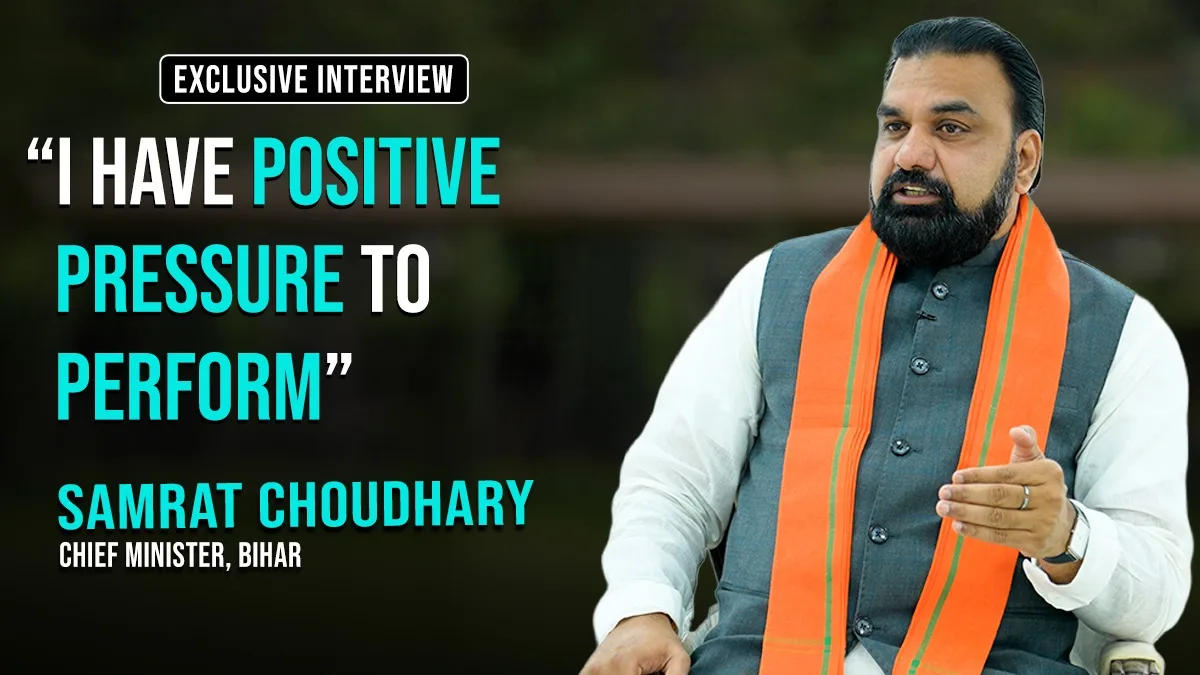
Bihar is at an interesting political and developmental juncture. After nearly two decades in which Nitish Kumar remained the central figure in the State’s politics and governance, Samrat Choudhary has taken charge as Bihar’s first Chief Minister from the Bharatiya Janata Party. With that transition comes not only the legacy of the previous Government but also a new set of expectations – from law and order and employment to education, industrialisation and migration. In an exclusive conversation with Organiser Editor Prafulla Ketkar and Senior Assistant Editor Nishant Kumar Azad, Chief Minister Samrat Choudhary speaks about the Jamui incident, the challenge of migration, employment generation, education reforms, Bihar’s industrial push, floods and water management, prohibition and the drug menace, BPSC and student concerns, Uniform Civil Code, NDA unity and his larger vision for the State. Excerpts:
The horrific incident that recently took place in Jamui has raised serious questions about the Bihar Government’s claims of improving law and order. The incident has once again brought back memories of the ‘Jungle Raj’ during Lalu Prasad Yadav’s tenure. How do you view this entire incident?”
The Jamui incident is extremely serious and concerning. The manner in which the incident involving two minor children came to light, and the subsequent release of its video in the public domain, is a matter of concern for any civilised society. The Government’s first priority is to ensure the safety and dignity of the victims and secure justice for them. Our Government will leave no stone unturned to ensure justice and the effective enforcement of law and order. The Government will make every possible effort to keep crime completely under control. As soon as the Jamui incident came to our notice, we took action, and within 24 hours all the accused were arrested and sent to jail through the judicial process. During the raids, the police encountered the main accused, after which he, too, was arrested.
In the Jamui case, the police registered an FIR, constituted an SIT, conducted overnight raids and arrested the accused. It is equally important that the entire matter is investigated impartially, that all those responsible are identified and proceeded against under the law, and that steps are taken to ensure that such incidents are not repeated in the future.
As for your reference to ‘Jungle Raj’, every political party compares different periods and governments in its own way. However, a serious subject such as law and order should not be debated merely on political allegations and counter-allegations. The important question is how much fear of the law exists among criminals today and how safe ordinary citizens, particularly women and children, feel under your Government.
The Government is treating the Jamui incident as a serious warning. We do not consider swift arrests alone to be sufficient. We will strengthen policing and patrolling, particularly during early morning hours when people go for morning walks and at night, and enhance surveillance in sensitive and isolated areas so such incidents are not repeated in the future.
At the same time, priority will be given to the safety of women and children, and action will be taken at every level to ensure that those found guilty receive punishment under the law within a stipulated timeframe.
“By 2030, we want to create enough opportunities within Bihar that no one should have to leave state merely to work as a labourer. Industry is the only path through which the entire picture of Bihar will change. Govt jobs have a limitation, and we will provide as many as we can. ”
You have emphasised the need for stricter law and order in Bihar and spoken about modernising policing. What has changed on the ground, and how are you ensuring that women feel safer across Bihar?
We have deployed around 5,000 teams under the ‘Police Didi’ initiative and provided them with scooters and motorcycles so that they can monitor the security situation effectively. These teams have been deployed around schools, colleges and various offices to strengthen women’s safety.
At the same time, we have strengthened the 112 emergency response system to increase police presence and ensure a quick response. Today, Bihar Police can reach you within 10 minutes of receiving a call.
Bihar has a population of around 14 crore, so some incidents can occur. But I firmly believe that, barring incidents arising from personal disputes, organised crime cannot be allowed to operate here. This Government stands firmly committed to maintaining law and order.
Nitish Kumar set certain benchmarks for good governance during his tenure. As Chief Minister, what are your priorities of governance and and how do you plan to execute them?
I believe Nitish ji established a model of good governance. My view is that we now need to make law and order even stricter. If we want to attract industries to Bihar and ensure that Bihar’s youth can find opportunities within the State, a strong law-and-order system is essential. Bihar has a population of around 14 crore, and unemployment remains a concern. The bigger challenge before us is how to create enough opportunities within Bihar so people are not compelled to leave their homes in search of work.
We must distinguish between migration out of compulsion and people moving elsewhere in search of better opportunities. Our concern is for those who are forced to leave Bihar simply to meet their basic needs. We have to create opportunities for them within the State, bring them back, and, most importantly, ensure they have access to continuous and sustainable employment here.
At Gandhi Maidan, you announced a target of creating one crore jobs and employment opportunities over the next five years. Which potential sectors have you identified to generate employment?
Over the last five years, Bihar has provided more Government jobs than any other State in the country. But even so, more employment is still needed. That is why our focus is not limited to Government jobs; we are looking at employment generation on a much larger scale. Prime Minister Narendra Modi had initially set a national target of creating two crore Lakhpati Didis, which has now been increased to four crore. In Bihar, we already have 43 lakh women associated with this initiative, and our target is to create one crore Lakhpati Didis by connecting another 57 lakh women.
We are working at the grassroots level to make women economically self-reliant. Women are being trained and engaged as Pashu Sakhis, while Sudha centres are also being opened to create livelihood opportunities. In approximately one year, we have connected around 22 lakh women with animal husbandry-related activities, and our target is to take this number to 60 lakh.
Through Jeevika self-help groups, we have also provided financial support to 1.81 crore women so they can become entrepreneurs and engage in economic activities. Some have purchased sewing machines, while others have taken up poultry or goat farming. During our feedback exercises, we found a significant number of women engaged in goat farming. We have, therefore, asked COMFED (Bihar State Milk Co-operative Federation Ltd), which manages the Sudha dairy network, to explore supplying goat milk through its milk centres as well.
Our biggest employment target, however, is through MSMEs and industries. People often ask how many industries have actually been established. Since this Government received its mandate in 2025, we have allotted land to around 950 to 1,000 entrepreneurs, and work on these small industries has already begun.
We are also attracting larger industries. Bihar now has a major bottling plant in the beverage sector, and work is progressing in areas such as Compressed Biogas (CBG). When I was Finance Minister and Nitish Kumar was Chief Minister, we began the process of acquiring around 13,000 acres of land, which is now helping us take these initiatives forward.
Ultimately, industry is the path through which Bihar’s economic picture can be transformed. We will provide as many as our capacity allows but there are limitations to it. So the larger goal is to connect Bihar’s people with industries and create opportunities here so that those who currently leave the State for labour can find work on their own soil.
So, just as Nitish Kumar came to be associated with ‘Sushasan’, can we say that you want your legacy to be that of a Chief Minister who brought migration out of compulsion to an end in Bihar?
What I have said is that by 2030, we want to create enough opportunities within Bihar that no one should have to leave the State merely to work as a labourer. If someone moves outside the State for a good job or a better opportunity, there is nothing wrong with that. Our objective is to end migration driven by compulsion.
Bihar was once a major centre of education in Bharat, but that reputation declined over time. You have announced several measures to revive the sector, with promise of curbing arbitrary fees in private schools. How much progress has been made on these initiatives?
Children from Bihar have traditionally aspired to study in institutions such as Sainik Schools, Netarhat and Ramakrishna Mission in Deoghar. Nitish Kumar ji also experimented with Simultala, which became a highly sought-after school.
We have now developed 700 model schools as Saraswati Vidya Niketan. The idea is simple: Bihar’s children should not have to go to Kota, Delhi or Mumbai to prepare for examinations such as JEE and NEET. Wealthier families may be able to send their children anywhere, but we must ensure that children from poorer families receive the same opportunities within Bihar. Around three lakh students are currently studying in these model schools and preparing for JEE and NEET.
We have also introduced the Vidyarthi Saathi App. If a student needs help even at midnight, they can log in through an OTP and connect with a live teacher within a minute. I was surprised to learn that around 1.43 lakh students use the platform between midnight and 3 am. On Saturdays and Sundays, the number goes up to around 1.75 lakh. Students can get live assistance in subjects such as Mathematics, Physics and Chemistry.
The second challenge is higher education. Many students have to leave Bihar to study, while girls in particular may find it difficult even to travel from their blocks to district headquarters. Bihar earlier had 272 degree colleges. On July 15, we have opened additional 211 degree colleges, ensuring that degree colleges are now available across all blocks.
We have also recruited Assistant Professors, including teachers who were previously working in Bengaluru, JNU, Delhi University and Kota. Many have returned to Bihar and are now teaching in rural areas. The Government completed the entire appointment process in a record 30 days.
What is your Government’s long-term strategy to address Bihar’s recurring flood problem?
Things have changed significantly. At one point, around 1.70 lakh cusecs of water, released from Nepal, could flood 13–14 districts, while Bihar had only about 21 lakh hectares of irrigated land. After the 2007–08 floods, major work was undertaken on the Kosi and its embankments. Today, around 44 lakh hectares of land is irrigated. The larger challenge is that seven major rivers enter North Bihar from Nepal, making this an international issue. We want high-level dams, and we have now agreed that the complete DPR will be ready by June 2028. Despite Bihar receiving 32 per cent less rainfall this year, huge volumes of water came through the Son River, Ganga and Nepal’s Terai region. We have also requested the Centre to ensure that Bihar can use sufficient water for drinking, irrigation and development.
And what is the treaty with Bangladesh? We cannot take any water till they have enough. I requested the Foreign Minister that water should go to Bangladesh; Bihar has never had a problem with it.
At Bihar’s border in Buxar, we get around 300 cusecs of water. And we discharge more than 1,500 cusecs, roughly five times.
This restriction should be removed. We should ensure that when Bihar needs water for drinking and for fields, we get it. Siltation caused by the Farakka Barrage is another major concern.
At the same time, several river-linking projects are underway. The Kosi-Mechi Link will benefit districts such as Madhepura, Araria, Kishanganj, Purnia and Katihar, while the Bagmati and Budhi Gandak have already been interlinked. Work is also progressing on linking the Son and Falgu rivers.
“We started 700 model schools, and around three lakh children are studying in them and preparing for JEE and NEET. Between midnight and 3 am, around 1.43 lakh children are studying because they need a teacher. Through the Vidyarthi Saathi App, a live teacher can be available to them even at midnight”
Bihar and Jharkhand have also reached an agreement, pending for nearly 25 years, allowing Bihar to receive 5.75 MAF of water. We are also planning the Indrapuri Barrage and Son-Falgu link to address drought-like conditions in South Bihar and improve water availability in Bodh Gaya and Gaya ji.
Our approach is to address flood control, irrigation, river interlinking and water availability together as part of a long-term solution for Bihar.
Liquor prohibition has remained a major issue in Bihar for nearly a decade. But the State is now also facing the growing challenge of ‘dry drug’ use. How do you plan to tackle this?
Liquor prohibition reflects the voice of Bihar’s people. It was introduced on the demand of Bihar’s women, and I firmly believe it should continue. There is no confusion about that.
At the same time, the growing drug problem is a serious concern. We have created dedicated units, launched special drives and are running de-addiction campaigns. We have identified affected areas, including Patna, Vaishali and around seven border districts, and are also tracking the routes through which drugs are entering the State. Our focus is both on enforcement and awareness, particularly among young people. Bihar has to fight this menace collectively, and I believe our youth will stand with the Government in this effort. Intoxication cannot bring happiness; any momentary effect ultimately causes harm and unrest.
The Centre has also constituted a high-powered committee to examine issues concerning border areas, including demographic changes. Is there any strategy to tackle this issue in the sensitive border regions?
Yes, work is already underway in identified border areas, including along the Nepal border and areas adjoining Bangladesh and Bengal. Joint action is also being taken to strengthen border management.
The Home Minister himself reviewed border-related issues for two days and issued several directions.
Youth remains at the centre of your Government’s priorities, from employment and migration to education. But issues such as paper leaks and recurring student protests have created a trust deficit among students. How do you plan to rebuild students’ trust in the system?
I want to assure students that institutions such as BPSC, SSC and BTC must be continuously improved. BPSC already has one of the best systems in the country, but we want to make it even better.
That is why we requested the Chief Justice to appoint a sitting High Court judge, rather than a retired judge, to oversee the process. We are also investigating complaints and applications submitted by student organisations. Since a sitting judge is now examining these matters, there is no interference from my side.
Our priority is to ensure justice for Bihar’s students and protect their future. Nobody can play games with the youth. That is why, when one of our officers made an inappropriate remark about students, we took action against him within an hour. Students are our future, and the Government will remain accountable to them.
With Bihar’s new industrial policy, investment summits and push for MSMEs, how much change is visible on the ground?
Investors are increasingly interested in Bihar, whether in semiconductors, food processing or solar energy, and we are continuously working to attract them.
We have introduced a policy requiring 30 per cent of goods to be procured from within Bihar. Our State budget is around Rs 3 lakh crore. If even Rs 1 lakh crore worth of products, from steel and industrial goods to IT and solar equipment, is purchased locally, it can significantly strengthen Bihar’s economy. We are also working towards making local manufacturing a condition in certain Government tenders. I introduced a similar 10 per cent provision in Panchayati Raj in 2021, and later, as Finance Minister, expanded the approach to all departments. If we manufacture and procure products such as cement, steel and solar equipment within Bihar, it will generate industry, employment and GST revenue. Our objective is to create an ecosystem that encourages industries to establish their units in Bihar.
You also mentioned food processing. What progress has been made on the Makhana Board?
The Makhana Board is almost fully organised and will become functional soon. Recently, 10 metric tonnes of branded makhana were exported directly from Bihar to Australia. Earlier, Bihar lacked dry ports and direct access to international markets. We are now developing and expanding dry-port facilities, with the aim of enabling direct exports from major centres such as Darbhanga, Purnia, Gaya and Patna.
Our objective is to create the necessary infrastructure so that Bihar’s products can be exported directly to markets across the world.
Uttar Pradesh’s One District One Product (ODOP) model has successfully promoted local products. Given sattu’s high protein value, does the Government plan to promote and brand it more widely, particularly among the youth?
Absolutely. That is why both sattu and makhana are being promoted as Bihar’s brands. Prime Minister Narendra Modi ji has similarly helped take products such as thekua to the international stage.
Bihar has enormous potential in products such as litchi, Jardalu mango, makhana, banana and maize. Our focus is now on encouraging processing units within Bihar so that farmers receive greater benefits.
We are also reviving the sugar industry. Of the 25 sugar mills that had closed, 10 have already restarted, and we are working to revive another five in areas including Darbhanga, Madhubani, Gopalganj, Motihari and Nawada. We are offering land at token rates and other incentives so that industries come to Bihar and the benefits directly reach our farmers.
You recently addressed the Luv-Kush Sammelan and again emphasised unity of the NDA allies. Was that message aimed at your own cadre and the allies or the opposition?
We fought the election together like the five Pandavas. In 2020, differences among the parties affected us, but when all five came together for the Lok Sabha and Assembly elections and our workers fought unitedly, we won 202 out of 243 seats.
That is why I used the example of five fingers. They may not be equal, but together they form a strong fist. My message to the BJP, JDU, LJP, Hindustani Awam Morcha and Rashtriya Lok Morcha is clear: we must remain united to face the challenges ahead.
This alliance has evolved over nearly 30 years. The BJP supported Nitish ji for many years, and today, when he relinquished power, JDU supported the BJP in forming the government under its Chief Minister. That reflects the strength of this long-standing partnership.
The Home Minister has said that UCC will be implemented in BJP-ruled States, but some of your NDA allies in Bihar have expressed reservations.
When we bring the UCC Bill, we will first discuss it with all our NDA partners JDU, LJP, HAM and RLM and build consensus. The Home Minister has given time until 2029, so there is no question of bringing it without consultation. JDU has said it wants discussions, while LJP has asked for the draft. We will discuss it with everyone, and only then will the Bill be brought.
In recent years, Bihar hosted multiple national and international tournaments. What is the Government doing to develop sporting talent, infrastructure and create more opportunities for Bihar’s youth?
We are developing sports complexes for football, cricket and hockey across Bihar. In the last two years, we have created around 5,000 playing grounds, and we plan to expand this further into villages.
Since 2024, Bihar has hosted three major international tournaments, two in hockey and one in Sepak Takraw and India won all three. Under our ‘Medal Lao, Naukri Pao’ initiative, around 120 sportspersons have been given Government jobs. Cricketers Mukesh Kumar and Akash Deep were directly appointed as DSPs.
“Of the 25 sugar mills that had closed, 10 have already restarted, and we are working to revive another five. We are offering land at token rates and other incentives so that industries come to Bihar and the benefits directly reach our farmers”
We are also renovating Patna’s Moin-ul-Haq Stadium with BCCI support at a cost of around Rs 550 crore. Players such as Vaibhav Suryavanshi and Ishan Kishan show Bihar’s sporting potential. Our aim is to create the infrastructure and opportunities needed for many more such players to emerge.
During the elections, provocative songs related to a certain caste went viral, which significantly affected the Opposition. Recently, another such song, based on another caste, gained popularity. Do you think this trend should be curbed?
Every caste is good. An individual can be wrong, but an entire caste or community cannot be blamed. Bihar has around 220 castes, and all of them have contributed to building and developing the State—some more, some less, but everyone has played a role.
Nobody has the right to insult an individual, and certainly not an entire caste. I have instructed the police to take action in such cases. Individuals can be wrong, but society as a whole cannot be condemned. Society is what takes us towards progress.
Nitish Kumar built a strong legacy. As you take over with a new set of challenges, do you see that legacy as a pressure?
Pressure is good; it should always be there. Shri Babu’s work inspired Karpoori Thakur ji, Karpoori ji’s work inspired Nitish Kumar ji, and I have had the opportunity to learn from Nitish ji while serving as his Deputy Chief minister.
If you are given the responsibility of leading Bihar, you have to work relentlessly because the State has been left behind. A gap created over 15 years may take 30 years to bridge. Bihar cannot progress with a nine-to-six approach.
Whether it is the Chief Minister, Ministers, officers or employees, everyone will have to put in more time and effort. This is our Bihar, and until we ensure the welfare of its people, we have to keep working.