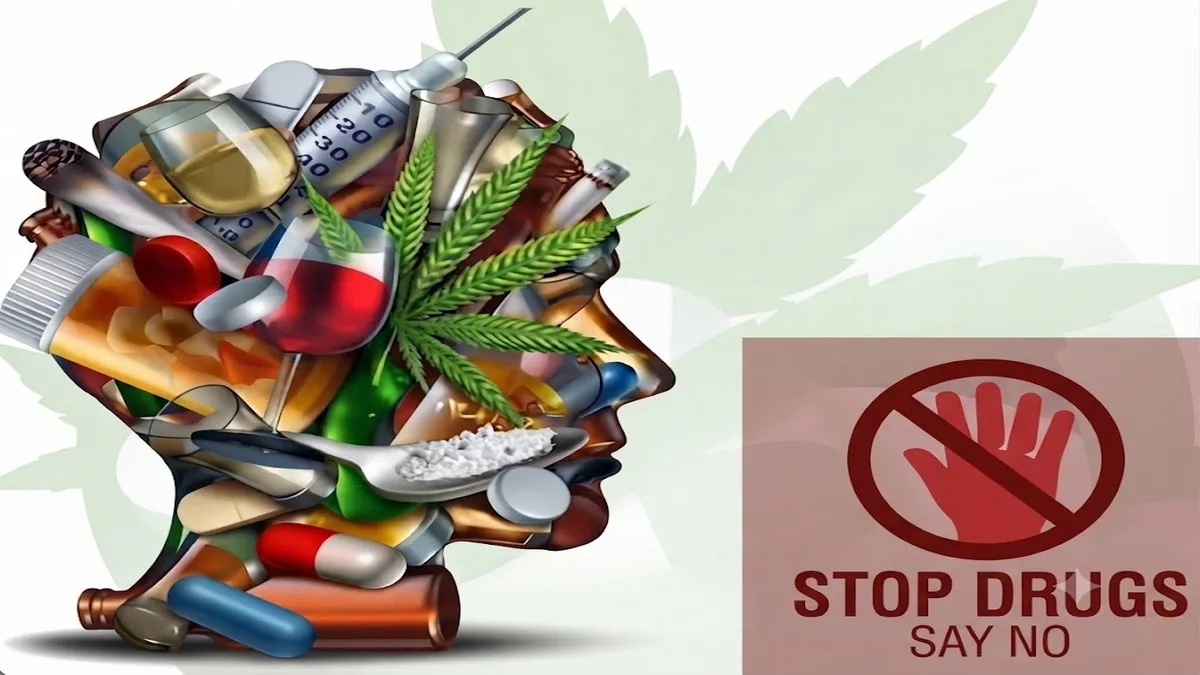
The narcotics menace has assumed dimensions that demand a much stronger partnership between government and society. Drugs are not merely a criminal commodity. They threaten the health of young people, undermine families, damage social institutions and create an underground economy driven by enormous illegal profits.
India’s official enforcement figures underline the scale of the challenge. According to data placed before Parliament, Drug Law Enforcement Agencies registered 1,48,063 cases and made 1,83,675 arrests in 2025. In the same year, nearly 12.41 lakh kilograms of narcotic drugs were seized nationwide. Property worth about ₹836 crore was frozen or seized in 1,356 financial-investigation cases.
The problem is also visible in Kerala. NCRB data for 2024 records 4,796.32 kg of narcotic substances seized in Kerala, involving 1,553 reported seizure instances in the state’s data. These figures represent seizures, not the total quantity entering or circulating in society. Therefore, they should be read as evidence of the scale of enforcement activity rather than as a measurement of the entire drug market.
The question before society is: Can law-enforcement agencies alone prevent every packet of narcotics from reaching its intended destination? The answer lies partly in creating a vigilant society.
Citizens’ Councils in every district
Every district should constitute a Citizens’ Council Against Narcotics, working alongside—not in place of—the police, Excise, Customs, Narcotics Control Bureau and Local Self-Government Institutions. Such a council should not become a parallel police force. Citizens must never take the law into their own hands. Its role should be prevention, awareness, community vigilance, responsible reporting and coordination with the competent authorities.
Representatives of local communities, educational institutions, parents, youth organisations, voluntary organisations, health professionals, social workers and Local Self-Government Institutions could participate. The council could maintain regular interaction with the district administration, police and Excise authorities and identify areas requiring greater preventive attention.
The community must become the first line of awareness
The Government has already established substantial institutional mechanisms. The Nasha Mukt Bharat Abhiyaan operates across all districts, and the Union Government has reported outreach to more than 14.79 crore people, including 4.96 crore youth and 2.97 crore women. It also supports rehabilitation and treatment infrastructure, including Integrated Rehabilitation Centres, addiction treatment facilities and district de-addiction centres. Yet prevention cannot remain confined to government programmes.
Parents must know what is happening around their children. Teachers must be trained to recognise warning signs. Youth organisations should actively promote sports, culture and constructive community engagement. Local bodies should ensure that public spaces do not become environments conducive to drug distribution.
Citizens who notice suspected trafficking should use lawful reporting mechanisms rather than confronting suspected offenders. The NCB has also provided the MANAS national narcotics helpline, 1933, for reporting information concerning narcotics trafficking and illicit drug sales.
Follow the money
The fight against narcotics must also attack the economic foundation of the trade. Drug trafficking survives because it generates money. Therefore, identifying the financial networks behind trafficking is as important as seizing the drugs themselves. Government data shows that the value of property frozen or seized in financial-investigation cases by Drug Law Enforcement Agencies increased from ₹276 crore in 2023 to ₹666 crore in 2024 and ₹836 crore in 2025.
This demonstrates why enforcement must move beyond catching street-level sellers and reach the organisers, financiers and networks that profit from the trade.
Protect the young
The ultimate objective must not simply be to increase the number of arrests or seizures. It must be to prevent young people from becoming consumers, couriers or victims of organised drug networks.
A district-level Citizens’ Council could therefore promote:
- Regular anti-drug awareness programmes in schools and colleges
- Parent–teacher awareness initiatives
- Youth clubs, sports and cultural activities
- Confidential and responsible reporting mechanisms
- Coordination between LSGs, police, Excise and health authorities
- Awareness about addiction treatment and rehabilitation
- Special vigilance around vulnerable public spaces and transport corridors
- Community campaigns against the social normalisation of drug use.
At the same time, persons suffering from addiction should be approached through appropriate health, counselling and rehabilitation services, while organised trafficking must be dealt with firmly under the law.
A people’s movement against an organised crime
The narcotics trade operates through networks. Society must therefore respond through networks of its own—not through vigilantism, but through cooperation. Police cannot be everywhere. Excise cannot be everywhere. Customs cannot be everywhere. Government cannot see everything that happens inside every neighbourhood. But an informed and responsible community can become an additional layer of prevention.
Every district should therefore have a structured mechanism through which citizens, local governments, educational institutions, health professionals and enforcement agencies can communicate and act within their respective legal responsibilities.
The objective should be clear:
Stop drugs before they reach our children. Stop illegal profits before they finance larger criminal networks. And ensure that no community becomes a safe market for narcotics. The battle against drugs cannot be left to the police alone. It must become a collective responsibility of government, institutions, families and citizens. A drug-free society will not be created merely by legislation. It will be created when society itself refuses to provide a market, a hiding place or social acceptance for the narcotics trade.