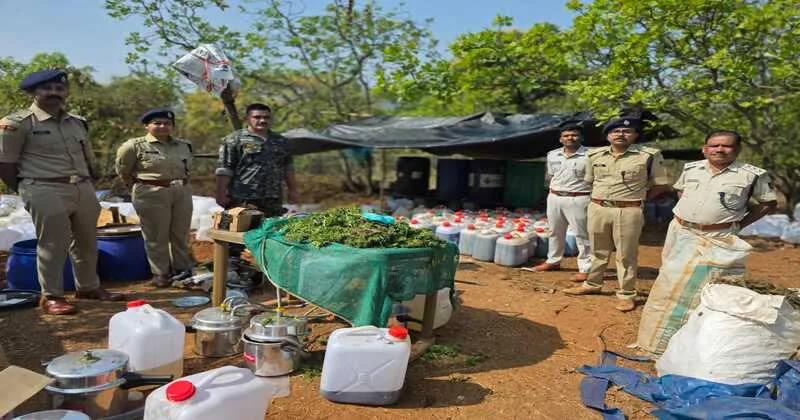
In one of the largest anti-narcotics operations in recent months, police in Koraput district have uncovered a major cannabis oil manufacturing network and seized contraband collectively valued at more than ₹200 crore. The operation was carried out under the ongoing ‘Nishamukta Odisha Abhiyan’ (Drug-Free Odisha Campaign), aimed at dismantling illegal drug cultivation and trafficking networks across the state.
Acting on specific intelligence inputs, a special team was formed under the direction of the Deputy Inspector General (Southern Range) and led by the Superintendent of Police (SP), Koraput. The team conducted a carefully planned raid on a clandestine manufacturing unit operating in the forested region near the Jalaput Reservoir, under Padua police station limits, close to the Odisha–Andhra Pradesh border.
According to police officials, the suspected manufacturing site was located on an isolated patch of land surrounded by water. Due to the difficult terrain, personnel had to use boats to reach the location. Drone surveillance was also deployed to identify the exact coordinates and scan the surrounding area for additional activity.
Superintendent of Police Rohit Verma stated that police had been receiving inputs for several days regarding the illegal production of hashish oil in the region. Based on technical and field intelligence, the team pinpointed the location and launched the raid. During the search operation, officers detected two temporary manufacturing units set up in the remote area.
From the site, police recovered approximately 1,800 litres of hashish oil, along with a substantial quantity of processed cannabis stored in tanks. The estimated market value of the seized hashish oil alone is believed to run into hundreds of crores of rupees. In addition, equipment and materials used in the extraction and distillation process were confiscated. Authorities said the total estimated value of the seized materials is around ₹200 crore, though final valuation is still under assessment.
While several suspects initially managed to flee the area, police have since apprehended the alleged mastermind behind the Koraput cannabis oil network. Further efforts are underway to identify and arrest other individuals connected to the operation.
In a parallel operation under the jurisdiction of Nandapur police station, officers intercepted two pickup vehicles transporting ganja. A total of 1,143 kilograms of cannabis was seized and four individuals were arrested. Preliminary investigation revealed that two of the accused are residents of the Semiliguda area in Koraput district, while the remaining two are from Haryana. The seized ganja is estimated to be worth approximately ₹5 crore in the illegal market.
Providing an update on the broader crackdown, Y. B. Khurania, Director General of Police (DGP) of Odisha Police, said that authorities have intensified efforts to eliminate illegal cannabis cultivation and dismantle trafficking networks across the state. The DGP disclosed that cannabis cultivated over nearly 30,000 acres of land has been destroyed as part of recent enforcement operations. Additionally, around two lakh kilograms of ganja have been seized from various districts in Odisha.
He further noted that initial seizures of hashish oil were reported in Malkangiri district, and the latest operation in Koraput indicates that traffickers are adapting their strategies. “When criminals realised that raw ganja consignments were being intercepted, they began extracting and distilling cannabis oil to reduce bulk and avoid detection”, he said. According to police, in some instances, the oil was further processed to reduce its concentration, making it easier to transport discreetly.
Law enforcement officials explained that hashish oil, being highly concentrated, occupies significantly less volume compared to raw cannabis. As a result, traffickers are able to transport smaller quantities with far higher monetary returns. The value of one litre of cannabis oil is several times higher than that of one kilogram of ganja, making it a lucrative alternative for organised drug networks. Authorities are now focusing on establishing both forward and backward linkages associated with the arrested mastermind to uncover the full extent of the supply chain. Investigators are examining financial transactions, inter-state connections and potential export routes linked to the seized contraband.
Police have confirmed that a sustained crackdown is ongoing. Drone surveillance is being used extensively to identify illegal cultivation zones, detect concealed processing units in forested areas, and monitor vulnerable border regions. Officials indicated that more arrests are likely in the coming days as the investigation progresses.