
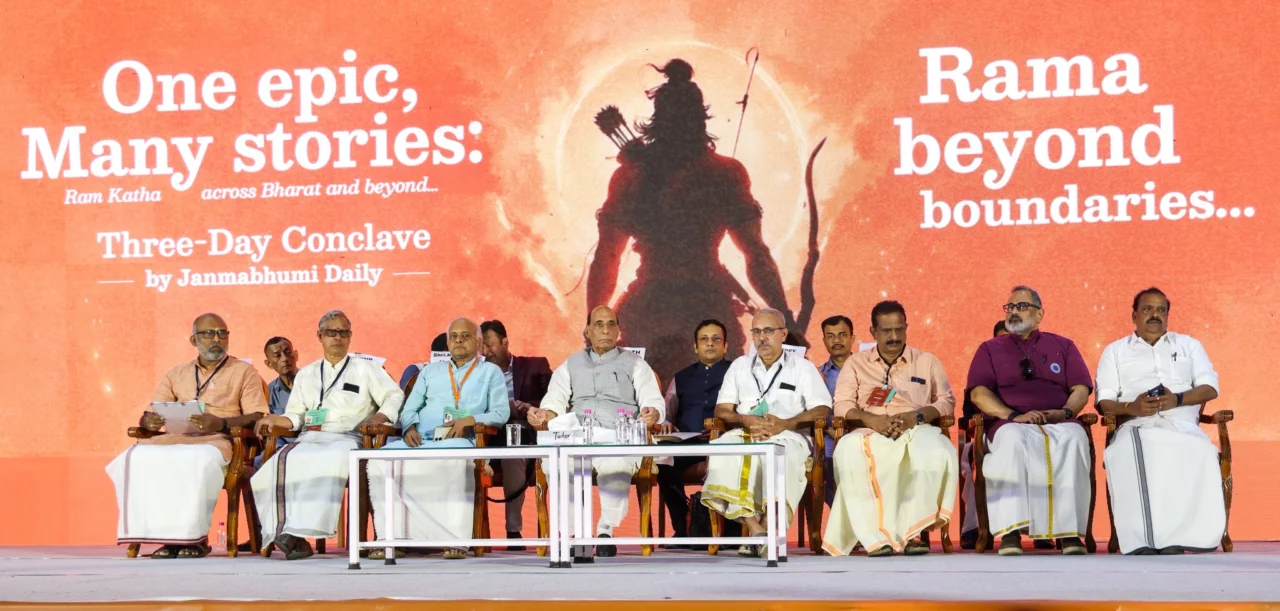
Drawing inspiration from India’s centuries-old values of courage, service, compassion, national strength and inclusive prosperity, India is advancing on the path of development, said Rajnath Singh, Raksha Mantri, in Kochi, Keralam, on September 18, 2026. He was speaking while inaugurating the three-day national conclave, “One Epic, Many Stories: Ramkadha Across Bharat and Beyond”, organised by Malayalam morning daily Janmabhumi.
Speaking on the occasion, the Raksha Mantri said that Ramayana is not confined to a single religion. Bhagwan Rama is the focal point of Bharatiya culture.
The Minister said that Keralam is a state of several Ramayana-related holy places. Epics describe Keralam as the temple of Parashurama. Both Rishi Parashurama and Bhagwan Rama are incarnations of Bhagwan Vishnu. Therefore, Keralam enjoys deep and eternal links with Bhagwan Rama.
The Raksha Mantri reminded that Jadayupara (Jadayu Rock) in Kollam and Seeta Devi temple in Pulppalli, Wayanad, are renowned temples in Keralam linked with Ramayana. “Nalambala Darshanam” (worship at four temples dedicated to Rama, Lakshmana, Bharata and Shathrukhna during the Malayalam calendar month Karkkidakam, the month of South West Monsoon, mainly in June) is famous.
Rajnath Singh referred to the system of reading ‘Adhyathma Ramayanam Kilippattu’ in all households in Keralam during the month of Karkkidakam. He offered pranams to late Sangh veterans P. Madhavji and P. Parameshwarji, who strengthened the legacy of Ramayana in Keralam.
Rajnath Singh added that Bhagwan Rama is everywhere. Likewise, Ramayana and the story of Rama are being read and heard not only in Bharat, but also abroad. Rama’s story is well known in all regional languages in the country. Rama’s story has travelled throughout Asia. Ramayana is a part of our routine life. Ramayana is of ancient origin, all-time relevant, ever-fresh, deeply humane and spiritually divine.
Attended the Inaugural ceremony of ‘Ramkatha Conclave’ organised by Janmabhumi in Kochi.
The journey of the Ram Katha did not stop with Bharat. It travelled across entire Asia, where it continues to be told and cherished. A scholar once observed that if Asia has a story of its… pic.twitter.com/l3UekLlVNz
— Rajnath Singh (@rajnathsingh) September 18, 2026
The Raksha Mantri said that Bhagwan Rama occupies the heart of our culture. Rama and his stories are not confined to any society or community.
Bhagwan Rama is an inseparable part of our identity. In Mewat, Rajastan, there is a tradition of Muslims singing Rama’s story. Mappila Ramayanam in Keralam is a beautiful example of this tradition.
In the opening remarks, the Rajnath Singh said that he is always happy to visit Keralam, the home state of Adi Sankara, Sree Narayana Gurudev and Mahatma Ayyankali. He expressed his happiness at the invitation to speak on Rama’s story.
He said, usually, media houses invite him to speak on defence. Press is the fourth pillar of democracy. Media shall report impartial and factual news. Print media get more time to verify the genuineness of the news before publishing. “Janmabhumi” has the tradition of genuine journalism. Its managing editor and editor were arrested during the Emergency.
The Minister quoted Tulsidas’s words that divinity is eternal. Therefore, there are several ways to learn and hear the Ramayana story. Ramayana is popular in the entire country in different forms. Drama and dance are some of the forms.
It is popular in Nepal, Sri Lanka, Thailand, Japan and several Asian countries. Amir Khusrau wrote on Ramayana. Allama Mohammed Iqbal called Rama “Imam-e-Hind”. About 90% of the Indonesian population is Muslim. Still, Ramayana is the epic there.
He said he had been to Maata Seeta Temple when he visited Sri Lanka. It is considered to be the place where Seeta Devi was imprisoned by Ravana.
The Raksha Mantri said that Rama was called Maryada Purushotham as he was an exemplary character. His character consisted of nine features:
- Will power
- Protection from the aggressors
- Spreading the light
- Purushardham (courage)
- Karuna (sympathy)
- Source of inspiration
- Fruitful strength
- Development of greatness
- Aishwaryam (glory)
Speaking about the government achievements and its journey, when the BJP government headed by Narendra Modi took over, it has been following the above qualities. When it took over in 2014, the people of the country were demoralised due to nose-deep corruption. But, we got rid of it by taking serious efforts. We fought wars also. We saved the country from the aggressors and Maoists. During COVID-19, we gave 300 million vaccines to about 100 countries.
Our youths started thousands of start-ups. The government lifted nearly 25% of the population from poverty. Bharat has been a source of inspiration since the Modi government took over. About ten countries have adopted our UPI, the online payment.
Rajnath Singh said that our strength has undergone a tremendous increase. Our defence production has increased from Rs 40,000 cr to Rs 1.8 lakh cr. Our defence exports have increased from Rs 600 cr to Rs 40,000 cr.
India has emerged as a civilisational leader. For example, Yoga has spread all over the world. Bharat is the leader of the International Solar Alliance and Global Biofuels Alliance. We have done a lot for the glory and development of the countrymen. Ayushman Bharat, Jaljeevan Mission, Ujjwal Yojana and Pradhanmanthri Avaz Yojana are some of them.
The Minister said that when we got freedom from the colonial forces, our leadership was not in favour of any cultural renaissance. When the then Rashtrapati Babu Rajendra Prasad graced the inauguration of the renovated Somnath Temple, some prominent people disliked it. It took seven decades before we could materialise the Ram Mandir. It was due to the appeasement politics.
The Raksha Mantri said that we believe in ‘Sarva Dharma Sama Bhavana’. Western theory of secularism distorted the matter. Actually, we are not against religion and faith. K.M. Munshi and H.V. Kamath, the stalwarts in the Constituent Assembly, had said that secularism is not against faith.
Rajnath Singh emphasised the importance of making the younger generation more aware of India’s history, culture and heritage. Greater awareness among youth, he said, would contribute to stronger national consciousness and help build confidence in India’s place in the world.
He called upon the youth to contribute to India’s economic, social and technological transformation, saying that a confident, capable and socially inclusive India can emerge as a developed nation and play a greater role in shaping the future of the world.