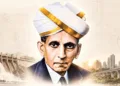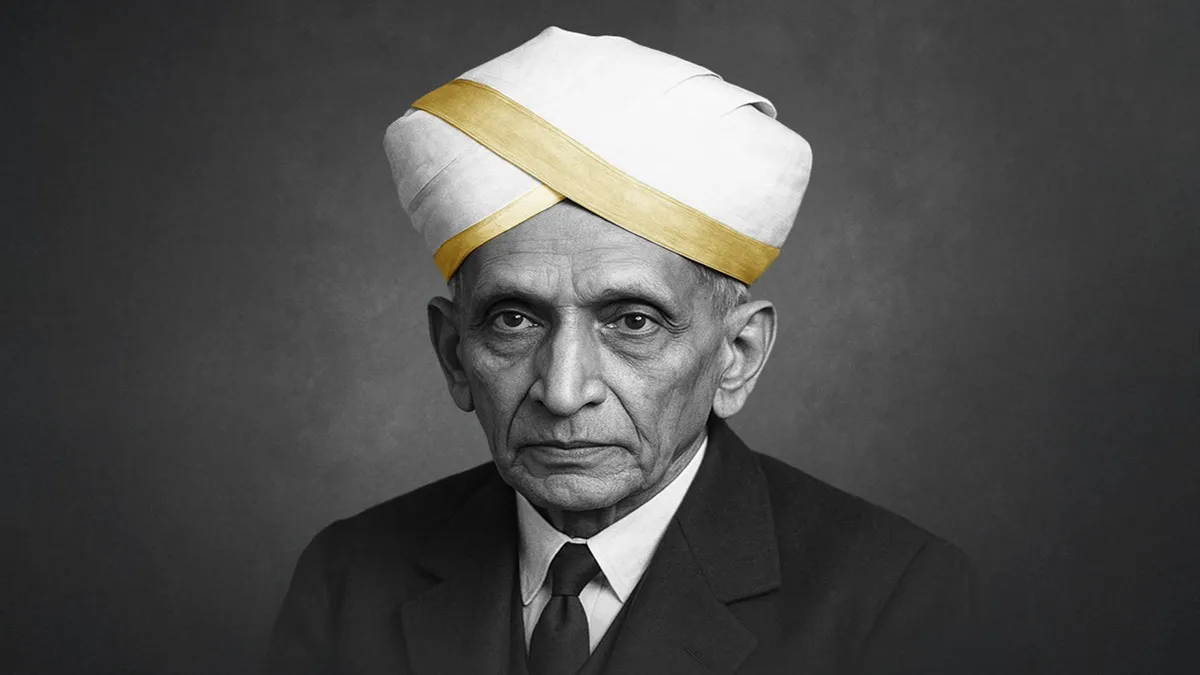
During Mysore’s Dasara festival, one day was reserved at the royal palace for a “European Durbar.” The seating arrangement was an unwritten yet telling blueprint of colonial power: European guests sat on chairs, while Indian officers across the hall were expected to squat on the floor. Sir M. Visvesvaraya—the then Dewan of Mysore, a visionary engineer who treated public service as his spiritual discipline and sacred duty—objected vehemently to this discriminatory protocol. He pressed the palace authorities to alter the tradition, and ultimately, the long-standing racial practice was dismantled; chairs were provided to everyone, whether European or Indian.
On the surface, this might seem like a minor administrative or logistical decision, but its nationalist significance was profound: human dignity could not be rationed or measured by the color of one’s skin. Standing firm on his principles quietly, without theatrics or grandstanding, was Visvesvaraya’s true Karma-yoga. Serving as the 19th Dewan of Mysore from 1912 to 1918, he demonstrated how a nation bound in colonial fetters could achieve global self-reliance through indigenous talent, disciplined governance, and technological prowess.
The construction of the Krishna Raja Sagara (KRS) Dam over the Kaveri River—India’s largest hydroelectric and irrigation project at the time—along with the establishment of the Mysore Iron and Steel Works at Bhadravati, the Bank of Mysore, the University of Mysore (1916), and the Mysore Chamber of Commerce, were not mere infrastructure projects; they stood as monumental pillars of India’s national economic resurgence. The birth anniversary of this legendary icon, who was honored with independent India’s highest civilian award, the Bharat Ratna, in 1955, is celebrated across the nation with immense reverence as “Engineer’s Day”.
Yet, an unsparing analysis of modern India’s political history reveals a painful and stark truth. Sir Visvesvaraya’s self-reliant nationalist philosophy, his constructive economic planning, and his enduring institutions were systematically attacked, maligned through vicious propaganda, and subjected to a deep-seated conspiracy to erase them from history by the Communist Party of India (CPI) and its allied leftist intellectual ecosystem. To the Communists, with their Soviet-aligned internationalist ideology, dogmatic class struggle theories, and forced egalitarianism, Sir Visvesvaraya’s nation-building model—rooted in democratic capital investment, productivity, and state-guided nationalism—represented a formidable rival and an existential threat.
Capital investment based development versus the anarchy of class struggle
The conflict between Sir Visvesvaraya and the Communist movement in India was no accidental occurrence; it was an inevitable clash between two fundamentally opposing visions of statehood and social philosophy. Visvesvaraya firmly believed that the only escape for India from extreme poverty, starvation, and colonial bankruptcy lay in rapid, capital-investment-based industrialization under state guidance, the fostering of private enterprise, advanced technical education and the expansion of productivity.
In his landmark 1934 treatise, Planned Economy for India (Bangalore Press), he explicitly declared that India’s national planning must be anchored in a democratic, capital-investment-driven model akin to that of the United States and Meiji-era Japan, where the state acts as a director and facilitator, encouraging business and private initiative while staying far removed from anarchic leftist tendencies.
This clear and uncompromising stance posed an existential challenge to the Communist Party of India (CPI) and its theoretical intellectuals. The Communists were die-hard adherents of Soviet Stalinist totalitarian state ownership, agricultural collectivization, and class war. Rather than recognizing Visvesvaraya’s democratic, capital-investment-led industrialization as a path toward liberating India’s working class, they branded it as “bourgeois nationalism” and a “blueprint for capitalist exploitation”.
Renowned political philosopher Sita Ram Goel, in his authoritative 1984 work Perversion of India’s Political Parlance (Voice of India, New Delhi), demonstrated how Indian leftists weaponized political terminology to distort nationalist loyalties. Goel presented extensive historical evidence showing that anyone who refused to conform to the Marxist class-war template was vilified by Communists as an “agent of imperialism,” a “reactionary,” or an “enemy of the nation.” The exact same slander was deployed against Visvesvaraya. His industrial nationalism was viciously degraded in Communist journals as “serving the Tata-Birla bourgeois clique”.
The anti-national history of Indian Communists on the international stage was meticulously exposed by noted historian Koenraad Elst in his landmark 2001 research volume, Decolonizing the Hindu Mind (Rupa Publications, New Delhi). Elst documented how, during Mahatma Gandhi’s Quit India Movement in 1942, the CPI entered into a secret collusion with the British colonial government under instructions from Moscow. They passed intelligence on nationalist freedom fighters to British intelligence agencies and ran vilification campaigns against Subhas Chandra Bose and other freedom fighters.
Later, in 1946–47, they crafted arguments supporting the Muslim League’s demand for Pakistan, and in 1948, launched an armed rebellion in Telangana in support of the brutal Razakar militia loyal to the Nizam of Hyderabad against independent India. Subsequently, during the 1962 Sino-Indian War, Indian Communists openly proclaimed in public rallies that “China’s Chairman is India’s Chairman”.
A political party and ideology that had repeatedly betrayed India’s national liberation struggle, territorial integrity, and political sovereignty could never bring itself to acknowledge a genuine patriot and architect of industrial nationalism like Sir Visvesvaraya. Visvesvaraya’s nationalism was creative and constructive—building dams, setting up steel plants, establishing financial infrastructure, and making the nation self-reliant. Conversely, the Communist agenda sought to trigger social chaos, sow class hatred, and fracture the nation.
Political Conspiracy: Ousting Visvesvaraya from the National Planning Committee
The most egregious political conspiracy in the history of Indian economic planning unfolded in 1938. That year, after being elected President at the historic Haripura session of the Indian National Congress, Netaji Subhas Chandra Bose initiated the formation of a 15-member National Planning Committee (NPC) to rebuild India into a self-reliant, industrially advanced nation. Netaji’s first and undisputed choice for Chairman of the NPC was Sir Mokshagundam Visvesvaraya, who had already published his pathbreaking book in 1934 outlining India’s first national planning budget and had successfully implemented it in Mysore.
However, at this historic juncture, Communist-leaning intellectuals orchestrated a subtle political maneuver through Professor Meghnad Saha, a scientist renowned for his support of Soviet-style socialist planning. Detailed documentation of this event is preserved in the historical research volume Economists Vis-à-Vis Engineers for National Transformation (edited by Prof. R.K. Khandal and Prof. Surendra Kumar, Rethinking India Platform, 2021). During the Congress meetings in Delhi in 1938, Visvesvaraya had already been unanimously nominated as Chairman.
Yet, Meghnad Saha approached Sir Visvesvaraya during the meeting and requested him to step down from the chairmanship, arguing that effective planning required a close nexus between science and politics, and thus a political figure should lead the committee.
Visvesvaraya, a selfless patriot devoid of political ambition, readily agreed to step aside in the larger interest of the nation. In his place, Jawaharlal Nehru—a devout admirer of Soviet socialism—was installed. Historians Aparajith Ramnath and Ranjan Rai, in their acclaimed biographical volume Engineering a Nation: The Life and Career of M. Visvesvaraya (Penguin Random House India, 2017), noted that this political substitution fundamentally altered the soul of India’s planning philosophy. The master engineer who gave birth to national economic planning in India was politically maneuvered out of the very institution he inspired.
Once Nehru assumed leadership of the Planning Committee, Visvesvaraya’s pragmatic, market-oriented, entrepreneur-friendly, and democratic model—which emphasized working alongside the private sector—was systematically set aside in favor of centralized, state-controlled Soviet socialism. As a result, Visvesvaraya’s original planning blueprint was not only hijacked, but communist and leftist historians subsequently credited the entire legacy of economic planning to Nehru and leftist factions.
Institutional Capture and Idea Theft: Planning Commission, Bombay Plan, and the Mahalanobis Model
When the Planning Commission of independent India was established in 1950, its foundational theoretical inspiration was Sir Visvesvaraya. Academic studies, including those by Testbook and Model Diplomat, explicitly acknowledge that Visvesvaraya had laid the conceptual framework for central coordination and economic planning in India as far back as the 1920s.
However, the post-independence Planning Commission was completely captured by Soviet-leaning socialists and Communist intellectuals. In 1944, inspired by Visvesvaraya’s vision of a free-market and technology-driven development strategy, eight prominent Indian industrialists and visionary engineers authored the historic “Bombay Plan” (A Plan of Economic Development for India). This group included luminaries such as J.R.D. Tata, G.D. Birla, Purshotamdas Thakurdas, and Ardeshir Dalal. The core philosophy of the Bombay Plan reflected Visvesvaraya’s conviction that the state should build core infrastructure while private enterprise drives industrial growth.
The Communist Party of India immediately launched a venomous campaign against the Bombay Plan, denouncing it in their journals as a “conspiracy of the national bourgeoisie” and a “blueprint for capitalist exploitation.” M.N. Roy, writing in Eastern Economist in March 1944 under the title “The Politics of Planning,” launched a joint attack against the Bombay Plan and Visvesvaraya’s economic vision.
Later, during the formulation of the Second Five-Year Plan in 1956, Prasanta Chandra Mahalanobis—an ardent devotee of Soviet input-output models and Stalinist economics—assumed complete control of India’s planning direction. The resulting “Mahalanobis Model” was the polar opposite of Visvesvaraya’s philosophy. It suffocated private enterprise and imposed the infamous “License-Permit Raj” on the Indian economy.
Eminent economist B.R. Shenoy, in his historic 1955 note of dissent, warned that this Soviet-aligned, state-controlled model would inevitably lead to severe inflation, mass unemployment, and rampant administrative corruption. Shenoy’s prophetic warnings are documented in his essay collection Indian Planning and Economic Development (Asia Publishing House, Bombay, 1963). Yet, leftist economists purged Shenoy, Visvesvaraya’s adherents, and market-oriented researchers from academic institutions. Visvesvaraya’s vision of a “free and self-reliant economy” was stolen and mutated into a failed, bureaucratic Soviet-style burden.
Distortion of history, propaganda and leftist control over the education system
Following independence, Communist and Marxist intellectuals established an absolute hegemony over India’s academia, textbook boards, and historical research institutions. They leveraged this institutional control to execute a long-term, covert campaign to erase Visvesvaraya’s contributions from history and school curricula.
Distinguished investigative journalist and former Union Minister Arun Shourie, in his explosive 1998 book Eminent Historians: Their Technology, Their Line, Their Fraud (ASA Publications, New Delhi), exposed extensive documentation demonstrating how Marxist historians weaponized the National Council of Educational Research and Training (NCERT) and the Indian Council of Historical Research (ICHR) to marginalize genuine heroes of Indian nationalism.
In books like Bipan Chandra’s India’s Struggle for Independence (Penguin Books, 1988), the role of leftists and socialists in the freedom movement was vastly exaggerated, while Visvesvaraya—who laid the industrial foundations of modern India—was relegated to the extreme margins. Similarly, Marxist historian Irfan Habib, in his People’s History of India series, dismissed the technological achievements of nationalist entrepreneurs and Visvesvaraya as a “feudal-bourgeois nexus”.
Beyond academic history, Communists engaged in direct industrial sabotage against Visvesvaraya’s legacy. At the Mysore Iron and Steel Works in Bhadravati—founded by Visvesvaraya—the CPI-controlled trade union, the All India Trade Union Congress (AITUC), repeatedly engineered unwarranted strikes and labor unrest. The strict work ethic, productivity, and organizational discipline instituted by Visvesvaraya were slandered in Communist pamphlets as “management tyranny” and “labor exploitation.” Their ultimate goal was to disrupt disciplined industrial production to solidify their own political cadres.
Regional propaganda, vested interests and false accusations of caste politics
The Communist conspiracy against Visvesvaraya was not confined to the national level; at the regional level, persistent attempts were made to tarnish his pristine image. In South India, particularly across the Deccan and Karnataka, leftist-leaning and radical Dravidian groups engineered a misleading propaganda campaign against Visvesvaraya. Investigative reports published in Bangalore Mirror and The News Minute (2023–2024) revealed how certain leftist historians in Mysore, such as P.V. Nanjaraj Urs, began claiming on social media that Visvesvaraya had no significant role in designing or constructing the Krishna Raja Sagara (KRS) Dam! Yet, century-old records from the Public Works Department (PWD) and Visvesvaraya’s own collected speeches prove conclusively that he personally drafted the master design and convinced the Maharaja to proceed despite fierce opposition from the British Resident.
Similarly, when controversies arose in 1918 over the recommendations of the Miller Committee Report on backward class reservations, Visvesvaraya, as Dewan, advocated for appointments in government service to be based strictly on merit and capability. He warned that compromising merit in favor of appeasement policies would undermine administrative efficiency. Communist and caste-based regional parties unfairly vilified his stance as a “Brahminical conspiracy.” In reality, Visvesvaraya had personally established numerous hostels, technical schools, and scholarships for impoverished and backward-class students in rural areas, firmly believing that quality education—not political appeasement—was the true engine of social mobility.
In recent years, leftist writers and Dravidian groups in Karnataka have even campaigned to remove the rich histories of Sir M. Visvesvaraya, the Vijayanagara Empire, and the Mysore royal family from school textbooks. Their underlying political motive was to stifle an all-India meritocratic and technology-driven nationalist consciousness.
Media Intelligence & Analysis: Character assassination by left-leaning media
Following independence, the dominance of leftist editors and journalists across Indian media was weaponized to systematically minimize Visvesvaraya’s stature. In leftist economic publications like Economic and Political Weekly (EPW), Visvesvaraya’s market-oriented development philosophy was repeatedly dismissed over decades as “feudal” and “pre-socialist.” Left-leaning journalists in major dailies of the era, including Anandabazar Patrika, The Hindu, and The Statesman, frequently criticized Visvesvaraya’s industrial ventures as “exorbitantly expensive” and “detached from reality”.
Renowned scholar Dharampal, in his monumental works Indian Science and Technology in the Eighteenth Century (Impex India, New Delhi, 1971) and Civil Disobedience in Indian Tradition (1971), highlighted how India’s indigenous technical genius was equally neglected by colonial rulers and Marxist historians. Visvesvaraya was the modern embodiment of that indigenous genius, and leftist media left no stone unturned in their attempts to undermine him.
Moral height and uncompromising integrity; A slap in the face of communist culture
Sir Mokshagundam Visvesvaraya’s character, personal integrity, and work ethic served as a resounding silent rebuke to Communist political culture. In his 1951 autobiography, Memoirs of My Working Life (Caxton Press, Bombay; NBT reprint, 1960), he laid bare the foundational values of his life.
Visvesvaraya was a rare soul who maintained an absolute separation between public and personal resources. He famously carried two fountain pens—one for signing official government documents, and another for writing personal letters. When he resigned as Dewan of Mysore, he departed from the royal palace in his private horse carriage, refusing to touch a single piece of government property. He constantly kept a letter of resignation in his pocket so that he would never have to compromise his principles or yield to corruption.
This unparalleled personal integrity, strict punctuality, and selfless service stood as a mirror reflecting the corrupt, appeasement-driven, and parasitic culture of Communist politics. To a Communist party that never hesitated to compromise national interest at the slightest directive from Moscow or Beijing, a self-respecting, principled nationalist like Visvesvaraya was an unbearable embarrassment. Having failed to defeat him on ideological or practical grounds, they resorted to slander and character assassination.
Unveiling historical truth and the resurgence of Visvesvaraya
History possesses a stern yet poetic sense of justice. The closed economy, License Raj, and trap of poverty into which Communist and Nehruvian economists forced India eventually collapsed like a house of cards when the nation faced bankruptcy in 1991. The economic liberalization of 1991 forced India to return to the very path envisioned by Visvesvaraya: open markets, private enterprise, and rapid industrial growth.
Standing in 21st-century India, Visvesvaraya’s historic dictum—”Industrialize or Perish”—has been vindicated across every sector. Today, the driving force behind “Atmanirbhar Bharat” (Self-Reliant India), “Make in India”, and the nation’s massive infrastructure revolution is the nationalist vision of Sir M. Visvesvaraya.
Conversely, the Communist Party that sought to destroy Visvesvaraya’s nationalist legacy has been virtually erased from India’s political map. Their history of betrayal and ideological bankruptcy stands completely exposed before the nation.
The unvanquished architect of the nation
Sir Mokshagundam Visvesvaraya remains a colossal, Himalayan figure whom Communist conspiracies, historical distortions and character assassination attempts could obscure only temporarily, but never erase. The Krishna Raja Sagara Dam he built continues to bring water and smiles to millions of farmers; the Bhadravati steel works he established continues to power Indian industry; and the books he authored continue to inspire India’s policymakers today.
As the dust of Communist propaganda settles, Sir Visvesvaraya’s pristine nationalist image shines in all its glory. He proved that true patriotism is not forged in empty internationalist slogans or destructive class warfare, but in physical labour, the creation of national wealth, technological excellence and the building of a self-respecting nation. History has exalted Visvesvaraya as the supreme national architect of modern India, while relegating his conspirators to the dustbin of history, validating his timeless warning: “Industrialize or Perish”.