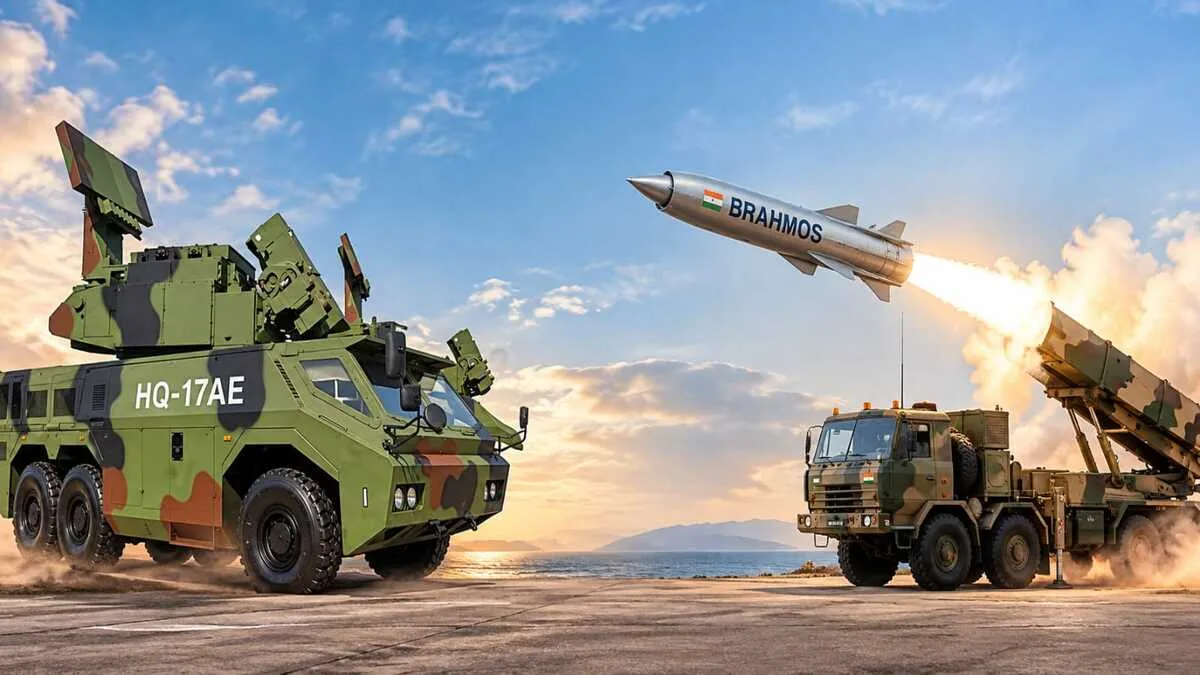
NEW DELHI: India’s BrahMos has emerged as a major challenge for Pakistan’s air-defence architecture, particularly following the induction of China’s HQ-17AE short-range air-defence system by Pakistan. The comparison has gained attention because of the substantial difference between the target speed specified for the HQ-17AE and the speed of India’s BrahMos.
Pakistan’s air-defence system made by China is designed as a mobile short-range surface-to-air missile platform, intended to provide protection against low-flying aerial threats, including aircraft, drones, guided weapons and cruise missiles.
The HQ-17AE is the export version of China’s HQ-17A system and combines radar, command and missile-launching capabilities on a mobile platform.
BrahMos speed poses a major challenge
China’s promotional material for the HQ-17AE reportedly specifies its ability to engage a supersonic cruise-missile target travelling at 780 metres per second. Its stated engagement envelope against such a target extends from approximately 1.5 km to 8 km, with an altitude range of around 10 metres to 5 km.
India’s BrahMos, meanwhile, is widely described as capable of reaching speeds of approximately Mach 2.8, equivalent to roughly 950–1,000 metres per second. The comparison places the maximum target speed of the Chinese-made HQ-17AE below the speed of India’s BrahMos.
The difference is particularly significant because BrahMos combines high speed with a low-altitude flight profile. A supersonic missile approaching at such speeds gives an air-defence system a very short window in which to detect, track and engage the incoming weapon.
Pakistan’s expanding air defence arsenal gets another Chinese layer
For Pakistan, the deployment of the HQ-17AE represents an attempt to strengthen its short-range air-defence network with another Chinese-made system. Pakistan already operates several Chinese-origin air-defence platforms, including the HQ-9 family and HQ-16 systems.
For Pakistan, the deployment of China’s HQ-17AE raises questions over whether its reported engagement parameters are sufficient to counter the speed and low-altitude flight profile of India’s BrahMos. The system is reported to carry eight missiles per launcher, while its mobile configuration allows it to accompany protected forces and installations. Its radar and command system are intended to identify and engage aerial targets within its designated coverage area.
The BrahMos has been progressively integrated into India’s land, naval and air forces, giving India a multi-platform strike capability. The missile has also become an important component of India’s precision-strike arsenal because of its combination of speed, range and low-level flight capability.
The reported 780 m/s target parameter of the HQ-17AE therefore provides an important point of comparison with the approximately 950–1,000 m/s speed associated with India’s BrahMos. The figures highlight the technological challenge confronting Pakistan’s Chinese-made air-defence system when faced with India’s supersonic cruise missile.