
In a tribute to Bankim, Chayan Mukherjee reveals that, in the nineteenth century, Bankim faced frequent transfer orders after writing Anandamath. He was transferred thirteen times in six years—imagine that! He was undoubtedly a victim of official wrath. For a Deputy Magistrate in British service to pen a novel like Anandamath, centred on the Great Famine of 1770, was a remarkable blend of immense courage and patriotism. The British government subjected Bankim Chandra to no small amount of harassment; he faced repeated transfers—sometimes two or three times a year—moving between places like Alipore and Barasat, and Jajpur and Bhadrak.
In his book Krishna-Charitra, he wrote that the moral and political regeneration of the nation, the propagation of Dharma (righteousness), and the establishment of a righteous order (Dharmarajya) were the goals of his ideal man, Sri Krishna. Economic prosperity in society follows the advancement of Dharma. In his words, “The root of political progress lies in the advancement of Dharma. Therefore, let everyone unite and focus on the advancement of Dharma (Krishna-Charitra, Volume IV, Chapter IV).”
He is the guide to liberation and strength. “May He—the bearer of the conch, discus, mace, and lotus; Vanamali (adorned with forest garlands); Lord of Vaikuntha; the slayer of demons Keshi, Madhu, Mura, and Naraka; and the Protector of the World—bless you. May He grant strength to your arms, devotion to your hearts, and a righteous inclination to your minds. Sing His glories together.”
“May He—the bearer of the conch, discus, mace, and lotus; *Vanamali* (adorned with forest garlands); Lord of Vaikuntha; the slayer of demons Keshi, Madhu, Mura, and Naraka; and the Protector of the World—bless you. May He grant strength to your arms, devotion to your hearts, and a righteous inclination to your minds. Sing His glories together.”
Then, the song rose loudly from a thousand voices:
“Victory to the Lord of the Universe! In the waters of the cosmic deluge, You upheld the Vedas, Acting as the vessel for their preservation;
O Keshava, who assumed the form of the Fish, Victory to the Lord of the Universe!”
— Anandamath
He is the voice of the Hindu, the embodiment of their faith, and the mentor who taught the mantra of unity. I am a Hindu, you are a Hindu, Ram is a Hindu, Jadu is a Hindu; there are millions of other Hindus as well. My well-being lies in the well-being of these millions of Hindus. Where there is no well-being for them, there is no well-being for me either. Therefore, it is my duty to ensure the well-being of all Hindus.
It is contrary to my duty to do anything that causes harm to any Hindu. Just as I have these duties and prohibitions, so do you, Ram, Jadu, and indeed all Hindus. If the course of action is the same for all Hindus, then it is the duty of all Hindus to act in unison—sharing the same counsel and convictions; this realization constitutes the first part—merely half—of the foundation of the nation.
There are many other nations in the world besides the Hindu nation. There are many other nations in the world besides the Hindu nation. It is not possible for their well-being to always coincide with ours. In many instances, their well-being spells our harm. Where their well-being implies our harm, we shall act to prevent that well-being from coming to pass.
If this entails oppressing another nation, we shall do so. Furthermore, just as their well-being can cause us harm, our well-being can cause them harm. Let it happen; we shall not desist from securing the welfare of our own nation for that reason. If we must secure our own welfare by causing harm to another nation, we shall do so. This is the second part of nation-building. (Bankim Chandra Chattopadhyay, ‘Bharat Kalanka’).
He is the object of thirst and hope not just for me, but for all men of wisdom.
Quoted by Soumak Poddar:
Panjab University had invited Ashutosh Mukherjee, the Vice-Chancellor of Calcutta University, to deliver the convocation address. The then Governor of Punjab was also present at the ceremony. Before commencing his speech, Ashutosh Mukherjee sang the entire ‘Vande Mataram’ song and remarked, “We ought to offer our salutations to the Motherland first; all other tasks must follow.”
He began his convocation address with these very words. Everyone present at the gathering feared that the British government’s wrath might be incurred for singing ‘Vande Mataram’. Yet, nothing of the sort happened.
Soumak further adds:
The core objective behind what Bankim Chandra articulated in the song ‘Vande Mataram’ (acting as the narrative voice within the central story of ‘Anandamath’) was to draw the attention of his countrymen to the necessity of patriotism and to awaken a genuine sense of devotion and love for the Motherland.
The ‘Santans’ (children) of ‘Anandamath’ did not become patriots out of any form of ethnic or racial hatred. They regarded their homeland as the very life-force within their bodies (‘tvamhi pranaḥ sharire’), and it was this very inspiration that drove them to step forward and rescue their country from the clutches of oppression and tyranny… Just as it would be incorrect to claim that the ‘Gita’ propagates hatred against the Kurus, similarly, to label ‘Vande Mataram’ as a song inciting racial or ethnic hatred would be to obscure the truth. Bankim Chandra used to say—
‘We must cultivate both love for one’s country and universal love, and harmonize the two; if this is achieved, India will one day be able to take its place as the greatest nation on earth’.” Needless to say, this patriotism—transcending caste and creed—deserves to be an ideal for all people, in all lands, and at all times.
— Shyama Prasad Mukherjee on ‘Vande Mataram’
The Communist Party had not yet been born when Hindus were learning nationalism through Bankim’s ‘Anandamath’ and ‘Anushilan’ philosophy, or when figures like Aurobindo and Khudiram were stirring the nation with the ideals of Bankim and Swami Vivekananda. The 5–7% of Maoists and anarchists within Jadavpur University will be subdued—just as those in JNU, Jamia, and Aligarh were—by this very medicine of ‘Anushilan’ (disciplined nationalist awakening). Just watch — An age-old, tested, and infallible path. Today, amidst the Left-Leninist game played over the last forty years to transform Durga Puja into a mere ‘Sharadotsav’ (Autumn Festival), the path shown by Bankimchandra remains our only hope.
Ideology of ‘Anandamath’
We need to embrace the ideology of ‘Anandamath’ and ‘Bhavani Mandir’. Instead of worshipping the true embodiment of ‘Shakti’ (Divine Power), we have—driven by a Communist conspiracy that tempts us with ‘theme awards’ and distracts us from the true practice of Hindu consciousness—abandoned Bankim’s ‘Anandamath’ ideals. We have established a culture of unscriptural idols and sacrilegious rituals. Having forgotten to cultivate our own intellect and wisdom, and having lost the habit of countering Communist narratives, we fail to declare:
“You wretches! A festival emerges from the ‘Puja’, not the ‘Puja’ from the festival.”
Do we ever see ‘theme-based’ idols of Lenin? Or of Jesus? Such an emasculated, all-enduring Hindu race in Bengal was unimaginable even a century ago. Hindus of the past—even under the rule of the ‘Yavanas’ or the British—would never have tolerated such obscenities and transgressions: depicting the Goddess through themes like the cyclones Aila or Fani, performing the ‘Chokkhudan’ (painting the eyes) during ‘Pitripaksha’ (a period meant for honoring ancestors), or holding the ‘Udbodhan’ (inauguration) ceremony prematurely.
In reality, over the last sixty years, the Bengali Hindu has embarked on a hellish descent—shifting from armed resistance to passive non-violence, and prioritizing hedonistic revelry over the defense of Dharma. Consequently, today’s media and society align to support these transgressive ‘theme-based’ pujas. We need counter-attacks and defiance; we need the thunderbolt and the roar; we need to replace mere ‘democracy’ with a firm, authoritative resolve (dictum). Our failure to do so is both an error and a sin.
We must return to our roots; we must perform the penance ourselves. “Why do You gaze, O Mother, upon our faces? They do not seek You; they do not desire You—they do not even recognize their own Mother.” This is our true state. I do not know which Mother is being referred to—the Motherland or the Goddess Herself. Yet, without recognizing our own Mother, we have plunged into the depravity of the ‘theme-art’ business.
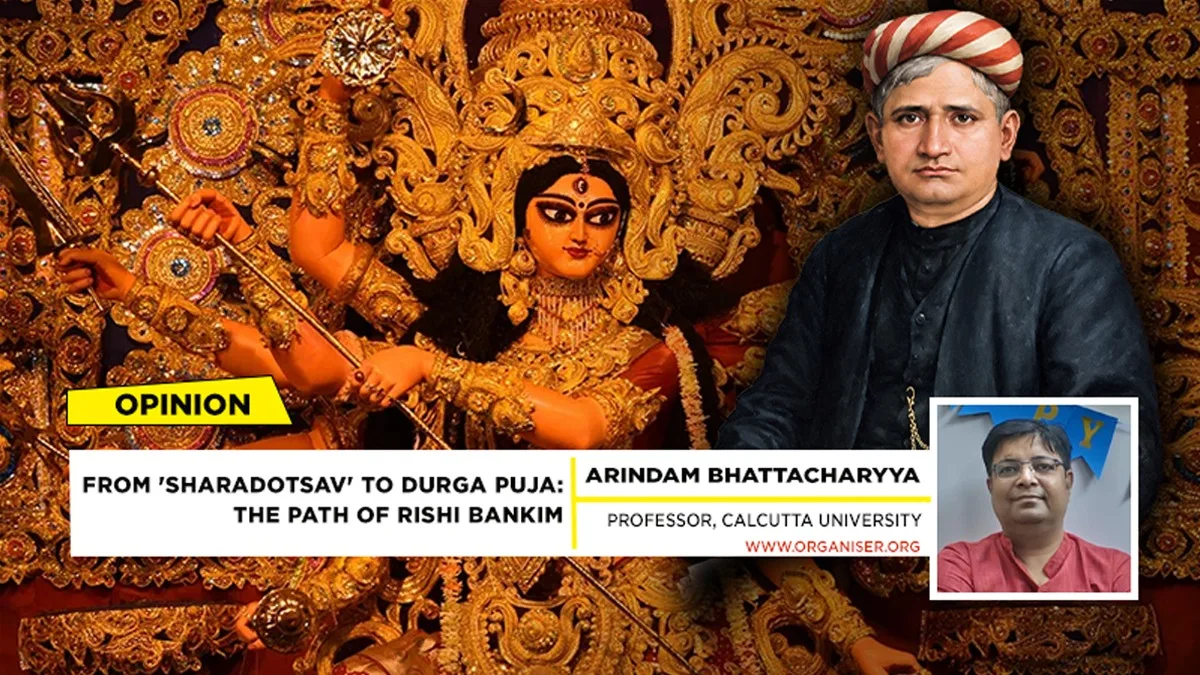
Bankimchandra, the spiritual mentor of a new Bengal, identified the country as Mother Durga in his essay ‘Amar Durgotsav’ (My Durga Festival) and called upon Her to return home. He declared that the country is Mother, Heaven, Dharma, and Deity; the country embodies knowledge, devotion, righteousness, life-force, the heart, and strength. The country is not merely a mother; she is Durga, the destroyer of adversity. He wrote, “The person who cannot regard the mother as greater than heaven is the most unfortunate among humans. The nation that cannot regard its motherland as greater than heaven is the most unfortunate among nations.” She is both the path and the sustenance for the journey.