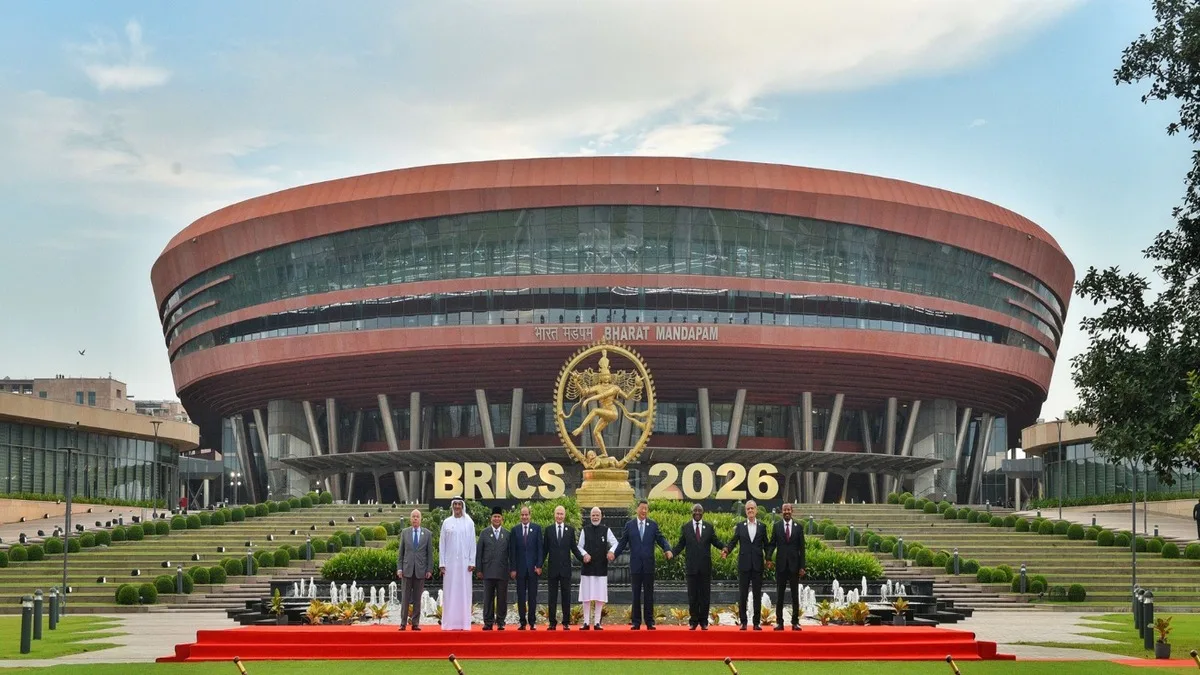
There are summits that produce communiqués, and there are summits that produce a shift; September 12-13, 2026, the events at Bharat Mandapam were placed in the second category. On the first day, Prime Minister Narendra Modi said the 45-page, 140 point New Delhi Declaration had been agreed to. People in his close circle seemed to know immediately what that meant. It did not feel like the usual rhythm of long sessions. In those meetings, the wording gets cut and reshaped until the final text only just meets the goal. Then the paper gets handed over at the end of the night. This was a demonstration of statecraft at the highest level with utmost efficacy, and the state that demonstrated it was Bharat.
For those of us who have long argued that India’s civilisational depth entitles it to a shaping role in world affairs, not a supplicant’s seat at somebody else’s table, the BRICS, New Delhi Summit was vindication written in real time. Eleven full members with genuinely divergent interests, ten partner nations, warring parties from the same conflict theatre seated in the same room, and yet a single, unanimous voice. That the world’s most fractious grouping spoke as one under India’s chairship is not an accident of scheduling. It is the product of a diplomatic doctrine that has matured over a decade, and that finally came of age in the capital of the world’s oldest living civilisation.
The impossible, made to look effortless
Consider what Indian diplomacy actually achieved. Iran and the United Arab Emirates, two BRICS members standing on opposite sides of an active West Asian conflict, a conflict in which Iranian retaliation had struck bases on Gulf Arab soil, were persuaded to endorse a common formulation on the very crisis dividing them. In May, the BRICS foreign ministers’ meeting in New Delhi had collapsed without a joint statement precisely because of this fault line. Four months later, the same fault line was bridged. Indian officials stayed up past midnight and spoke with Tehran and Abu Dhabi. They kept the tone careful and urged restraint. The message avoided pointing to any one side.
Later, during the summit, another moment drew attention. In a calm, low key meeting, Iranian President Masoud Pezeshkian sat with the Abu Dhabi Crown Prince. That two adversaries chose New Delhi as neutral ground for dialogue tells you everything about the trust India has painstakingly banked across West Asia. This is the true meaning of soft power, not cultural exports alone, but the credibility to be the room in which enemies talk. Where the great powers of the twentieth century projected influence through fleets and bases, Bharat now projects it through the sheer capacity to convene, to balance, and to be trusted by all sides at once. That is a strategic asset no aircraft carrier can buy.
A message delivered, and an address it reached
For the nationalist reader, the most gratifying passage of the New Delhi Declaration needs no interpretation. In the strongest possible terms, the assembled leaders, including China and Russia, condemned the 22 April 2025 Pahalgam terror attack in Jammu and Kashmir, in which twenty-six innocents were slaughtered. The Declaration reaffirmed the fight against terrorism “in all its forms and manifestations, including the cross-border movement of terrorists, terrorism financing and safe havens,” and, crucially, demanded “zero tolerance for terrorism” while rejecting the “double standards” that have for too long shielded the sponsors of jihadist violence.
Every word of that formulation is precisely targeted. Cross-border movement. Terror financing. Safe havens. Double standards. No name is mentioned, and none needs to be. The entire international community understands the address to which this message was posted. That India secured such language in a consensus document, with Beijing’s signature on it, the very Beijing that shielded Islamabad during Operation Sindoor, is a counter-terrorism victory of the first order. It internationalises India’s decades-long demand that the plumbing of terror, its money and its sanctuaries, be treated as the strategic threat it truly is.
Here the deeper doctrine reveals itself. Modern security is no longer won only at the Line of Control; it is won in the ledgers, the payment rails and the shell companies through which violence is capitalised. The Declaration’s extensive language on illicit financial flows, virtual-asset abuse, trade-based money laundering, and the new menace of cross-border “scam compounds” reflects a hard truth India has understood better than most: strangle the financing, and you strangle the capability. To have BRICS adopt this as a collective posture is to build a financial immune system for the Global South, and India was its architect.
Strategic Autonomy, on full display
The Western commentariat arrived at New Delhi expecting to file one of two lazy stories: either India had been captured by an anti-Western axis, or BRICS had fractured into irrelevance. Both narratives died at Bharat Mandapam.
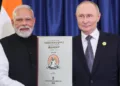
In three days, the Prime Minister held fifteen bilateral meetings. He welcomed Vladimir Putin with the kind of ease you would expect from a relationship built over many years. He also gave him a Russian edition of the Thirukkural, an old Tamil work on ethics and rule of life. The meeting felt like a mix of pride in culture and careful personal outreach.
Later, he hosted Xi Jinping. This was Xi’s first trip to India in seven years. It was also the third year in a row that the two leaders met. During their talks, they repeated that disagreements should not turn into open fights. They also said that calm must continue along the Line of Actual Control.
Modi and Xi then said they could help in the Russia-Ukraine conflict. The offer was taken up publicly by the Kremlin. Pause on the enormity of that image. The Prime Minister of Bharat, alongside the President of China, positioning themselves as potential peacemakers in Europe’s largest war, a war the transatlantic alliance has failed to end. This is not a nation seeking permission to matter. This is a nation whose counsel is now sought in the settlement of conflicts far from its shores. And yet India conceded nothing of its clear-eyed realism. New Delhi is not pretending that Chinese expansion is gone. It is also not saying the border issue is solved.
India keeps talking to Beijing because talks work only when power is real. This is how a strong country deals with a hard neighbour. It does not rely on staying away. It does not give in either.
Indian leaders call this competitive coexistence. Both sides understand the point. India speaks with China while its position is getting stronger.
Deterring the Hegemon Without Declaring War on Anyone
The genius of India’s presidency lay in how it handled the elephant not in the room, Washington. President Trump has branded BRICS “anti-American” and threatened hundred-per-cent tariffs should the bloc dare touch the dollar’s primacy. The lazy response would have been either to cower or to escalate. Bharat did neither.
The New Delhi Declaration condemned “unilateral coercive measures” and secondary sanctions “contrary to international law.” It voiced serious concern over unilateral tariffs and non-tariff barriers that violate WTO principles. It demanded restoration of a functioning WTO dispute-settlement mechanism. When Xi took his veiled dig at American adventurism in West Asia, the sentiment sat comfortably within a text India had shaped. This is hegemonic deterrence executed with surgical precision, i.e. a collective Global South refusal to accept economic coercion as the normal grammar of international relations.
Yet India was equally firm that BRICS “is not a bloc against anyone.” New Delhi explicitly rejected the fantasy of a single BRICS currency replacing the dollar, choosing instead the pragmatic path, local-currency trade, interoperable payment systems, the BRICS Cross-Border Payments Initiative. This is the mark of a mature power, meaning, it reduces the dependence that makes coercion possible without picking a fight it need not pick. Bharat is not trying to divest anyone. It is simply building a world where no one can hold a gun to the Global South’s economy and call it diplomacy.
Technology Sovereignty: The atmanirbhar advantage goes global
If there was one theme that announced Bharat’s confidence most vividly, it was technology. India did not arrive at New Delhi with a solicitory posture for foreign expertise. It arrived with thirty-seven indigenous deep-tech innovations on display at the Bharat Innovates exposition, AI-enabled cervical cancer screening, maternal and foetal health monitoring, satellite infrastructure, robotics, advanced materials, and, most tellingly, a home-grown 64-qubit quantum processor alongside an eight-qubit educational system.
At the Business Forum, the Prime Minister reminded the world that India’s Unified Payments Interface now handles roughly half of all real-time digital payments on the planet. Read that again: a technology conceived, built and scaled in Bharat is now the beating heart of the world’s digital-payments revolution, and India is offering it as a Digital Public Infrastructure template to the entire Global South. Where once developing nations were told to import their futures from the West, Bharat now exports the architecture of financial inclusion itself.
This is Atmanirbhar Bharat operating at civilisational scale.
At New Delhi, India said that AI, quantum, semiconductors, cyberspace, and biotechnology are not just chances to gain an advantage. They are the areas where the next set of rules will be shaped. India also made a clear point that the Global South should be part of the talks where these rules are made, not left to hear decisions after they are finalized.
The Prime Minister added a firm note on the weaponisation of critical minerals. He argued that control over resources is tied to national security. In his view, no country should be made to depend on supply chains it cannot control.
Pyramid to Platform: The doctrine, stated plainly
The intellectual heart of the summit was PM Modi’s own formulation, and it deserves to enter the permanent lexicon of Indian strategic thought. The Global South, he observed, “stands in the front row of global crises but in the back row of decision-making.” His answer was a ten-point roadmap to transform the “pyramid of privilege” into a “platform of partnership,” organised around three pillars, representation, responsiveness, and rule-making.
His demand that UN Security Council reform “can no longer be postponed,” tied to a definite timeframe, is the assertion of a nation that knows the institutions of 1945 cannot govern the realities of 2026. That China and Russia, permanent members both, reiterated their support for India’s and Brazil’s aspirations to a greater UNSC role is not merely a footnote, but a confidence marker on the road to New Delhi’s rightful place at the high table.
And in the phrase destined to be quoted for years, the call for the Global South to move “from rule-taker to rule-shaper”, India offered not resentment but leadership, i.e. to train young diplomats of developing nations in negotiation, law and craft. His proposal for a Seafarers’ Emergency Support Network, born of the attacks on merchant shipping in the Strait of Hormuz, revealed a leader thinking not in abstractions but in the concrete welfare of the humblest workers who keep global trade alive.
The civilisational confidence
Underneath the geopolitics ran a current unmistakably Bharatiya. The Prime Minister spoke of development and environment as complementary because, in Indian civilisation, “nature is revered as a mother.” The summit’s all-vegetarian banquet, its BRICS Bazaar of handlooms and crafts, the Thirukkural in Putin’s hands, none of this was ornamental. It was the assertion of a nation that no longer seeks Western validation for its identity, that offers its dharmic inheritance not as museum-piece but as living guidance for a fractured world. PM Modi’s closing benediction, “may our diversity be our identity, our cooperation our inspiration, and our progress serve all of humanity”, could serve as the motto of an Indian century.
The New Delhi Moment
The economist Jeffrey Sachs said it plainly during the summit: at some point this century, India will be the world’s largest economy, and the centre of gravity of the global economy has returned to Asia, where it resided for two millennia before its brief nineteenth-century departure. The 18th BRICS Summit was the diplomatic expression of that economic destiny.
Bharat did not merely host a summit. It authored a consensus where division was expected, bent adversaries toward dialogue, hardened the world’s stance against terror financing, defended the Global South against economic coercion, showcased indigenous technology as a gift to the world, and reframed the entire architecture of global governance in the language of partnership. It did all this while conceding nothing of its strategic autonomy and everything to its civilisational confidence.
The road to Viksit Bharat 2047 runs through moments like these, moments when the world discovers that the future is not something that happens to Bharat, but something Bharat has resolved to shape. New Delhi, September 2026, was such a moment. The pyramid is cracking. The platform is being built. And the hand laying its foundation is unmistakably ours.