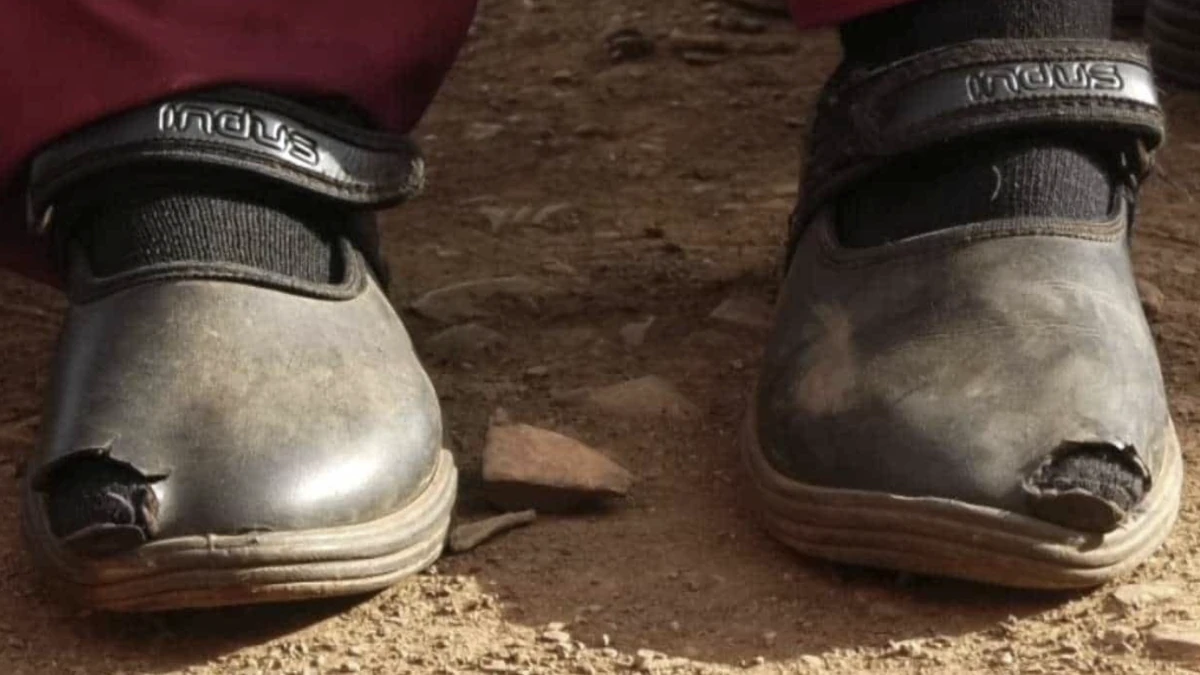
DHARWAD: Allegations of irregularities in the Karnataka government’s scheme to provide free shoes and socks to students in government schools have raised questions about supply quality and this year’s procurement process.
The controversy came to light after several students reportedly found that the shoes supplied to them developed serious defects within days of being worn. In one reported instance, shoes allegedly began tearing within just three days. The issue gained wider attention after reports highlighted the poor quality of the footwear supplied under the government programme.
Following the media reports, the Lokayukta took suo motu cognisance of the matter. Upalokayukta Justice K. Phaneendra has now directed that a case be registered, raising expectations among parents that those responsible for supplying substandard footwear could face action.
The scheme provides one pair of shoes and two pairs of socks every year to students studying in government schools. In previous years, schools largely handled procurement. Headmasters and School Development and Monitoring Committee members purchased footwear for students, allowing schools to select suppliers based on their requirements.
However, the government changed the procurement mechanism this year. Citing delays in completing purchases at the school level, the authorities opted for a centralised procurement system and invited a statewide tender. The state-level tender selected a contractor to supply shoes and socks to government schools across Karnataka.
While the move was intended to ensure timely procurement and uniformity, complaints about the shoes’ quality have raised questions about whether adequate quality-control mechanisms were followed before the products were distributed to students.
Another concern is the timing of the distribution. According to the reports, students received the footwear nearly three months after schools had reopened. By the time the shoes reached students, a substantial part of the academic year had already passed.
The reported defects have further complicated the situation because complaints have emerged from multiple districts rather than being restricted to a single school or locality. This has raised concerns about whether the supplier caused the problem or whether the footwear’s quality was adequately checked before statewide distribution.
The Lokayukta’s intervention has been welcomed by parents and others demanding accountability. They said public money is being spent on welfare schemes meant to benefit children from economically weaker sections, and such programmes should not be vulnerable to poor-quality procurement.
However, the decision to initiate action against education officials at the district and taluk levels has raised concerns within the department. Officials have reportedly questioned why District Deputy Directors of Public Instruction (DDPIs) and Block Education Officers (BEOs) should face proceedings when they had no role in selecting the contractor or purchasing the footwear.
Under the new system, the state conducted the procurement. The selected agency was responsible for supplying the shoes to schools, while local education authorities and school staff were primarily involved in receiving and distributing the material.
Officials therefore argue that fixing responsibility solely on district-level education officers may not address the actual source of the alleged irregularities. They have sought clarity on the responsibility of the agency that won the statewide tender, as well as those involved in evaluating the bids, approving the products and monitoring their quality.
The controversy has also raised practical concerns about replacing the defective footwear. If poor-quality shoes had been identified in only one or two schools, replacing them might have been relatively straightforward. But complaints from several districts could make a statewide replacement exercise more complicated.
Since the original distribution itself was delayed by several months, parents fear that replacing the footwear could take considerable time. Without an immediate solution, students may have to keep using defective shoes or buy their own footwear.
The issue has consequently developed into a larger question about the effectiveness of centralised government procurement. While centralisation can reduce delays and ensure standardisation, officials must also ensure strict inspection, quality certification and accountability at every stage of the procurement chain.
Parents and education activists have urged the Lokayukta to identify those responsible for the alleged lapses, rather than allowing accountability to stop at the district level. They have demanded a detailed examination of the tender process, the supplier’s credentials, quality-testing records, inspection procedures and payments made for the footwear.