
The Chhattisgarh High Court has ruled that the Idara-E-Shariya Islami Court has no legal authority to declare a person divorced or determine their marital status. The case concerned a Muslim woman who was purportedly declared divorced by Triple Talaq through a January 18, 2022 communication issued by the Shariya body.
The High Court held that the private religious institution cannot function as a court under the Constitution or Indian law.
High Court rejects Shariya Court’s legal authority
The judgment was delivered by Justice Amitendra Kishore Prasad on September 7, 2026, in a writ petition filed by Nirosh Abbasi, a 38-year-old woman from Raipur.
Abbasi had challenged the January 18, 2022 order issued by the Idara-E-Shariya Islami Court, which purported to declare that she had been divorced through Triple Talaq. She also challenged the authority of the institution to function as a court and determine her marital status.
The court record states that Abbasi had earlier complained against her husband and in-laws. The One Stop Sakhi Centre had initiated counselling, but the process failed. An FIR was subsequently registered at Mahila Thana, Raipur, under Sections 498-A and 34 of the Indian Penal Code.
The judgment records that notices purporting to effect Triple Talaq under Shariyat Law had already been served on Abbasi. Despite the registration of the FIR and proceedings before the competent authorities, the Idara-E-Shariya Islami Court issued its January 18, 2022 communication. Abbasi received the communication on January 21, 2022.
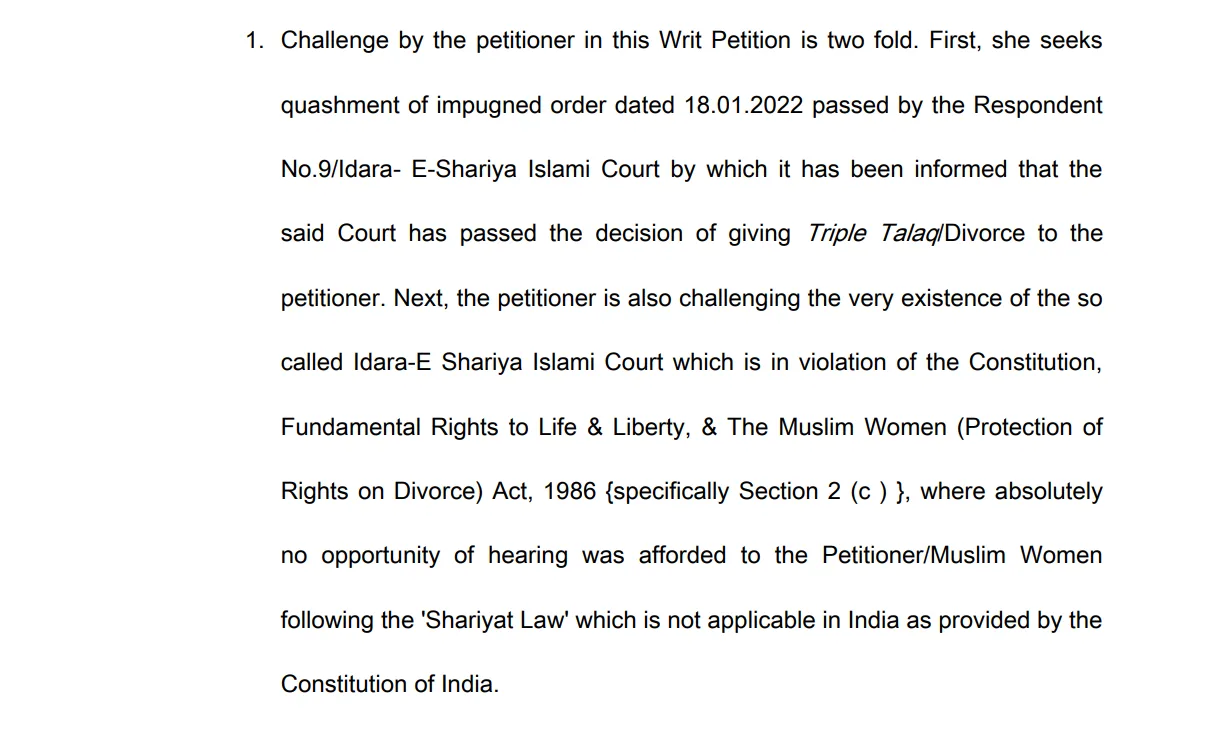
The High Court identified the central question as whether the institution, despite calling itself the “Idara-E-Shariya Islami Court”, had the legal authority to determine Abbasi’s marital status and legal rights.
The court gave a clear answer: “The answer to the aforesaid question is no.”
Triple Talaq at the centre of the original dispute
The judgment makes clear that Triple Talaq, or Talaq-e-Biddat, was part of the original dispute.
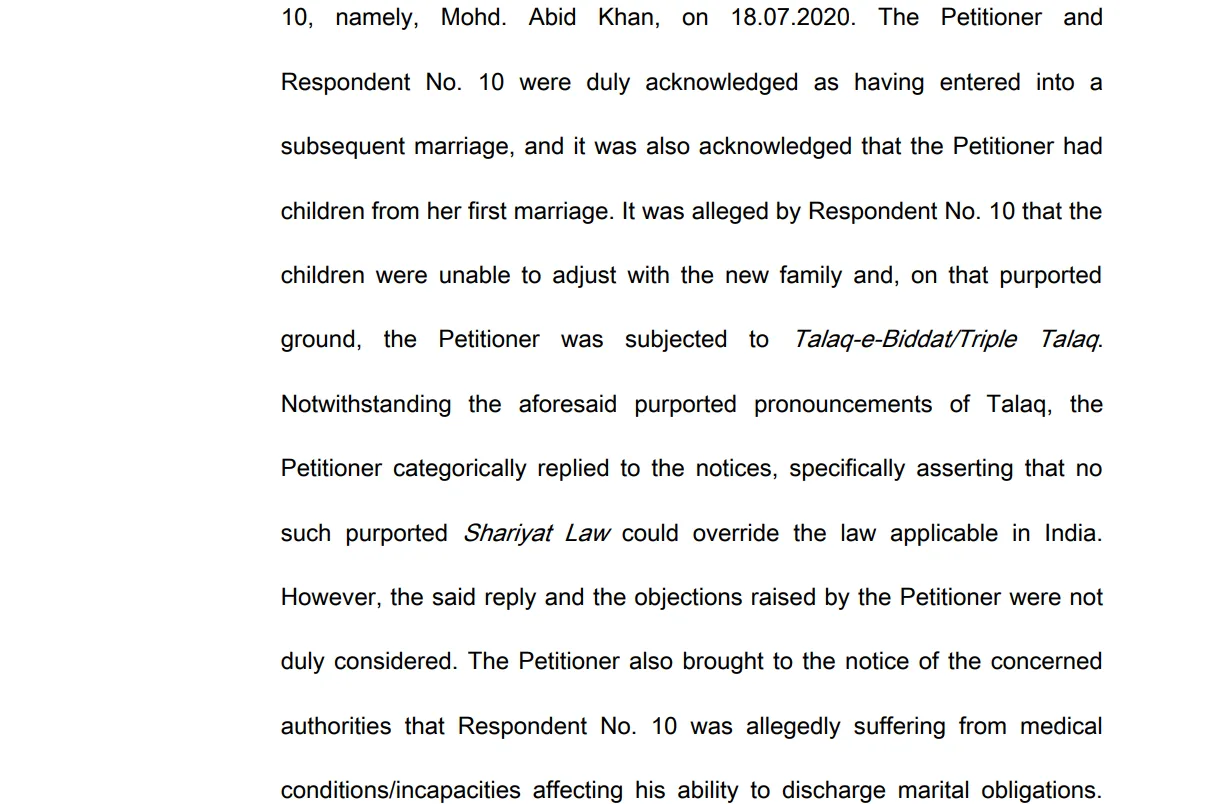
According to the case record, Abbasi had been subjected to purported pronouncements of Talaq-e-Biddat/Triple Talaq. The record says she responded to the notices and maintained that Shariyat Law could not override the law applicable in India.
The court also recorded that the complaint and FIR specifically mentioned that notices purporting to effect Triple Talaq had been served on her.
It was against this background that the Idara-E-Shariya Islami Court subsequently issued its January 18, 2022 communication purporting to declare her divorced by Triple Talaq.
The High Court, however, did not treat the Shariya body’s communication as a legally binding divorce decree.
Shariya body cannot function as a court
The High Court held that the Idara-E-Shariya Islami Court cannot be recognised as a court constituted under the Constitution or any statute.
It held that the institution had no jurisdiction to adjudicate the marital status of Abbasi or pass an order determining whether she stood divorced from her husband.
The court said the January 18, 2022 document was, at most, a communication or religious opinion issued by a private body.
It did not amount to a judicial decree dissolving the marriage.
The judgment specifically states that the communication “does not constitute a decree or judicial determination of dissolution of marriage.” It further says that the document “neither creates, extinguishes nor alters any legally enforceable right or status” of the woman.
This was the central legal finding of the judgment.
The issue before the High Court was therefore not simply whether a religious institution could give an opinion on religious matters. The question was whether such an institution could give that opinion the force of a court order and use it to determine the legal status of a citizen.
The court held that it could not.
Husband’s separate claim of Talaq-e-Hasan
The judgment also records a separate claim made by the woman’s husband, Mohd. Abid Khan.
During the proceedings, Khan’s counsel submitted that, because of domestic discord and irreconcilable differences, he had pronounced Talaq-e-Hasan in three phases through communications dated August 31, September 30 and October 30, 2021.
His counsel argued that these pronouncements were made under what he claimed were his personal rights under Muslim Personal Law.
The husband’s position was also that the Idara-E-Shariya Islami Court itself had no statutory or judicial status and could not determine the civil or legal rights of the parties. According to his submission, the January 18, 2022 document merely communicated the alleged execution of Talaq and should not itself be treated as a judicial determination.
This distinction between Triple Talaq/Talaq-e-Biddat and Talaq-e-Hasan is important to understanding the judgment.
The January 18, 2022 communication challenged by Abbasi purported to declare her divorced by Triple Talaq. Separately, the husband relied on three communications through which he claimed to have pronounced Talaq-e-Hasan.
The High Court dealt with the legal authority of the Shariya institution but deliberately did not decide the larger constitutional question surrounding Talaq-e-Hasan.
High Court leaves Talaq-e-Hasan validity open
The court expressly clarified that its ruling was confined to the competence and legal effect of the January 18, 2022 communication issued by the Idara-E-Shariya Islami Court.
It said it was “not called upon” in the proceedings to decide the larger constitutional validity of Talaq-e-Hasan.
The judgment records that the husband had relied upon alleged pronouncements of Talaq-e-Hasan made on August 31, September 30 and October 30, 2021.
The court further noted that constitutional and legal questions concerning unilateral Talaq-e-Hasan were already the subject of proceedings before the Supreme Court.
The High Court therefore consciously left that issue open.
This means the judgment does not declare Talaq-e-Hasan unconstitutional. The High Court has only ruled on the separate question of whether the Idara-E-Shariya Islami Court could exercise judicial authority and give legal effect to its own declaration.
Supreme Court’s Vishwa Lochan Madan judgment cited
The High Court relied on the Supreme Court’s 2014 judgment in Vishwa Lochan Madan v. Union of India while examining the legal status of religious bodies such as Dar-ul-Qaza and the legal effect of fatwas.
The Supreme Court had held that adjudicatory power must come from a validly enacted law. A Dar-ul-Qaza is not created or sanctioned by legislation and therefore its opinions or fatwas do not amount to adjudication by an authority forming part of India’s recognised judicial system.
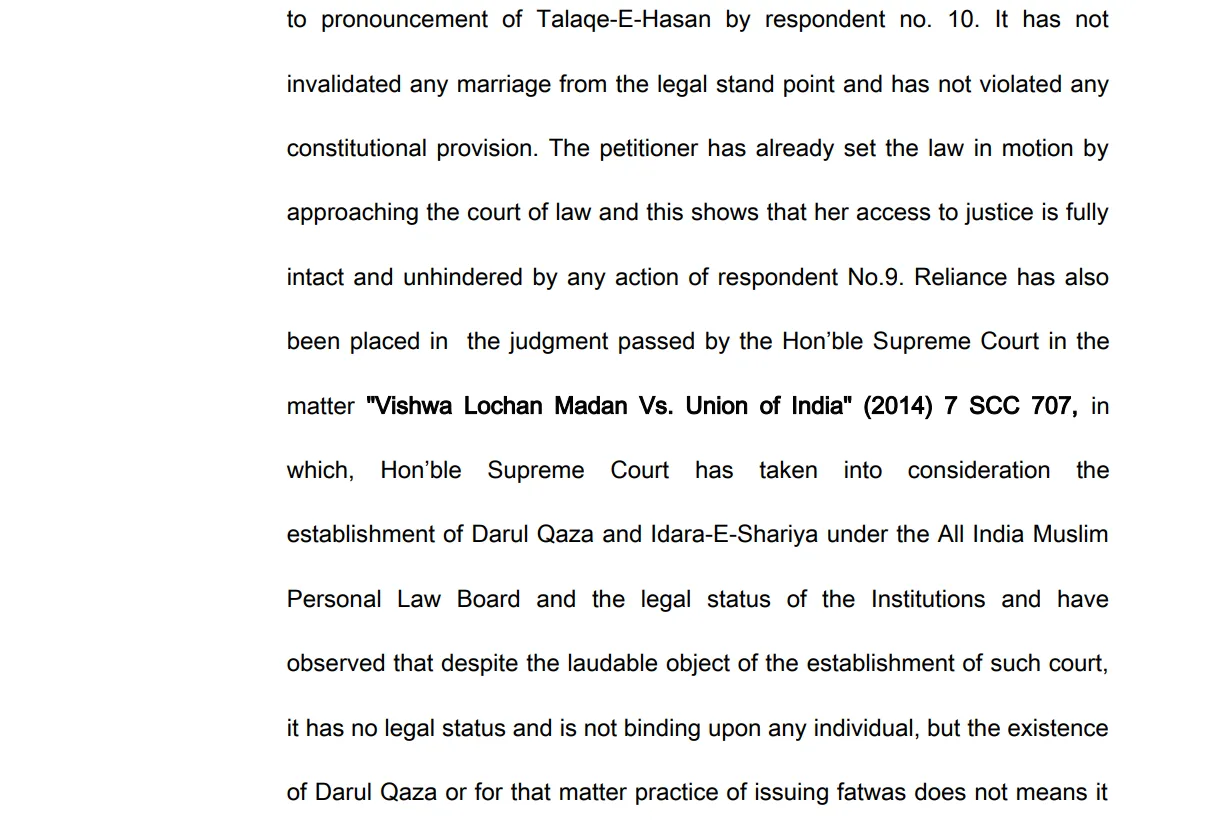
The High Court noted the Supreme Court’s position that a fatwa is an opinion and not a decree. Such an opinion is not binding on a court, the State or an individual and cannot be enforced through coercive legal processes.
At the same time, the Supreme Court had not declared the mere existence of Dar-ul-Qaza or the practice of issuing fatwas illegal. Such bodies could continue to function as informal systems for amicable settlement, but their decisions would not have the force of law.
The Chhattisgarh High Court applied these principles to the Idara-E-Shariya Islami Court.
State says India cannot have a parallel religious judicial system
During the proceedings, the Chhattisgarh government argued that the constitutional and legal framework of India does not recognise a parallel judicial system based on religion.
The State submitted that institutions calling themselves “Sharia Courts”, “Darul Qaza” or “Courts of Kazi” have no statutory recognition or judicial authority to decide civil and matrimonial disputes.
According to the State, any decision, settlement or decree issued by such an extra-judicial forum has no binding legal force and cannot be executed through State machinery.
The State said such institutions could at most function as informal mediation or conciliation forums, with recommendations that remain non-binding. It also submitted that an informal body cannot assume the powers of a statutory court or issue coercive orders against an unwilling person.
The State further alleged that the Idara-E-Shariya Islami Court had projected itself as a court by using the word “Court” in its name, displaying an emblem containing a balance, recording statements, taking evidence and describing its final outcome as a “judgement”.
The High Court ultimately accepted the core legal argument that the institution could not assume the powers of a court recognised under Indian law.
Shariya body said it was only a religious and advisory institution
The Idara-E-Shariya Islami Court itself took a different position before the High Court.
According to its submission, it was a religious and advisory institution and did not exercise judicial or statutory powers. It denied running a parallel judicial system or claiming legal status as a court.
It said it functioned in a religious and conciliatory capacity and provided opinions or documentation based on religious understanding.
Regarding the January 18, 2022 communication, the institution said it was only a religious declaration recording the pronouncement of divorce by Talaq-e-Hasan by the husband and was not a legal instrument.
It maintained that it had not legally invalidated the marriage and had only given a religious finding based on the Quran and Shariya.
The High Court, however, held that whatever the institution’s description of itself, it could not exercise the legal authority of a court.
Supreme Court precedent does not give Shariya body judicial power
The High Court also made it clear that the pendency of proceedings concerning Talaq-e-Hasan before the Supreme Court does not give a private religious body any additional legal jurisdiction.
The court said that a purported decision of a private religious body cannot substitute for adjudication by a court established under law.
In other words, the question of whether a particular form of divorce is legally valid is different from the question of whether a private institution has the authority to make a legally binding determination about it.
The High Court answered the latter question firmly: the Idara-E-Shariya Islami Court does not have such authority.
January 18 order declared without legal authority
In its operative directions, the High Court allowed the writ petition in part.
It declared that the January 18, 2022 order or communication issued by the Idara-E-Shariya Islami Court, to the extent that it purported to determine or declare Abbasi’s marital status or dissolve her marriage, was “without legal authority.”
The court further held that the communication was incapable of conferring or altering any legal right, status or obligation of the parties.
It also ruled that the Idara-E-Shariya Islami Court had no jurisdiction to function as a court constituted under the Constitution or any law enacted by a competent legislature.
Any opinion, verdict or decision issued by the institution cannot be enforced through coercive process or treated as a binding adjudication of the civil or matrimonial rights of the parties.
Religious opinion cannot replace a court
The judgment draws a clear distinction between religious belief and legal authority.
The court did not say that individuals cannot seek religious advice or guidance. Its ruling was that such advice cannot be converted into a legally enforceable judicial order by a private institution.
The High Court concluded that religion may guide an individual’s conscience and personal faith, but a religious institution or private body cannot assume the authority of a court established under law.
The court said that religious belief cannot be used as a means of determining or enforcing the legal status and rights of an individual.
It concluded with a clear constitutional principle: “The rule of law and the constitutional framework remain paramount.”