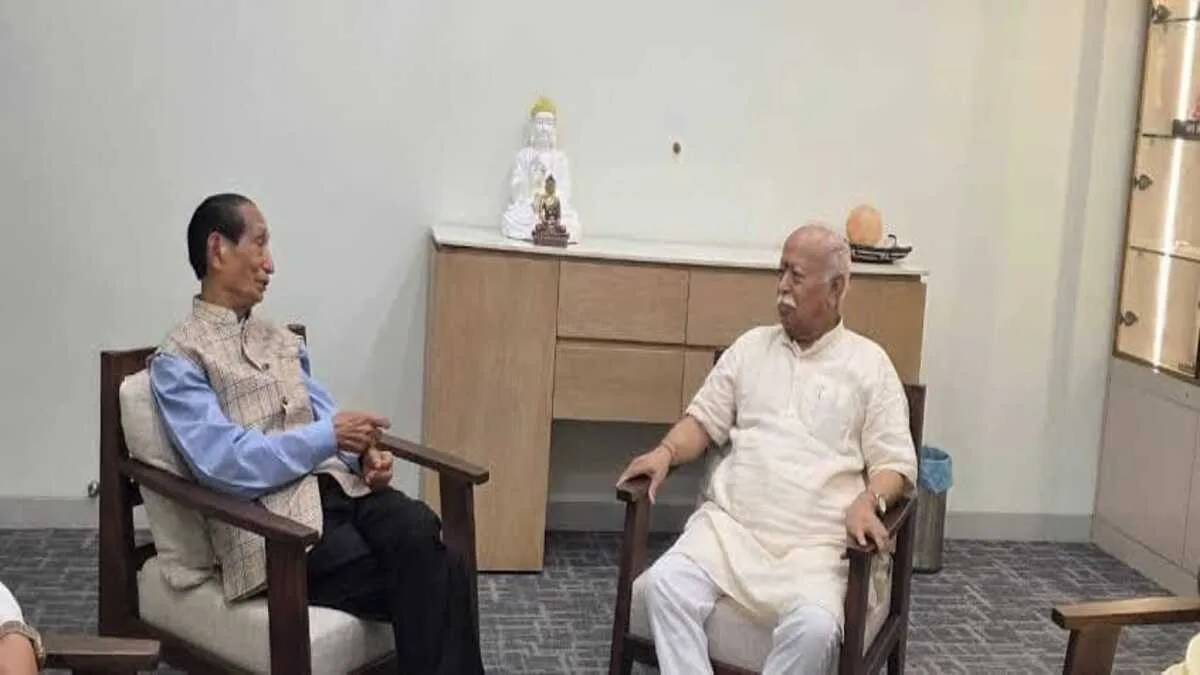
NEW DELHI: Emphasising that India’s enduring strength rests on its unique framework of “unity in diversity,” Dr SC Jamir highlighted the need to embrace the nation’s diverse regional, religious, and cultural identities without imposing uniformity. Welcoming Dr. Mohan Bhagwat’s public statements abroad championing secularism and diversity as the core strength of the Indian Union, Jamir urged the RSS leadership to actively promote this inclusive vision nationwide. Framed around mutual respect and peaceful coexistence, Jamir’s dialogue with Bhagwat serves as a call for national integration that protects minority rights, honours Nagaland’s distinct constitutional protections, and pressures the Central Government to bring a swift, decisive end to the long-pending Naga political issue.
A Crucial Dialogue: Bridging Misconceptions Between Mainland India and the Northeast
Addressing members of the press following his meeting with Dr Mohan Bhagwat, veteran politician and former Governor Dr. S. C. Jamir outlined the key motivations behind his initiative to meet the leadership of the RSS.
Dr. Jamir emphasised that his approach was guided purely by his commitment to the Naga people and God, transcending partisan lines. Accompanied by Nagaland Pradesh Congress Committee (NPCC) Working President C. Apok Jamir and administrative representatives, Jamir clarified that engaging with different political and ideological groups—whether the RSS, BJP, or left-leaning organisations—is essential to build a national consensus on the Naga issue.
“I am a free, independent man. My obligation is towards the Naga people and God. Unless we explain the Naga issue to all sections of the people, it will not be complete.” — Dr. S. C. Jamir
Redefining ‘Indianness’: Unity Through Pluralism, Not Uniformity
At the heart of Dr. Jamir’s presentation to the RSS leadership was a philosophical and constitutional discourse on what constitutes true Indian identity. Rejecting rigid notions of conformism—such as enforcing a single language, uniform attire, or a single faith—Jamir asserted that India’s civilizational genius lies in its historical capacity to synthesize diverse cultures, customs, and philosophies into a single, cohesive identity.
The Essence of Oneness: True national integration cannot be achieved through coercive uniformity (“one stick to beat everybody”), but through a voluntary “oneness” where every regional identity feels safe and respected.
Survival of Humanity & Civilization: Humanity thrives when communities are permitted to live according to their distinct heritage; imposing cultural homogeneity poses a existential threat to the secular framework of the Indian Republic.
Historical Synthesis: From ancient times through successive historical epochs, India’s greatest moments emerged when vast regional diversities were united under a single, overarching national vision.
Secularism as the Naga Ideal & Protection under Article 371A
Dr. Jamir drew attention to the Naga understanding of secularism, defining it as the pinnacle of unity in diversity where diverse religious and cultural groups live together in harmony. He cited Nagaland’s social fabric as a living model of interfaith harmony, where citizens across Christian, Hindu, and Muslim communities enthusiastically celebrate each other’s religious festivals, such as Durga Puja and Christmas.
Addressing constitutional provisions, Dr. Jamir clarified the intent behind Article 371A of the Constitution of India, which safeguards Naga customary laws, social norms, and religious practices:
Christian Identity in Nagaland: Nagaland is a predominantly Christian state. Protection of religious practices under Article 371A explicitly encompasses Christian traditions, just as converted Hindu communities across India retain full constitutional rights.
Protection of Minorities: Being a Christian or belonging to a religious minority does not diminish one’s patriotism or citizenship. Christians across the country must be protected against persecution to safeguard India’s national integrity.
Integration of the Northeast: Highlighting the historical isolation of parts of the Northeast during British rule as “excluded areas,” Jamir noted that Nagas officially joined the Indian nation with the creation of Nagaland State on December 1, 1963. Having embraced equal partnership in building modern India, the region must not face discrimination or social alienation.
Commending Dr Mohan Bhagwat’s Stand on Inclusive Values
During the discussion, Dr Jamir commended RSS sarsanghchalak Dr Mohan Bhagwat for his public statements made during international visits to the United States and Canada, where Bhagwat affirmed that secularism and “unity in diversity” form the backbone of India’s global success story.
Jamir urged the RSS Sarsanghchalak to disseminate these positive messages of inclusivity directly to the cadre within India. He noted that any attempt to transform India into a theocratic state would undermine national unity, emphasizing that appreciating the constructive contributions of minority communities—including Christian institutions in education and healthcare—strengthens the nation as a whole.
The Naga Political Crisis: Proliferation of Factions & Collapse of Governance
Shifting to the ground reality in Nagaland, Dr. Jamir presented a stark assessment of the decades-long political stalemate. While acknowledging historical milestones such as the 16-Point Agreement of 1960, the Framework Agreement of 2015, and the Agreed Position of 2017, Jamir expressed deep concern over the protracted delay in finalizing a political solution.
Historical Phase: Single Negotiation (NNC)
└── Ceasefires & Extended Talks (20+ Years)
├── Proliferation into ~37 Parallel Factions
├── Widespread Extortion & Multiple Extra-Constitutional Authorities
└── Evolving Public Frustration & Youth Unrest
Factional Proliferation: What was once a single movement under the Naga National Council (NNC) has fractured into over 30 parallel factions, creating multiple extra-constitutional authorities operating on extortion and parallel directives.
Impact on Governance: The prevalence of parallel structures has compromised local state administration and market stability, particularly in commercial hubs like Dimapur.
Pressing Societal Concerns: Youth Frustration and the FCRA Amendment
During the interactive Q&A session with journalists, Dr. Jamir addressed key social issues currently affecting the Northeast:
Rising Youth Restlessness: Reacting to emerging youth-led movements such as “Fed Up Naga,” Jamir warned that rising unemployment, insecurity, and lack of socio-economic opportunities are driving the younger generation to desperation. He urged the state government to address these grievances constructively.
Opposition to FCRA Amendments: Expressing concern over the Foreign Contribution (Regulation) Amendment Bill, Dr. Jamir voiced opposition to policies that restrict legitimate international assistance for non-profit education and healthcare facilities. He suggested that state assemblies in the Northeast consider passing formal resolutions against measures that disrupt essential social welfare services.
Dr SC Jamir’s dialogue with Dr Mohan Bhagwat underscores the necessity of inclusive political dialogue in resolving complex historical disputes. By reaffirming that Nagaland’s unique cultural and religious character is fully compatible with Indian national identity, Jamir’s message highlights secularism, mutual respect, and constitutional safeguards as the path forward for regional peace and national unity.