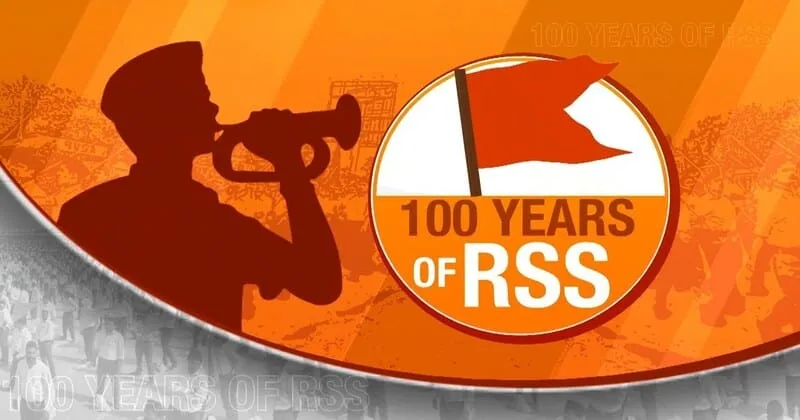
How the RSS built power upstream from Indian politics. Three days before Mohan Bhagwat appeared in New York, the Commission on International Religious Freedom asked the government to revoke his visa. Bhagwat is the head of the Rashtriya Swayamsevak Sangh, or RSS, a century-old Hindu organisation that supplied much of the ideological formation of India’s ruling Bharatiya Janata Party. USCIRF accused members of the broader RSS ecosystem of violence against religious minorities and urged sanctions against RSS members and Indian officials. New York Mayor Zohran Mamdani condemned the organization’s worldview as exclusionary. The Commission’s rebukes are complicated by its controversial reputation: it lacks any enforcement mechanism, has faced accusations of sympathy toward Islamists, and frequently includes evangelical Christians on its board—allowing the RSS to frame the criticism as a politically motivated attack.
Bhagwat arrived at Madison Square Garden and gave his critics an inconvenient speech. He told Indian Americans that America was now their karmabhumi—the country in which they lived and worked—and that they owed it their loyalty. At a separate faith-leaders conference, he was asked about Muslims in India. “If any Hindu thinks that there should be no Muslims in Bharat,” he replied, “he will not remain Hindu.” Different religious paths, he argued, were compatible with a common humanity and with the civilisation the RSS calls Hindu.
There are two ways to process this contradiction. The first is to decide that Bhagwat has exposed the hysterical ignorance of the RSS’s critics. The second is to assume that he was moderating his rhetoric for an American audience. Both explanations may contain glimpses of what the RSS actually is.
The RSS has become one of the most consequential political organisations in the world, but it does not fit easily into the buzzwords used about it. It is not a political party, although it helped produce the politicians who run India. It is not a church, although its account of India depends on Hinduism, which can both be a religion and a way of life. It is not a conventional militia, although drills, uniforms and physical discipline have been part of its organisational culture. It runs schools, relief efforts and civic programs, but calling it a charity would be absurd. It has an ideology, but its most important achievement is organisational rather than ideological.
For people who prefer easy labels, the RSS is either a fascist paramilitary group or a harmless service organisation unfairly maligned by people who dislike assertive Hindus. An institution capable of surviving for a century and helping transform the politics of 1.4 billion people deserves a better description.
The Grammar of Discipline
The RSS was founded in Nagpur in 1925 by Keshav Baliram Hedgewar, a physician and nationalist activist preoccupied with a problem that afflicted many Hindu intellectuals of his generation. India possessed an enormous civilizational inheritance, but Hindus did not behave as a coherent political unit. They were divided by caste, region, language, sect and local custom. Hedgewar’s answer was not a political manifesto, but organisation.
This is why photographs of RSS men in khaki shorts are simultaneously revealing and misleading. The uniform, drills and rows of marching men make the European comparison almost irresistible, particularly to an American audience taught to associate uniforms with fascism. But drill and uniforms belonged to a much wider world in colonial India. Scout organisations, physical-culture associations, akharas, service organisations, police units and nationalist volunteer groups all borrowed from a common vocabulary of discipline, exercise, character formation and public service. Carey Watt’s history of Indian voluntary organisations finds martial drill across groups whose principal purposes were civic and social rather than military.
None of this requires pretending that the RSS was the YMCA version of Hinduism. Hedgewar wanted a disciplined Hindu organisation because he believed political weakness followed social disunity. The shakha—the neighbourhood gathering that became the basic RSS unit—combined physical exercise, games, drill, discussion, ideological instruction and civic responsibility.
Walter Andersen and Shridhar Damle, whose work remains among the best organisational studies of the RSS, describe daily meetings as the heart of the system. Volunteers arrive, participate in training, and some lead small groups. A smaller number still become pracharaks, full-time workers who can be sent elsewhere to organise, teach and connect the movement’s institutions. Most people who attend a shakha never become full-time cadres. The organisation is simultaneously a social environment, a screening mechanism and a leadership pipeline.
The phrase Sangh Parivar—the family of the Sangh—describes the network that grew around the RSS. It is not a holding company with obedient subsidiaries, as some journalists like to describe it. The ABVP organises students; the Bharatiya Mazdoor Sangh, workers; Vidya Bharati, schools; Seva Bharati, welfare projects; the Vishwa Hindu Parishad, religious leaders and campaigns; and the BJP, elections. Personnel and ideas move among them, but their priorities can diverge. Division of labour is a better term to describe this system, rather than a military command structure.
A conventional political party functions by contesting an election, announcing a candidate or trying to pass legislation. The RSS works farther upstream. It creates habits, relationships, vocabulary and personnel that can later flow into other institutions. A swayamsevak might spend his life inside the organisation, move into an affiliated body, enter the BJP or simply carry its vision of nationhood into his profession and community. Its political influence is therefore not always an order issued from the top. Its influence is carried by its people.
American commentators mash four distinct mindsets together—Hinduism, Hindutva, the RSS, and the BJP—as if they were a monolith, and then act surprised when their predictions misfire. Hinduism is the oldest and least tidy of them. It has no pope, no universal baptism, no membership roll and no singular heretical test. A Hindu community may form around a deity, temple, teacher, philosophical school, or inherited family custom. Americans who apply concepts learned from Protestant Christianity—what is their scripture, what must the believer affirm, who has authority to define doctrine?—find it all confusing. The questions do not map neatly on the subject.
This does not mean Hinduism is a mere grab-bag of unrelated traditions that the British simply dumped into a single category. Indian thinkers were grouping, comparing, and even attempting to unify what we now call Hindu philosophical traditions long before the British Raj. Colonial administrators and nineteenth-century reformers systematised these pre-existing intellectual currents, consolidating them into the modern framework of Hinduism. The British did not invent Hinduism from nothing. Nor did they discover it fully formed. Hindu unity, therefore, has a history.
Hindutva is something else. It is a modern political language of Hindu peoplehood, national culture and civilisation. Vinayak Damodar Savarkar, who gave the term its most famous twentieth-century formulation, explicitly distinguished Hindutva from Hinduism. His definition was not just religious; it concerned territory, ancestry, culture and political belonging. It was also more exclusionary than the broader language Bhagwat now prefers. Savarkar’s fatherland-and-holy-land formulation placed Muslims and Christians in a different relationship to the Hindu nation because their sacred geographies extended beyond India.
One can debate how much contemporary RSS thinking should be read through Savarkar, but one cannot simply wave away that genealogy. Nor can every expression of Hindu nationalism be reduced to Savarkarism. Vanya Vaidehi Bhargav’s work on Lala Lajpat Rai demonstrates that early Hindu nationalist thinking contained competing answers to the problem of Indian nationhood. At different points, Rai imagined Hindu consolidation as compatible with a larger Indian nation containing Muslims and Christians as distinct communities. Long before it was codified in any manifesto, Hindu nationalism was a contested vision of nationhood.
Hindu nationalism and communalism are capable of reinforcing one another, but they are not synonyms. Hindu nationalism imagines a political community organised around Hindu culture and history. Communalism organises politics through antagonism between religious communities—a logic that applies as readily to Muslim nationalism in Pakistan as it does to Hindu majoritarianism in India. A Hindu nationalist can become violently communal. A Hindu political organisation can exploit anti-Muslim sentiment. None of that means hostility to Muslims supplies the complete definition of Hindu nationalism.
The RSS is the organisation that attempted to turn one of these ideas into social practice. It has doctrine and intellectual lineage, but it is above all a machinery of formation: shakhas, camps, pracharaks, ceremonies and relationships. The organisation matters because it can reproduce an interpretation of India through people rather than merely publish it in books.
Then there is the BJP. The BJP fights elections, distributes tickets, assembles coalitions, raises money, governs states, manages parliamentary factions and confronts all the compromises that accompany democratic power. Prime Minister Narendra Modi spent his early political life as an RSS pracharak, as did many BJP leaders, and the party’s relationship with the wider Sangh is obvious. The older BJP depended much more heavily on RSS workers for ground organisation. Under Modi and Amit Shah, the BJP built its own grassroots infrastructure: membership drives, booth committees, district offices, training systems, archives and local leadership structures. The BJP is no longer as dependent on Nagpur to send volunteers every five years.
No longer conjoined twins, the relationship is now more of an alliance. There are bargains and leadership clashes, but command-and-control does not overlap. The 1980s are when this split appeared organically. The BJP emerged in 1980 from the Jana Sangh wing of the collapsed Janata Party, initially selling itself as a moderate outfit of “Gandhian socialism” and “positive secularism.” It won two of 542 parliamentary seats in 1984. Meanwhile, the VHP—created in 1964 with RSS backing to organise Hindu religious authorities—was building a mass campaign around a disputed site at Ayodhya, long believed by Hindus to be the birthplace of Rama, the legendary king from the Indian epic the Ramayana.
The 1984 loss forced a reckoning. The BJP dropped its secular camouflage and adopted Deendayal Upadhyaya’s Integral Humanism, rejecting Western capitalism and Soviet socialism in favour of a more self-conscious Indian worldview. It elevated L. K. Advani to party president, and at Palampur in 1989 formally endorsed the Ram temple construction. RSS cadres provided the grassroots muscle; the VHP supplied religious fervour; the BJP translated it into votes. The party jumped from two seats to eighty-five in five years. Ayodhya wasn’t the only factor—Congress’s collapse, opposition realignments, and Rajiv Gandhi’s corruption scandals all contributed—but it proved that the Sangh Parivar was better at grassroots politics than most Indian parties: it mobilised a national movement through a decentralised network that needed no central command.
Is that a semantic distinction? Perhaps. For those opposed to the RSS project, there is no difference. Did the RSS authorise that BJP minister’s remark? Did the BJP direct that RSS affiliate’s campaign? If a man with a saffron flag commits a crime, which organisation is responsible? The fact remains that the catch-all phrase “Hindu nationalist” falls short of answering these questions.
The question of violence deserves its own examination. The evidence is grave enough to rule out both collective guilt and institutional denial. For now, a simpler distinction will suffice. An organisation should be judged not only by what it formally orders but by what it encourages, protects, and tolerates.
The Civilisational Embrace
Bhagwat’s speeches in New York should be viewed from a more intellectually honest lens. When he calls India a Hindu civilisation while insisting that Muslims belong within it, he is not using Hindu as a denominational label. He is making a civilizational claim: Indian national culture emerged in a landscape overwhelmingly shaped by traditions now called Hindu. Citizenship and religion need not be uniform.
The obvious objection: Why should a Muslim accept someone else’s religious vocabulary as the name for the civilisation to which he belongs? Civilizational inclusion can feel generous to the group doing the including and absorption to the group being included. Sikh organisations have made similar objections when RSS-associated bodies have treated Sikh traditions as part of a wider Hindu civilizational family. These centuries-long tensions are also present among Buddhists and tribal traditions. An embrace can be perceived as a claim of ownership.
It is reductive to frame the debate solely around whether Bhagwat secretly wishes to expel Muslims from India. His public position is more complex—and for that reason, more politically consequential. He wants Muslims inside a national civilisation whose historical grammar he calls Hindu. A serious critic would interrogate that vision, not invent a caricature to knock down.
The organisational genius of the RSS is that it does not rely on rote adherence to this theory of civilisation. It builds relationships. Its affiliates operate schools, health services, relief work, unions, student organisations, and other institutions. Research on Sangh service organisations found that sustained education and health programs could build goodwill among poorer communities that had not historically supported the BJP. The mechanism was not mysterious. People notice organisations that appear and stay even beyond election season. Electoral gains following social service do not prove ideological conversion. A poor voter may appreciate a clinic run by a Sangh affiliate and remain indifferent to any intellectual theory of Hindu civilisation. The RSS does not need converts; it needs familiarity. That is its political capital.
This is why describing the RSS as merely an ideological extremist organisation misses the mark. Ideology is not irrelevant—the organisation plainly seeks to reshape how Indians imagine their nation. But its enduring strength lies in embedding that ideology in social habits: meetings, service, festivals, relationships, and career trajectories.
The Test of State Power
If the RSS were simply a fringe militia, the political problem would be comparatively easy. States know what to do with illegal armed organisations. If it were simply a cultural club, its political importance would be exaggerated. The RSS is harder to evaluate because it has filled the gaps between civic institutions and political power. Its influence can be direct, affiliated, personal, ideological or simply imitative.
Success, then, isn’t without cost. Defenders are correct to insist that a century of civic work cannot be reduced to the rogue crimes of saffron-waving nationalists. But the movement cannot have it both ways. If it is merely a cultural organisation, why do its alumni occupy the commanding heights of the Indian state? And if its civilizational umbrella is universal, why is rejecting its grammar frequently condemned as ‘anti-national’?
The RSS defenders are also right that the terms fascist and paramilitary are often used in American debate as cheap substitutes for understanding non-western political systems. But defenders of the RSS answer with a fiction of their own: the idea that the movement is only a voluntary body whose proximity to state power is somehow accidental. There is nothing accidental about it. The RSS was created to reshape Hindu society. It trained people to carry a conception of national life into public institutions. Its cadres helped build a political family that eventually produced the dominant party in India. Modi’s biography is not an embarrassing coincidence for the RSS to ignore; it is the culmination of the project set in motion in 1925 by Hedgewar. The next question then is: what restraints accompany that success?
Bhagwat’s statement about Muslims matters because leaders’ words are evidence of what an institution wishes to say about itself. They should not be read as absolution for every local transgression by every Sangh affiliate. But neither should critics seal their interpretation so tightly that the organisation’s own leader could never say anything to challenge it.
The RSS increasingly invites us to apply a better standard. If Hindu civilisation is truly as capacious as Bhagwat insists, then institutions shaped by his movement should be able to serve Indians who reject that civilizational framework entirely. A Muslim should not have to affect cultural Hinduness to claim equal citizenship. A secular Indian should not have to venerate the RSS to expect neutral treatment from an official formed in its ethos. An organisation confident that it represents Indian civilisation should be able to tolerate citizens who think it represents nothing of the sort.
That test lies ahead. The RSS’s historic achievement is now settled: it has mastered the art of self-reproduction.
Indian politics has never had a shortage of charismatic leaders, ideologies, crowds or angry men willing to exploit what is wrong with the country. What is scarce is an organisation that can recruit a teenager, train him, embed him in a network and sustain that network for decades. Independent India, meanwhile, solved the puzzle of how to win elections. Its answer was the charismatic leader, street factionalism, and the caste-broker. This formula delivered governments, but it could never build institutions with a shelf-life longer than the men running them. The RSS learned to subordinate personality to organisational unity. What happens when an organisation built on that ruthless logic inherits a state built on brokerage and personal loyalty—and whether it can escape the dysfunction it was built to exploit—is the question that animates Part II.