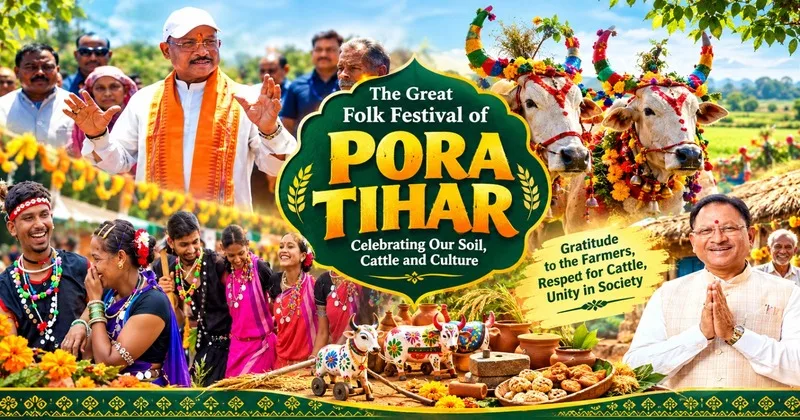
RAIPUR: The sacred soil, folk culture and agriculture-based lifestyle of Chhattisgarh’s most vibrant and deeply cherished grand festival, ‘Pora Tihar’ (Pola festival), is being celebrated across the state today with unprecedented joy, enthusiasm and traditional devotion. During the months of Sawan and Bhadon, when paddy crops sway across the fields and the arduous work of biyasi and weeding has been completed, the farmer of Chhattisgarh breathes a sigh of relief. He expresses his happiness and hope for a successful harvest by showing gratitude towards cattle.
In fact, since early this morning, an extraordinary and enchanting scene has been witnessed across the rural and urban areas of the state. The melodies of Chhattisgarhi folk songs are echoing from homes, the aroma of traditional delicacies is wafting from kitchens, and the laughter of children in the markets is adding to the festive atmosphere. On this sacred occasion of Pora Tihar, Chhattisgarh Chief Minister Vishnu Deo Sai has extended greetings and best wishes to all residents of the state, especially farmer brothers and mothers and sisters. In his special official message, the Chief Minister highlighted Chhattisgarh’s folk culture and said, “The happiness of Chhattisgarh lies in the happiness of our farmer brothers and sisters. Pora Tihar is a sacred festival celebrating the hard work of our food-growers, their affection for livestock and the values rooted in the soil of Chhattisgarh. Our government is working with complete commitment for the prosperity of farmer families and the advancement of agriculture. On this sacred occasion, we wish that every farmer’s home remains filled with happiness, prosperity and well-being. Many, many greetings and heartfelt best wishes to you all on Pora Tihar.”
हमारे किसान भाई-बहनों की खुशियों में ही छत्तीसगढ़ की खुशियां बसती हैं।
पोरा तिहार हमारे अन्नदाताओं की मेहनत, पशुधन के प्रति उनके स्नेह और छत्तीसगढ़ की माटी से जुड़े संस्कारों का पावन पर्व है। किसान परिवारों की खुशहाली और खेती-किसानी की समृद्धि के लिए हमारी सरकार पूरी प्रतिबद्धता… pic.twitter.com/4IxyXDmz3X
— Vishnu Deo Sai (@vishnudsai) September 10, 2026
Pora Tihar is the greatest celebration of our state’s agricultural culture, our profound faith in cattle and a way of life rooted in the soil. This festival reminds us that the bulls and livestock that toil in the fields to produce food are not merely animals, but an important part of our families. Our government is fully committed to preserving Chhattisgarh’s ancient folk traditions, festivals and cultural heritage and passing them on to the next generation. Chief Minister Sai further said that when children play with clay bulls and utensils on this day, they unknowingly become connected with their soil and its concerns. In this age of modernity, holding on to one’s roots is Chhattisgarh’s true strength.
State Agriculture and Animal Husbandry Minister Ramvichar Netam extended greetings to the farmers of the state on this folk festival and highlighted the importance of livestock. In his official statement, he said that even in this era of mechanisation, the importance of bulls in rural life and the agricultural system has not diminished by even a fraction. Pora Tihar conveys an excellent message of animal protection and development to society. Through the Gauthans, our government is continuously undertaking major initiatives on the ground for the protection and development of livestock and the promotion of organic farming. Today is a day of self-respect and pride for every farmer.
He said that this festival is a living expression of the centuries-old affectionate relationship between farmers, agriculture and bulls, as well as of labour and gratitude. It is a special festival to express respect and gratitude towards the bulls that work shoulder to shoulder with farmers in producing food in the fields. This festival brings alive the hard work of our food-growers, their affection for livestock and the rich heritage of Chhattisgarhi values. On this sacred occasion, we wish that every farmer’s home remains filled with happiness, prosperity and well-being and that the land of the state always remains abundant in grain and wealth.
आज #नवा_रायपुर स्थित आवासीय परिसर में धर्मपत्नी श्रीमती पुष्पा नेताम जी के साथ #छत्तीसगढ़ के पारंपरिक पोरा तिहार के पावन अवसर पर महादेव के परम भक्त नंदी महाराज की विधिवत पूजा-अर्चना की और प्रदेशवासियों के सुख, शांति, समृद्धि एवं मंगलमय जीवन की कामना की। इस अवसर पर प्रसाद स्वरूप… pic.twitter.com/4w2rPnoDVZ
— Ramvichar Netam (@ramvicharnetam) September 10, 2026
State Culture and Folk Art Minister Rajesh Agrawal, highlighting Chhattisgarhi self-respect, said that the festivals of Chhattisgarh are no longer confined to the lanes of villages; rather, through the special efforts of our government, they are being given a new grandeur and wider recognition as state-level celebrations. Through the Teeja-Pora Mahotsav, the art, traditional cuisine and folk forms of our soil are receiving a new identity at national and international levels. This is a festival that brings pride to every Chhattisgarhi and places their cultural identity in the global spotlight.
Chhattisgarh Finance Minister OP Choudhary said, “Pora Tihar is an important festival associated with Chhattisgarh’s rich folk culture, agricultural traditions and rural life. This festival expresses respect and gratitude towards our soil, farming and livestock.” He said that the folk festivals of Chhattisgarh are a symbol of our cultural identity and pride. Through Pora Tihar, our traditions, folk beliefs and values are passed from one generation to another. The festival also conveys a message of strengthening mutual love, brotherhood and harmony in society.
माटी के मान, किसान के सम्मान अउ हमर छत्तीसगढ़ी संस्कृति के लोकपरब पोरा तिहार के जम्मो प्रदेशवासी मन ला गाड़ा-गाड़ा बधाई अउ शुभकामना।
भगवान करा अरजी हे कि हमर खेत-खार सदा दिन हरियर रहय, कोठार-कोठी अन्न के भंडार ले भरे रहय अउ हर किसान परिवार के जीयन मां सुख, समृद्धि अउ खुशहाली… pic.twitter.com/DuGhwYn6mK
— Rajesh Agrawal (@RajeshAgBJP) September 10, 2026
Unique and Enchanting Decoration of Bulls Begins in the Morning
Meanwhile, Vikesh Kumar Hichami, a social worker leading an organisation of the tribal community, said that this festival, celebrated on Amavasya of the Krishna Paksha of Bhadrapada, is essentially a day to express reverence towards the sons of the soil (farmers), speechless cattle and Mother Earth. It is a sacred moment when the hands that plough the fields and the soil that produces food celebrate together in harmony. From a religious perspective, this day is an expression of gratitude towards Nandi, the vehicle of Lord Shiva, and Goddess Lakshmi, the goddess of grain. On this day, bulls are decorated and their aarti is performed, demonstrating that in Sanatan and folk culture, animals are regarded not merely as property, but as a divine part of the family.
He said that, historically, the history of the Pola festival is linked to the agricultural traditions of the Indus Valley Civilisation, where evidence of the worship of humped bulls has been found. Its philosophical aspect is that human beings cannot survive alone in this creation. Silent animals and nature make an equal contribution to keeping us alive. From a scientific perspective, at this time the Kharif crops, particularly paddy, are in the pregnancy (gabhote) stage. Ploughing is stopped in the fields during this period so that the roots of the plants are not damaged. Bulls are given rest during this period, which is consistent with animal health science. Turmeric and oil are applied to the bodies of the bulls, protecting them from skin infections and parasites that occur during the rainy season.
According to a report from ground zero, preparations for Pora Tihar began on a war footing from the early hours of today. In the villages, farmers set out at dawn with their bulls and buffaloes towards nearby rivers, ponds and reservoirs, where the animals were lovingly bathed and cleaned in the cool water. After this, the bulls were traditionally decorated outside homes and Gauthans. Their horns were specially shaved and sharpened, and intricate designs in red, yellow, green and bright colours were applied to them. Garlands made of cowries, colourful beads and small bells (galeba) were tied around the bulls’ necks, so that when the bulls walked, the jingling of the bells made the entire atmosphere musical. Along with this, beautiful velvet coverings were placed over the bulls’ backs, while peacock feathers and decorative tassels adorned their foreheads. The sight made it appear as though Nandi Maharaj himself had descended upon the earth.
आज पोरा तिहार के पावन अवसर पर घर में पारंपरिक पूजा हुई, धर्मपत्नी ने हमारे छत्तीसगढ़ के पारंपरिक रीति-रिवाज एवं विधि-विधान से पूजा-अर्चना की।
यह पावन पर्व हमारी कृषि संस्कृति, परंपराओं और माटी से जुड़े संस्कारों का प्रतीक है। पोरा तिहार पर अन्नदाता किसानों एवं समस्त… pic.twitter.com/xaRfwj0fFk
— Arun Sao (@ArunSao3) September 10, 2026
Collective Worship in Gauthans and Exciting Bull-Racing Competitions
In the afternoon, public Gauthans and open grounds in rural areas across the state became the main centres of the celebrations, where all the farmers of the village gathered at a designated place with their decorated pairs of bulls. The village Baiga (chief traditional priest) conducted collective worship amid the chanting of mantras and the beat of drums. The bulls’ feet were washed, sandalwood and kumkum tilaks were applied to their foreheads, and a grand aarti was performed with incense and lamps. After the worship, the bulls were fed specially prepared ‘Kanha’ (a mixture of rice, pulses and medicinal herbs) so that they would remain healthy and energetic throughout the year. Following the collective worship, the biggest attraction was the exciting bull-racing competition, which drew crowds of thousands of villagers in the rural areas of Bilaspur, Durg, Bemetara and Rajim. Spectators applauded enthusiastically as the bulls raced at great speed and courageous farmers controlled them, while the winners were honoured with cash prizes and mementoes.
Clay Nandi Figures and ‘Janta-Pora’ Create a Stir in the Markets
The most beautiful and innocent aspect of Pora Tihar is the unique enthusiasm of children, due to which all small and large markets across the state witnessed huge crowds at potters’ stalls from the morning. Children arrived with their parents to buy colourful pairs of bulls made of clay, with wooden wheels fitted underneath. They pull these with ropes and race them through the lanes, shouting ‘Pora-Pora’ with joyous laughter. On the other hand, for young girls in the household, small clay toy utensils such as a janta (grinding mill), pora (pot), stove, frying pan and spoon were purchased. Girls use these utensils to play traditional games in which they symbolically cook food. Sociologists believe that this unique game teaches children from an early age, in a very natural manner, about their basic agricultural culture, respect for labour, kitchen management and the fundamental values of household life.
देशभर के सभी किसान भाई-बहनों एवं अन्नदाताओं को लोक पर्व पोला की हार्दिक बधाई एवं शुभकामनाएँ।
छत्तीसगढ़ में इसे “पोरा तिहार” के रूप में मनाया जाता है। यह पर्व किसान और बैलों के प्रति सम्मान एवं कृतज्ञता का प्रतीक है।
ईश्वर से कामना है कि सभी किसानों के जीवन में सुख, समृद्धि एवं… pic.twitter.com/IS4zD3R9zQ
— Roopkumari Choudhary (@RoopkumariBJP) September 10, 2026
The Earthy Aroma of Thethri-Khurmi in the Kitchen and Social Harmony
On the occasion of Pora Tihar, every household in Chhattisgarh is filled with unique flavours, sweetness and an earthy aroma, for which Chhattisgarhi homemakers had been preparing in their kitchens several days in advance. On this day, a very crispy and savoury dish called ‘Thethri’, prepared especially by mixing gram flour, carom seeds, salt and moyan, was made. It is shaped by hand into an eight (8) or circular form. Alongside this, an extremely crisp and sweet delicacy called ‘Khurmi’, prepared from wheat flour, semolina, coconut, ghee and jaggery syrup, was also made. Apart from these traditional dishes, offerings of ‘Cheela’ and ‘Fara’, prepared from rice flour, were first made to God and the cattle, after which family members consumed them. This festival is a major example of social harmony, where people forget distinctions of high and low and caste differences, visit one another’s homes, distribute Thethri-Khurmi and embrace each other while offering ‘Many, many greetings on Pora Tihar’.
Welcoming the Teeja Festival and Daughters Returning to Their Maternal Homes
According to Chhattisgarh’s ancient folk tradition, the Pola festival is not merely a farmers’ festival, but is also a sacred day celebrating immense respect for daughters and their arrival at their maternal homes. On this day, married sisters and daughters of the state return to their maternal homes from their in-laws’ houses. Their brothers or fathers specifically go to their in-laws’ homes to bring them back, a practice locally known as ‘Teeja bringing home’. After reaching their maternal homes, all mothers and sisters will begin preparations from tomorrow for the arduous 24-hour waterless fast of the grand Teeja Tihar festival of marital prosperity (14 September). On the day of Teeja, women observe a difficult 24-hour fast without consuming food or water for the long life and happiness and prosperity of their husbands. They make sand idols of Lord Shiva and Goddess Parvati and remain awake throughout the night, worshipping them with devotion.
छत्तीसगढ़ की समृद्ध लोकपरंपरा और किसान संस्कृति से जुड़े पावन पर्व “पोरा तिहार” की सभी प्रदेशवासियों, विशेषकर अन्नदाताओं को हार्दिक बधाई एवं शुभकामनाएं।
यह पर्व हमारे पशुधन के प्रति सम्मान, कृतज्ञता और खेती-किसानी में उनके अमूल्य योगदान को स्मरण करने का अवसर है। pic.twitter.com/v4JvtUMraf
— Dr Raman Singh (@drramansingh) September 10, 2026
‘Pora’ Conveys a Message of Connection with the Soil
It is noteworthy that at a time when, in the blind race towards modernity, human beings are increasingly moving away from their folk traditions, forests and nature, Chhattisgarh’s Pora Tihar gives a powerful message to return to our roots. This festival teaches us that even after reaching the heights of development and travelling to the moon and stars, we must never forget to express gratitude to the soil, the food-grower and the silent animals upon whose strength human civilisation rests.
Even after the arrival of tractors and modern machinery, this traditional spirit of worshipping bulls proves how deeply rooted the feeling of gratitude is in Chhattisgarh’s culture. It should remain the collective responsibility of both the government and society in the future to ensure that the radiance of this priceless cultural heritage never fades in the maze of modernity and that it is preserved for the generations to come.