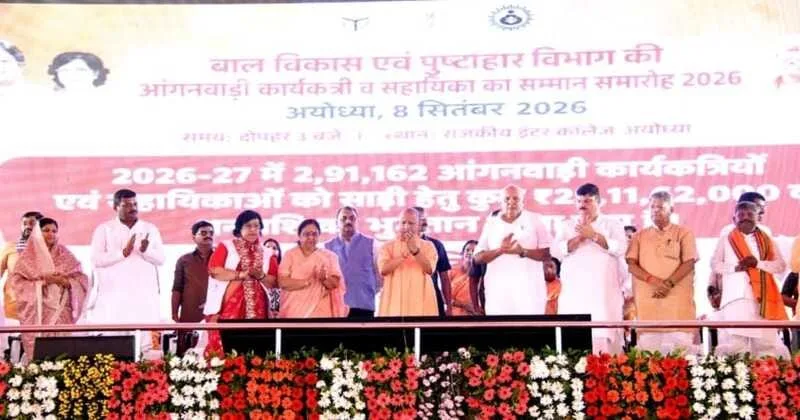
LUCKNOW: For the women who run Uttar Pradesh Anganwadi centres, the working day begins before the first child walks in. They weigh infants, track pregnancies, distribute supplementary nutrition, maintain registers, follow up on immunisation and also teach pre-school lessons. For a long time, the compensation attached to these Karyakartri has moved in a modest and slow way.
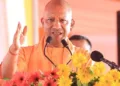
That is what the state government has now moved to change. Speaking at a programme in Ayodhya, Chief Minister Yogi Adityanath announced that the monthly honorarium of Anganwadi workers will be raised to Rs 12,000, while helpers will receive Rs 6,000 a month.
The Chief Minister said the decision was in line with the vision of Prime Minister Narendra Modi and that four categories of benefits were being extended to Anganwadi workers and helpers across the state.
From Rs 3,000 to Rs 12,000, honorarium to the worker
The revision is best understood against where the honorarium stood earlier. Anganwadi workers in Uttar Pradesh were once paid Rs 3,000 a month. The figure was raised to Rs 8,000 during the present government tenure. With the latest announcement, it moves to Rs 12,000 per month. Helpers, who have assisted with cooking, cleaning and supervising children at the centres, were earlier paid Rs 1,500 a month. Their honorarium was subsequently revised to Rs 4,000 and will now be increased to Rs 6,000. It’s a four-fold rise for workers and a four-fold rise for helpers over the period, though the increases came in stages rather than at once.
For a workforce made up almost entirely of women, many of them from lower-income rural households, an increase of this size changes the monthly household calculation directly. The honorarium is not a salary in the formal sense, since Anganwadi workers are classified as honorary workers under the Integrated Child Development Services scheme. But for a large number of families, it is a dependable and often primary source of income and one of the few earnings that reaches a woman’s own hands each month.
Cashless treatment up to Rs 5 lakh
The second major component of the announcement relates to health. The Chief Minister said that every Anganwadi worker and helper in the state will be entitled to cashless medical treatment worth Rs 5 lakh each year. The facility will be available at empanelled hospitals, government hospitals and medical colleges. He clarified that this is not a one-time arrangement but an annual entitlement.
The significance of this provision lies in what it replaces. Anganwadi workers are not government employees in the conventional sense and therefore fall outside most departmental medical reimbursement systems. A serious illness in the family has often meant either borrowing money at high interest or postponing treatment until the situation worsens.
A cashless cover removes the requirement of paying upfront and waiting for reimbursement later, which is usually the point at which such schemes stop working for low-income households. The money never has to be arranged in the first place.
Extending the cover to helpers as well is worth noting. Assistants are the lowest-paid category within the Anganwadi system and the least likely to have any other form of health protection, whether through an employer, a pension scheme or private insurance.
More than 70,000 centres restructured
Beyond individual entitlements, the Chief Minister pointed to changes in the physical infrastructure of the Anganwadi network itself. He said that over the past nine years, more than 70,000 Anganwadi centres in the state have been given a systematic and organised form. The department has also been directed to ensure that every Anganwadi centre eventually has a building of its own.
A significant number of Anganwadi centres across the country function from rented rooms, panchayat buildings, verandahs or shared spaces inside primary schools. Where a centre has no fixed premises, everything else becomes harder. Nutrition supplies cannot be stored safely, hygiene is difficult to maintain, pre-school activity has no dedicated space, and attendance drops through the monsoon and the peak summer months.
Providing dedicated buildings is therefore less about construction figures and more about making the centre a fixed, recognisable place in the village where one of the parents can rely on every day, and children associate with routine.
Education schemes as the wider backdrop
The Chief Minister placed the announcement within the state’s broader work in school education. He named Operation Kayakalp, the Nipun Bharat Abhiyan, Project Alankar, PM SHRI schools and the Mukhyamantri Model Composite Vidyalaya, saying these had become models in the education sector. This link between these programmes and Anganwadi centres is not incidental.
Operation Kayakalp focused on basic facilities in government primary schools, covering drinking water, toilets, classrooms, furniture and boundary walls. Nipun Bharat concentrates on foundational literacy and numeracy, the skills children are expected to acquire in the earliest school years. Project Alankar and the composite school model extend infrastructure work to upper primary and secondary levels, while PM SHRI schools are meant to function as demonstration institutions.
Under the National Education Policy 2020, the Anganwadi centre is treated as the first stage of the schooling system rather than a separate welfare service. Children between three and six years are to receive structured early childhood care and education there before entering Class 1.
That shift places the Anganwadi worker in the role of a teacher, in addition to the existing responsibilities in nutrition and health monitoring. Seen from that angle, raising honorarium, extending health cover and building permanent centres belong to the same effort as improving primary schools.
Where Uttar Pradesh now stands
Uttar Pradesh operates as one of the largest Anganwadi networks in the country. The system covers child nutrition, immunisation support, growth monitoring, antenatal and postnatal follow-up with pre-school education, and it depends almost entirely on local women who are known to the households they serve.
That familiarity is the network’s main strength. A worker who lives in the same village is far more likely to know which child has stopped attending, which mother has missed a check-up and which household needs supplementary nutrition most urgently. No survey or dashboard substitutes for that knowledge.
Honorarium levels have been a recurring demand from Anganwadi associations in several states, and the amounts vary widely across the country. In Kerala, for instance, workers and helpers draw monthly payments of Rs 12,000 and Rs 8,000 respectively, following revisions made in recent years. Uttar Pradesh’s revised figure for workers brings it into a comparable range, in a state with a far larger network to fund.
Retaining trained workers and keeping them motivated through the long hours and expanding paperwork the job now demands has been a persistent challenge nationally. Better compensation does not resolve every part of that problem, but it addresses the part workers have raised most consistently.
A workforce of women in Supporting Viksit Bharat
There is also an economic dimension that runs alongside the welfare one. Anganwadi work is one of the few forms of regular, locally available paid engagement for women in rural Uttar Pradesh. It does not require migration, it fits within the village, and it carries a degree of social standing because the worker is recognised as the person responsible for the community’s youngest children.
Raising what that work pays therefore sends a signal beyond the individual recipient. It affects how the role is viewed within the household and the villages, and it makes the position more attractive to educated young women in rural areas who might otherwise not consider it.
As with the welfare announcement, the outcome will depend on execution. The revised honorarium will need to reach workers on time each month, without the delays that often affect payments in large schemes. The cashless facility will require a straightforward enrolment and identification process, so that a worker admitted to an empanelled hospital is not turned away over documentation. The commitment to buildings will need sustained budgetary allocation across several years, since more than 70,000 centres cannot be housed in a single cycle.
Monitoring will matter as well. Whether the additional support translates into better attendance, improved nutrition indicators and stronger school readiness is something that will show up in data over time rather than in the announcement itself.
If those elements hold, the change will be felt where it matters most, in the small rooms across the state where children receive their first meal outside home and their first lesson before school. For now, the announcement gives Uttar Pradesh’s Anganwadi workers and helpers something they have sought for a long time: better pay for demanding work and a safety net of their own while they spend their days looking after everyone else’s children.