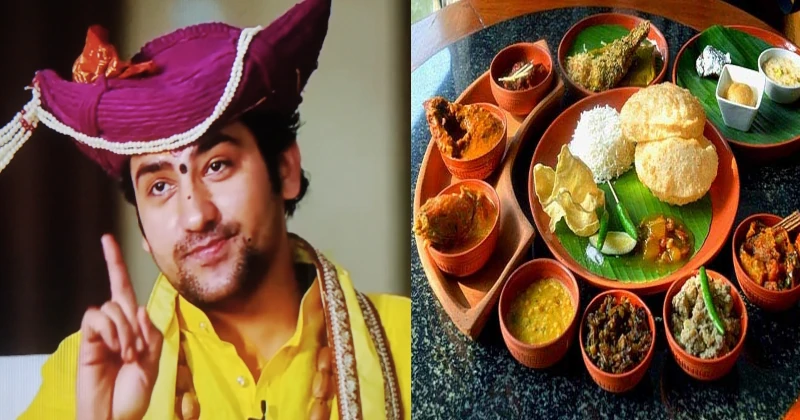
A fresh debate has emerged after a recent comment by Dhirendra Krishna Shastri on vegetarian and non-vegetarian food practices during Durga Puja. The controversy, however, raises a larger question: should an individual’s food preference become the measure of their adherence to Hindu Dharma?
From the perspective of Hindu tradition itself, the answer is clearly no. It is neither fair nor intellectually sound to label someone “anti-Hindu” merely because of their dietary practices. A single, uniform food code has never defined Hindu Dharma. Its vast scriptural and cultural traditions contain diverse practices concerning food, ritual and worship. For instance, the Shastric tradition references consuming non-vegetarian food on Navami. Therefore, reducing the question of Hindu identity to whether someone eats vegetarian or non-vegetarian food is a distortion of a far more complex civilisational tradition.
Swami Vivekananda’s writings are particularly instructive here. In his letter to Sarala Devi Chaudhurani, then editor of *Bharati*, dated 24 April 1897, Vivekananda addressed questions of food and religious practice in a manner that cautions against making dietary observance the primary measure of spiritual or civilisational identity. His larger vision of Hinduism was expansive, rooted in strength, character, spirituality and the freedom to approach Dharma through diverse paths.
Yet another side of the present controversy deserves equal scrutiny. If one disagrees with a particular statement made by a Hindu religious figure, disagreement is legitimate. But to use one individual’s comment as an opportunity to attack Hindu Dharma itself is intellectually dishonest. Hindu Dharma is unique among the world’s major religious traditions precisely because it has never insisted upon one prophet, one scripture, one theological formulation or one compulsory mode of worship.
Its civilisational character is plural by nature. The Hindu tradition accommodates Shaiva, Vaishnava, Shakta, Smarta and numerous other streams. It contains traditions of asceticism as well as household life, ritualism as well as philosophical inquiry, vegetarian practices as well as traditions in which animal sacrifice has existed. This diversity is not a weakness to be explained away; it is one of the defining features of the Hindu civilisational experience.
What kind of religion is this that declares, “Ekam Sat Viprā Bahudhā Vadanti”; Truth is One, though the wise speak of it in many ways? Just think about the depth of diversity that this civilisation has carried across thousands of years. Countless traditions, sampradayas, philosophical schools, forms of worship, rituals, customs, languages, and regional practices exist. Yet, despite this extraordinary diversity, an underlying consciousness of unity remains.
That is why the Vedic tradition also gives us the profound call: “Saṅgacchadhvaṃ Saṃvadadhvaṃ Saṃ Vo Manāṃsi Jānatām”, let us move together, speak together and let our minds be united. This is the remarkable civilisational vision of Hindu Dharma: diversity need not mean division, and unity need not require uniformity.
Hindu Dharma never demanded that every individual must worship in the same manner, follow the same philosophical school or observe identical customs. Instead, it allowed different paths to coexist within a larger civilisational framework. This is why Hindu society can contain immense diversity and yet retain a sense of civilisational unity. The plurality of Hindu traditions is not a contradiction to Hindu unity; it is one of its greatest strengths. This is what we need to remember today: Hindu Dharma does not teach us to eliminate differences. It teaches us how to remain united despite them.
That is why the current debate also exposes a curious inconsistency. Some of those who are today presenting vegetarianism as an oppressive or exclusionary imposition have, at other times, themselves condemned the practice of animal sacrifice associated with certain Hindu traditions. If pluralism is the principle, it must apply consistently. One cannot demand tolerance when one’s preferred practice is being questioned and abandon that same principle when an unfamiliar Hindu practice is under discussion.
The real issue, therefore, is not whether one should eat vegetarian or non-vegetarian food. Nor should Hindu society be forced into a single dietary mould. Individuals and communities may follow their own traditions, convictions and practices, provided they do not turn those preferences into instruments for denigrating others.
What deserves criticism is not diversity within Hinduism, but the attempt to erase that diversity. Public discourse also needs greater intellectual honesty. A statement by an individual, whether a religious leader, intellectual or political figure, cannot automatically be equated with the entire Hindu tradition. Hindu Dharma cannot be judged by the most controversial sentence uttered by one of its representatives any more than any other vast civilisation can be understood through one isolated opinion.
The appropriate response to disagreement is therefore dialogue, not caricature. Hinduism does not need to prove its pluralism by denying the existence of any particular practice. Nor does it need to defend every statement made in its name. It does, however, require an honest understanding of its internal diversity.
The debate around food during Durga Puja should consequently become an opportunity to understand Hindu Dharma better, not to weaponise dietary preferences against Hindus, and certainly not to manufacture a simplistic binary between “liberal” and “orthodox” Hinduism.
The strength of the Hindu tradition lies precisely in its capacity to accommodate difference without losing its civilisational unity. That plurality deserves consistent defence, without selective outrage.