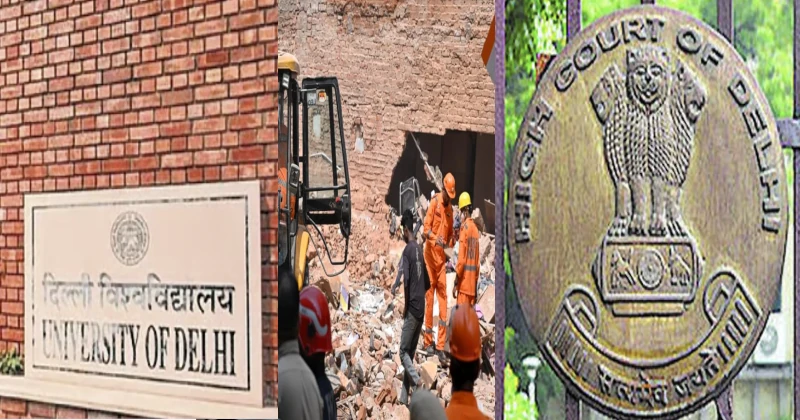
NEW DELHI: The Delhi High Court on September 9 issued notice to the Centre, Delhi Government and Delhi University on a Public Interest Litigation seeking a time-bound policy for providing adequate hostel accommodation across DU colleges, days after the devastating Satya Niketan building collapse claimed seven lives, including five students.
A Division Bench comprising Chief Justice Devendra Kumar Upadhyaya and Justice Tejas Karia sought responses from the authorities on the petition filed by National Students’ Union of India president Vinod Jakhar through advocate Vimal Tyagi. The Court questioned the impleadment of the University Grants Commission and directed its deletion from the array of parties, while observing that PIL jurisdiction was a “very serious business”. The matter will next be heard on September 25.
The petition seeks a comprehensive, college-wise assessment of existing hostel capacity and the residential needs of Delhi University students, followed by the formulation of a time-bound Hostel Development Policy or Master Plan to create safe and affordable institutional accommodation.
Where sufficient land is available within college campuses, the plea seeks to construct or expand hostels. For institutions facing genuine space constraints, it proposes common or “cluster hostels” on suitable Government or University land to serve students from neighbouring colleges.
The Satya Niketan tragedy has brought Delhi’s longstanding student-housing problem into sharp focus. On September 6, a five-storey building functioning as a boys’ paying-guest accommodation near Delhi University’s South Campus collapsed while repair work was underway. Seven persons were killed and several others injured.
The fresh PIL describes the collapse as a grave warning about the risks faced by thousands of students dependent on private PGs because their colleges lack adequate residential facilities.
Significantly, the petition points out that Delhi University, established in 1922, describes itself as a “unitary, teaching and residential University”. From merely 750 students at its inception, DU now has approximately 1.32 lakh students enrolled in regular programmes, while several colleges still operate without adequate hostel infrastructure.
The hostel issue comes alongside another PIL already before the High Court over the Satya Niketan collapse itself. During proceedings earlier this week, the same Bench termed the tragedy “most unfortunate” and questioned whether responsibility could be confined to the building owners alone. It also flagged the roles of the Municipal Corporation of Delhi and DU, noting that the shortage of institutional accommodation leaves outstation students dependent upon private PG establishments.
The Court has separately directed the MCD to examine at its highest executive level whether the collapsed structure had valid construction permission and, if violations are established, to identify officials responsible for regulatory lapses.
The two proceedings have consequently placed both dimensions of Delhi’s student-housing crisis before the judiciary: unsafe or poorly regulated private accommodation on one side, and the shortage of institutional hostels that pushes students towards such establishments on the other.
For parents who send their children from across Bharat to study in the national capital, accommodation cannot remain an afterthought. The Satya Niketan tragedy has now forced a larger question into the courtroom. Whether expanding educational opportunities must also carry an institutional responsibility to ensure students have a safe roof over their heads.
