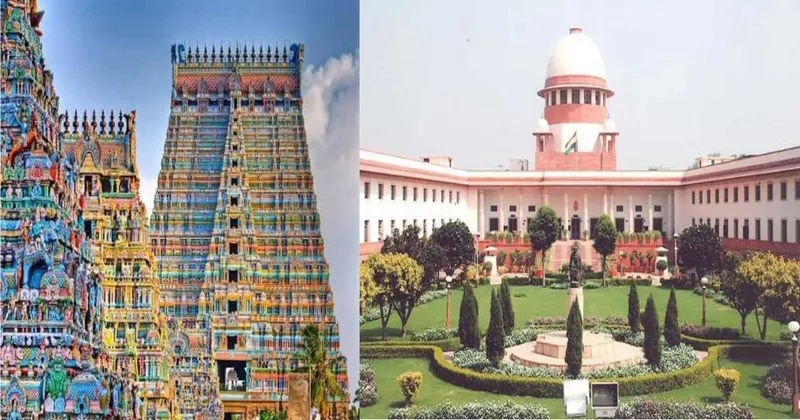
CHENNAI: The Supreme Court has declined to interfere with the Madras High Court judgment restoring the rights of Sri Annamalainathar Temple at Kadayanallur, Tenkasi, over 3.93 acres on which houses occupied predominantly by Muslim families, besides a mosque and an Arabic school, had subsequently come up.
A Bench of Justices Aravind Kumar and Vipul M Pancholi on September 7 refused to interfere with the High Court ruling. The principal challenge was Masjithut Thaqwa & Ors v. K.G. Krishnan & Ors., SLP(C) No.7703/2026, with S. Vaidyanathan v. K.G. Krishnan, SLP(C) No.7554/2026 connected to it.
The litigation reveals how temple property, once improperly alienated, passed through several hands and eventually became a residential settlement.
The disputed 3.93 acres formed part of the Annamalainathar Temple’s considerably larger holdings: 31.44 acres of Nanja and 94.11 acres of Punja land. In 1994, the Temple Administration Board permitted its sale with an upset price of Rs 3.10 lakh. At the auction held on June 19, 1995, R Subramanian, nephew of hereditary trustee V Subramaniya Iyer, emerged as the highest bidder for Rs 10.17 lakh.
But the Madras High Court found a fundamental breach of Section 34 of the Tamil Nadu Hindu Religious and Charitable Endowments Act. Objections from persons interested in the temple were required to be invited before sanctioning the alienation. Here, they were sought only after the auction. The Division Bench termed the violation fatal, stressing that the statutory safeguards exist precisely to prevent temple properties from being undervalued or improperly alienated.
The HR&CE Commissioner consequently cancelled the auction in 1997. A civil court subsequently declared the sale deeds null and void in 2001. Yet, in 2002, the Tamil Nadu Government issued an order reviving the transaction, culminating in another sale deed in 2004.
What followed radically altered the character of the land. Court records state that the property was sold to 13 persons, subdivided and thereafter transferred to more than 100 persons. Residential houses were constructed and Masjithut Thaqwa and an Arabic school run by the local Muslim Jamaat also came up on portions of the Temple property.
In its December 15, 2025 judgment, the Bench of Justices Anita Sumanth and N Senthilkumar found the auction tainted by “gross non-compliance” with statutory requirements and possible collusion involving the then trustee. Crucially, the Court held that “temple/deity interest would override private interest” and reminded authorities that courts act as guardians where temple properties are imperilled.
The Court was equally categorical that mere prolonged occupation could not confer title over temple land. It held that improperly acquired individual interests must yield where the protection of temple property is involved.
Proceedings under Section 78 were initiated against 83 unauthorised occupants. The High Court permitted eviction while giving occupants willing to remain an option to become lawful tenants of the Temple and pay fair rent. Eventually, 81 occupants sought tenancy. Thus, continued possession, where regularised, would be under the Temple rather than in derogation of its ownership.
The Supreme Court’s refusal to interfere now leaves that framework intact. The presence of houses, a mosque or an Arabic school after successive transfers could not cure the illegality at the root of the transaction. A Hindu temple’s property, the courts have made clear, cannot be permanently lost merely because an unlawful alienation is followed by years of occupation and construction.