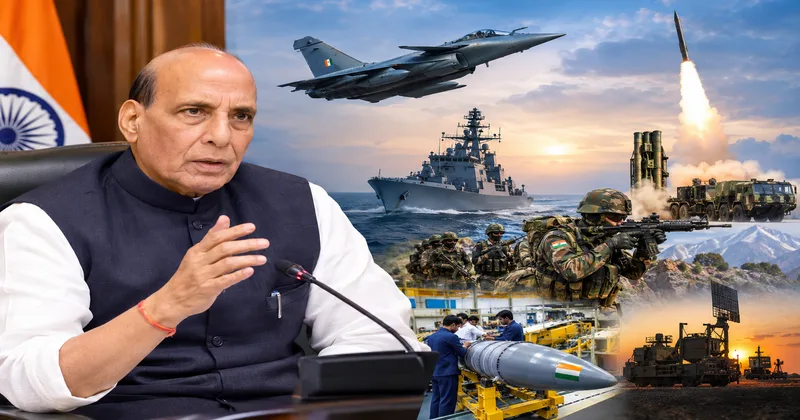
New Delhi: The Defence Acquisition Council (DAC), chaired by Defence Minister Rajnath Singh, on September 7, 2026, accorded Acceptance of Necessity (AoN)—the in-principle administrative approval—for a wide range of defence acquisition proposals. The aqcuistion worth approximately ₹1.10 lakh crore, marks a major push to strengthen the operational capabilities of the Indian Army, Navy and Air Force while deepening defence indigenisation and Atmanirbharata. The advanced military tech which is predominantly home-grown aids India to seek strategic salience against multifront threat.
Chaired the meeting of Defence Acquisition Council (DAC) today.
The DAC accorded Acceptance of Necessity (AoN) to various acquisition proposals of the Defence Forces at an estimated cost of about Rs 1,10,000 crore.Of the total AoNs accorded, approximately 98% of procurements…
— Rajnath Singh (@rajnathsingh) September 7, 2026
The approvals cover critical military platforms and systems ranging from CBRN reconnaissance vehicles, mine-laying systems and advanced light helicopters to naval radars, marine gas turbines, electronic warfare systems and secure-access technology. Significantly, the Defence Ministry said that the approximately 98 per cent of the total procurements will be sourced from Indian industry, underscoring the government’s emphasis on building domestic defence manufacturing ecosystem and reducing dependence on foreign suppliers.
Indian Army to receive mobility, reconnaissance and bridging capabilities
For the Indian Army, the DAC cleared procurement proposals for Chemical Biological Radiological and Nuclear (CBRN) Recce Vehicles, High Mobility Vehicles (HMVs), Self-Propelled Mechanical Mine Layers (MMLs), Advanced Light Helicopters (ALHs), Trawl Tanks and the Sarvatra Bridge System.
The CBRN reconnaissance vehicles are designed to detect, identify, monitor and mark areas contaminated by chemical, biological, radiological and nuclear agents. Such systems are expected to strengthen the Indian Army’s ability to operate in environments affected by hazardous substances and respond effectively to CBRN threats.
The approval for High Mobility Vehicles is aimed at enhancing troop and equipment mobility, logistics support and operational flexibility, particularly in challenging terrain. Their enhanced mobility will be relevant for military formations operating in difficult and geographically demanding environments.
The DAC also approved Self-Propelled Mechanical Mine Layers, which will provide the Army with a faster and more responsive capability to lay mines during operations. The system is intended to achieve the required operational capability for mine-laying in difficult terrain while improving the speed and flexibility of such operations.
The Defence Acquisition Council (DAC), chaired by Raksha Mantri Shri Rajnath Singh, today accorded 'Acceptance of Necessity' to various acquisition proposals of Indian Army, Navy and Air Force worth Rs 1.10 lakh crore. Of the total AoNs accorded, approximately 98% of procurements… pic.twitter.com/6uipmZlLed
— Ministry of Defence, Government of India (@SpokespersonMoD) September 7, 2026
Another major component of the Army’s acquisition package is the Advanced Light Helicopter (ALH). These helicopters will be used by both the Indian Army and Indian Air Force for complex missions across different terrains and operational situations. Their multi-role capability is expected to strengthen tactical mobility and support operations where rapid deployment and air mobility are critical.
The Army will also receive Trawl Tanks and the Sarvatra Bridge System, which will support fighting formations in crossing obstacles during military operations. Together, these systems will provide composite crossing capabilities across varied terrain, helping formations maintain operational momentum during manoeuvres.
Indian Navy to strengthen radar surveillance and propulsion
For the Indian Navy, the DAC accorded AoN for the procurement of Arudhra Radars as well as the design, development and subsequent procurement of Marine Gas Turbines (MGTs).
The Arudhra radar system will replace existing Air Route Surveillance Radars at various naval air stations. The move is aimed at modernising the Navy’s surveillance infrastructure and strengthening its ability to monitor and manage air activity around naval installations.
The approval for the design and development of Marine Gas Turbines is particularly significant from the perspective of defence self-reliance. MGTs are used as propulsion systems for warships and indigenous development and subsequent procurement are expected to reduce the Navy’s dependence on foreign vendors for a critical component of naval platforms.
The move comes amid a broader effort to develop domestic capabilities across the defence technology ecosystem, including propulsion systems and other complex technologies traditionally dependent on overseas suppliers.
Air Force gets electronic warfare and secure-access boost
The DAC also cleared several proposals aimed at strengthening the war-fighting capabilities of the Indian Air Force’s fighter aircraft, transport aircraft and helicopters.
Among the approved systems is the Ground-Based Multi-Purpose Jammer (GBMPJ). The system will provide jamming capabilities against adversary radars, strengthening the electronic warfare capabilities available to the armed forces. By disrupting or degrading hostile radar systems, such technology can support the survivability and operational effectiveness of India’s air assets during military operations.
The Council also approved installation of the Defence Forces Secure Access Card (DEFSAC) System, which is designed to replace existing paper-based identity cards, passes and permits with an interoperable smart-card system based on Radio Frequency Identification (RFID) technology.
The shift is expected to modernise access-control mechanisms across defence establishments while improving interoperability and security. Moving away from conventional paper-based credentials could also make verification and access management more efficient across different defence establishments and formations.
98% procurement from Indian industry: A boost to indigenisation & self-reliance
The scale and composition of the approvals highlight the government’s dual focus on military modernisation and defence indigenisation.
With approximately 98 per cent of the total procurements under the approved AoNs planned from Indian industry, the latest DAC decisions are expected to provide a significant boost to domestic defence manufacturers and the wider defence-industrial ecosystem.
The approvals span platforms, mobility systems, surveillance equipment, propulsion technologies, electronic warfare systems and digital security infrastructure. This breadth reflects an approach that seeks not only to acquire new military equipment but also to expand India’s capacity to design, develop and manufacture critical defence technologies domestically.