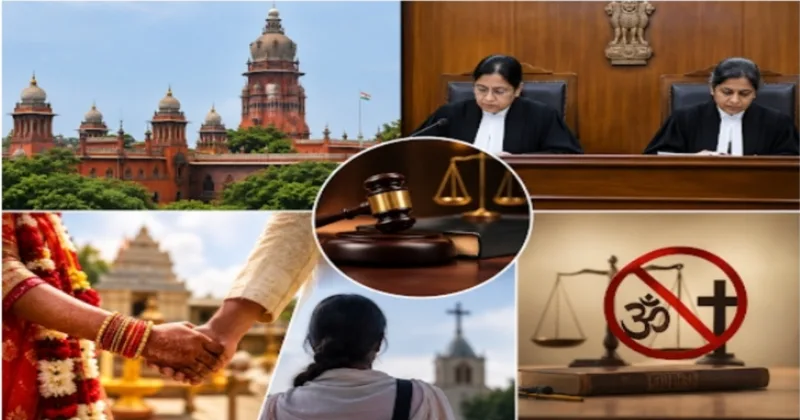
Chennai: The Madras High Court has held that a Christian woman cannot invoke the Hindu Marriage Act, 1955 to seek restitution of conjugal rights against a Hindu man, reaffirming that the statute applies to marriages between persons governed by Hindu law and cannot be expanded merely because Section 9 uses the expressions “husband” and “wife”.
A Division Bench comprising Justice P.T. Asha and Justice N. Mala delivered the judgment in S. Rani v. Sampath on August 19, 2026, while dismissing an appeal against a 2015 order of the Family Court, Villupuram. The Family Court had rejected the woman’s petition seeking restitution of conjugal rights under Section 9 of the Hindu Marriage Act.
The appellant claimed that she had married the respondent on July 10, 2008 according to Hindu rites and customs at a temple in Villupuram. The respondent disputed the alleged marriage and specifically contended that the appellant was a Christian and therefore had to establish the validity of the marriage under the law applicable to the parties.
The Family Court had found that the appellant was Christian by religion and that the alleged marriage was not valid under the Hindu Marriage Act. The High Court declined to interfere with those factual findings, noting that they were based on the evidence on record and disclosed no perversity.
Significantly, the woman’s religious identity was established through school admission registers, which recorded her religion as Christian, as well as the testimony of her own nephew that the family professed Christianity. The Bench therefore proceeded to examine whether a Christian could maintain a Section 9 proceeding on the basis of an alleged marriage with a Hindu solemnised according to Hindu rites.
The Court relied upon the Supreme Court’s decision in Gullipilli Sowria Raj v. Bandaru Pavani, where it was held that the scheme of the Hindu Marriage Act contemplates marriage between two Hindus. Section 5 expressly provides that a Hindu marriage may be solemnised between “any two Hindus”, while Section 7 prescribes the ceremonies through which such a marriage may be solemnised.
An interesting argument was nevertheless advanced on behalf of the appellant. Her counsel submitted that Section 9 merely refers to a “husband” and “wife” and does not expressly use the expressions “Hindu husband” or “Hindu wife”. Therefore, it was argued, the remedy of restitution could be available even where one spouse was not Hindu.
The High Court firmly rejected this reading.
The Bench said Section 9 could not be isolated from the rest of the enactment. The Preamble, Section 2 governing the application of the Act, Section 5 governing conditions for a Hindu marriage, and Section 7 dealing with Hindu marriage ceremonies had to be read together. The statutory scheme, the Court observed, could not be overridden merely because Section 9 employed the common nouns “husband” and “wife”.
It consequently held that, for purposes of Section 9, “husband” and “wife” mean persons whose marriage falls within the Hindu Marriage Act. Unless both parties are governed by the Act, the marriage cannot be treated as a Hindu marriage for invoking its matrimonial remedies.
Accordingly, the Court held that the Christian woman’s petition against the Hindu respondent under Section 9 was “per se not maintainable”, upheld the Family Court’s decision and dismissed the appeal.
The ruling is important not because it places any embargo on inter-faith relationships, but because it reiterates a basic principle of personal-law adjudication: a statutory remedy cannot be detached from the statute’s own field of application. The Hindu Marriage Act codifies matrimonial law for those whom Parliament has expressly brought within its fold; its provisions cannot be selectively invoked while disregarding that foundational legislative scheme.