New Delhi: A Chinese high school’s reported requirement that students watch the state-run evening news every day has intensified criticism that the Chinese Communist Party (CCP) is extending political indoctrination into students’ daily routines and making ideological teaching an integral part of school life.
Screenshots circulating on Chinese social media show the reported schedule for the senior high school division of Haikou No. 4 Secondary School in Hainan Province. The timetable requires students to spend 30 minutes during evening study sessions watching the Chinese state broadcaster’s flagship evening news programme. The mandatory political content is reportedly scheduled every day at 7 p.m., before students begin two 70-minute evening study sessions.
The reported school routine begins at 6:20 a.m. and includes nine classes during the day. Students living in dormitories are scheduled to turn off their lights at 11 p.m. The placement of state-run news within this tightly controlled timetable has prompted criticism that political teaching and Chinese Communist Party messaging are being incorporated into students’ everyday education rather than being confined to conventional classroom subjects.
Critics have compared the schedule to a highly regimented institutional routine, while questioning whether compulsory viewing of Chinese state media amounts to political indoctrination of school students. The controversy has also renewed scrutiny of the role of CCP ideology in China’s education system and the extent to which students are exposed to information outside officially approved narratives.
Political indoctrination extends beyond the classroom
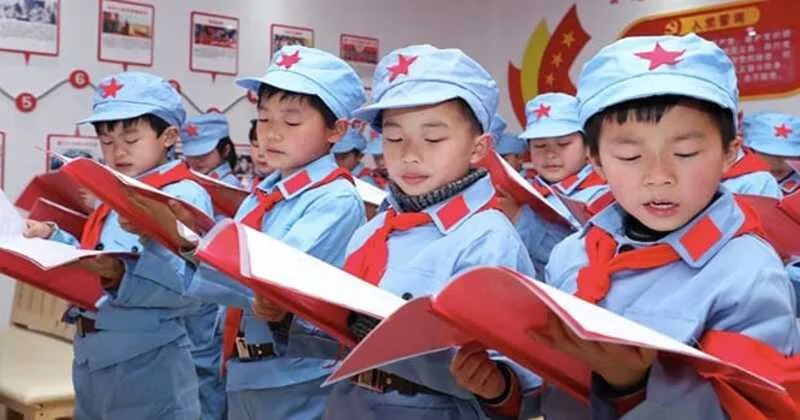
The reported practice at the Hainan school has been linked to broader concerns about Chinese Communist Party indoctrination in schools. School activities in China includes activities such as daily flag-raising ceremonies, singing the national anthem and the use of textbooks that promote the Communist Party and its political narrative.
Political messaging also reportedly begins at an early age. Children in kindergarten are exposed to so-called red songs carrying revolutionary communist themes, while concepts of loyalty to the Party and the country are introduced through educational activities. Critics argue that this creates a continuous process of Chinese Communist Party indoctrination that begins in early childhood and continues through successive stages of schooling.
A central concern is the limited access students may have to alternative sources of information. The state-run evening news is not simply treated as an ordinary news programme in the criticism surrounding the school timetable. It functions as a major platform for the Chinese Communist Party to communicate its political positions, promote its leadership and reinforce official narratives.
Making such programming part of a compulsory school schedule therefore raises questions about political indoctrination and media control. Students are exposed to a single state-controlled source at a fixed time as part of their formal daily routine, potentially reinforcing the ideological framework promoted by the Chinese Communist Party.
The controversy highlights how CCP political teaching can operate through both formal education and state media. Rather than limiting ideological instruction to textbooks and dedicated political classes, critics argue that the Chinese education system embeds Chinese Communist Party ideology across students’ daily experiences.
The reported Haikou timetable has consequently become a symbol of wider concerns over the use of schools for political indoctrination. It has also fuelled debate over whether Chinese students are being educated in an environment where academic learning, political teaching and loyalty to the Chinese Communist Party are increasingly intertwined.