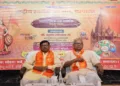
Param Pujaniya Sarsanghchalak Dr Mohan Bhagwat’s sojourn in North America was initiated as a routine global dialogue tour of the Rashtriya Swayamsevak Sangh (RSS). As this is the centenary year of the Sangh, the tour gained more publicity. Those who opposed it helped enhance the curiosity. This was all along expected lines. But three public addresses by Mohan Ji changed the orbit completely. It was a quantum jump in the mission of rousing the humanity.
The eternal message of Hindutva has been disseminated throughout the world for ages. This has been the life mission of Bharat. The same thought was expressed in three different dimensions by Mohan Ji, according to the occasion and the audience. In the first programme, an interfaith dialogue titled ‘One World, One Humanity’, Mohan Ji asserted the immortal proclamation of the Rishis, that “Truth is one; knowledgeable seers express it variously.” In contemporary idiom — unity manifesting in diversity.
the West
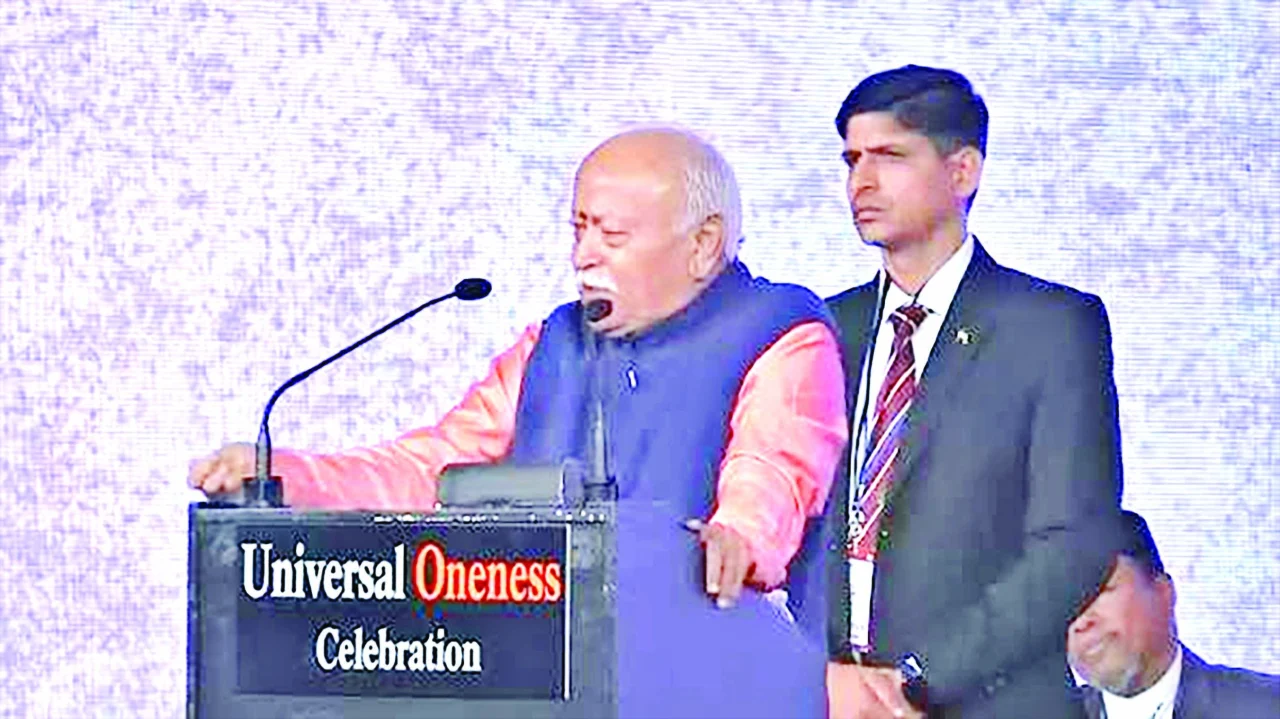
The next large multinational public gathering at Madison Square Garden witnessed a futuristic elaboration of the foundational concept of Hindutva — Oneness. The concept of Brahmanda is more profound than the expression ‘Universe’, but due to the limitations of the English language, it had to be explained in established terms such as ‘Universal Oneness’. The third programme in Toronto was on the role of Hindus and Bharat in guiding humanity towards practising this art and science of harmonious living. To regain the acclaimed position of Vishwaguru, a Hindu must first become Vishwabandhu – Friend of all.
Three Dimensions of One Eternal Principle
Thus, all three messages are essentially a gradual unfolding of the eternal principle of existential unity. Oneness and its omnipresence, its diverse manifestations, and the benevolent role of Hindus in re-establishing this harmonious world order — all three are essential today. This is really the most important need of the hour. Mohanji explained the Vision — Oneness, its application — Diversity, and its process — Brotherhood, respectively in the three addresses.
Everything in Bharat is neither the first nor novel; the same is true of this call to rise. This has happened innumerable times in the known and documented history of Bharat. But in the recent times in North America, this is the third wave of enlightenment from the land of the Vedas. The US, being the self-proclaimed dominant leader of the world, amplified these waves to affect western intellectuals and academics and then ripple across the whole world.
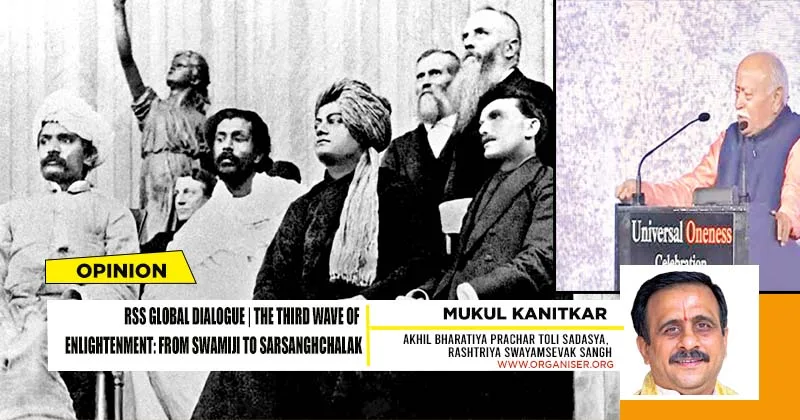
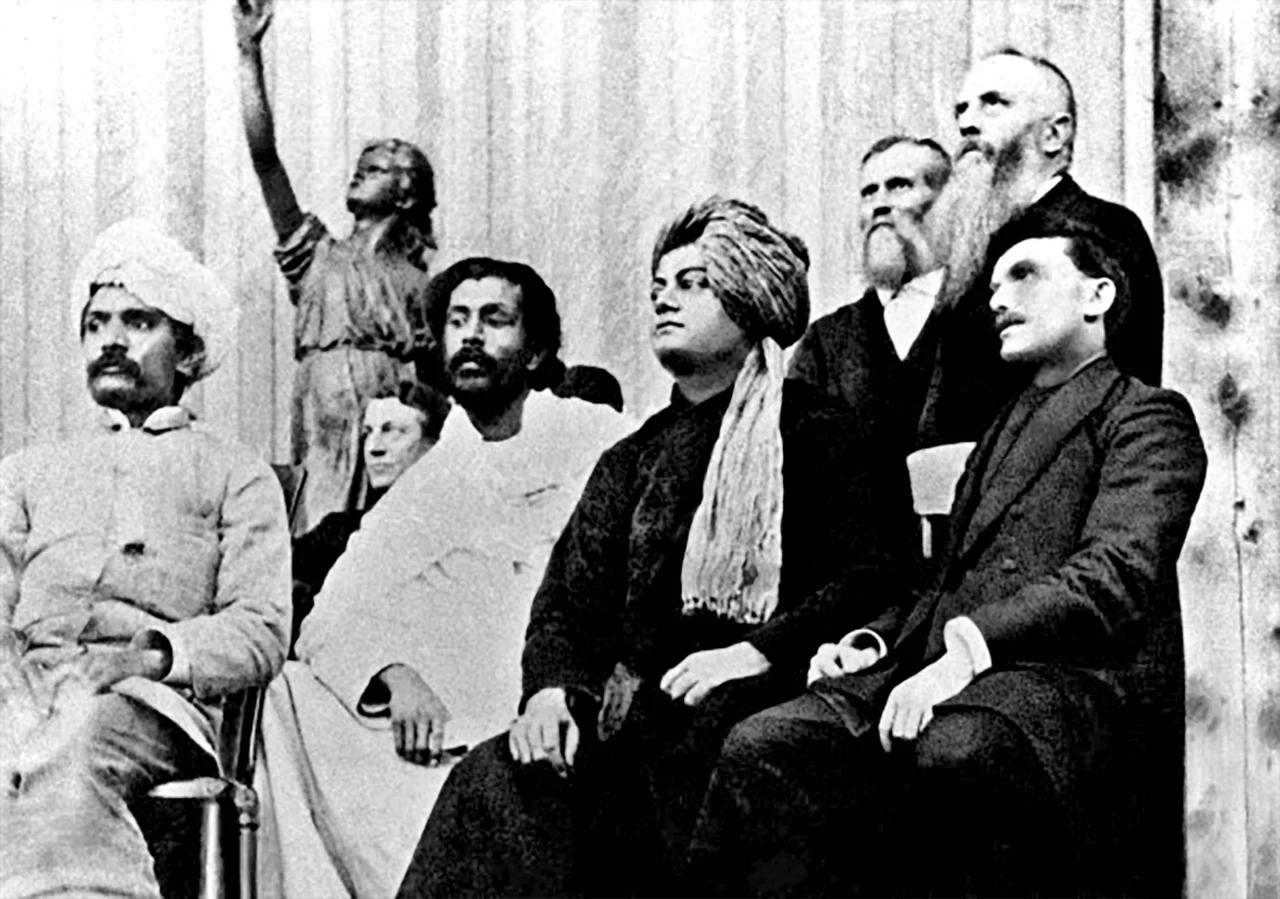
The first wave was Swami Vivekananda’s Chicago Address on September 11, 1893. At the World’s Parliament of Religions, organised by the Church to declare Christianity as the supreme religion, Swamiji delivered the all-inclusive message of Hindutva. It is even now celebrated as a clarion call for Universal Brotherhood. This was continued by Swami Abhedananda, Swami Ramananda, Swami Yogananda, Shri La Prabhupada and many others.
A great contribution to the west’s journey of self-realisation was made by Osho Rajneesh and Maharshi Mahesh Yogi in the last century. All of them faced irrational opposition, character assassination and institutional obstruction. But the wave of Oriental awakening perpetuated. This was taken forward in the present era by contemporary Gurus such as TVS Iyengar, Sri Sri Ravi Shankar, Sadguru Jaggi Vasudev and Swami Ramdev. One of the greatest self-realised Masters of the present times is Mata Amritanandamayi. Her divine hug of oneness has transformed millions of Sadhakas in more than 180 countries across the world. All this Hindu influence actualised in the second wave of enlightenment on June 21, 2015, in the form of the International Day of Yoga. The whole world was inspired to search within by practising oneness through Yoga. This was the invocation of Bharat Mata becoming Vishwaguru once again.
The Third Wave
Param Pujaniya Sarsanghchalak Ji’s present visit is in the same league — the third wave of enlightenment. Swami Vivekananda philosophically illustrated the oneness of Hindus when he said: we do not just tolerate other religions; we accept every religion as true.
The second wave of enlightenment, in the form of the International Day of Yoga, put this transcendence into practice when millions of faithful followers of various religious ideologies came together to perform yogic practices.
It was another Vivekananda Moment when Mohan Ji summed up the message of the interfaith meet by saying that there are multiple ways to reach the ultimate truth. One can seek the Supreme through various paths. Every genuine enquiry of a seeker, practised incessantly, has the potential to reach the same Absolute.
This is very natural for a Hindu who chants many shlokas, such as: “Ruchinam Vaichitryat Rujukutil Nana Pathjusham | Nrinaam eko gamyah tvamasi payasaam Arnav iva||” (As all the rivers flowing in a curled or straight path ultimately reach the ocean, in the same way all the people practising according to their distinct interests finally attain You — the Ultimate.) This was Quoted by Swamiji from Shiva Mahimna Stotram. Another popular tribute to Vishnu: “Akashat patitam toyam yatha gachchhati sagaram | Sarvadeva namaskarah Keshavam prati gachchhati||” (All the water descending from the sky goes to the ocean; in the same way, salutations to all the Devas ultimately go to Keshava.)
But for a follower of any of the Abrahamic religions, this all-inclusive monotheism is very hard to swallow. For them, there is only one God, one messenger and one path to salvation. That is the basis of their existence. If they accept that there can be multiple paths to Mukti, it takes away their foundation for conversion. This is what Swami Vivekananda did 133 years ago when he called the church bell rung in honour of the conference a death knell for bigotry and hatred towards others.
Mohan Ji’s definition of Hindutva as an inclusive way of life is of the same order. His most discussed and misquoted statement — ‘If anyone imagines Bharat without any Muslim, he is not a Hindu’ — in fact enshrines the basic principle that all religions are true. This is the essence of Hindu Dharma. We do not believe in annihilation; instead, we assimilate all. One who thinks that all Muslims can be migrated to Pakistan or Bangladesh is shortsighted. All the Hindus in Bharat envision an integrated Bharat. The unnatural partition must go away. For that, we all have to learn to live together amicably.
This is possible only when Hindus are united and strong. When Hindu Dharma weakens, the world suffers intolerance and violence. Thus, taken together, the three addresses of the RSS Sarsanghchalak, constitute the third wave of enlightenment. This Oriental wisdom of oneness, harmony and self-realisation is an urgent need for today’s conflict-ridden world. All the challenges faced by humanity, such as terrorism and religious violence, climate change, economic growth without equality, social disharmony and mental health, can be resolved by this integrated and holistic vision.
Eleanor Stark, in 1988 CE, wrote a book titled The Gift Unopened: A New American Revolution. She called Swami Vivekananda’s message the gift unopened by Americans. The problems faced by the US population at that time could have been avoided if they had heeded the teachings of Vedanta propounded by Swami Vivekananda. According to her, Americans wasted a great opportunity and she called upon them to awaken. The first wave of enlightenment was triggered by the individual brilliance of Swami Vivekananda. It was not backed by any institutional mechanism. Hence, the effect was more of an awe. It helped Swamiji to start a mission in Bharat and arouse his countrymen to the task of being the guide of humanity.
The second wave of enlightenment was backed not only by many institutions, albeit competing and seldom on the same page, but finally, with government backing, succeeded in the declaration of the International Day of Yoga. The objective being focused and pertaining to the discipline of Yoga, its influence is exemplary yet limited. This has helped the world in combating mental and physical health issues. But the much bigger and more important human challenges yet remain to be addressed.
The third wave is neither personality-oriented nor institutional nor governmental. Though Mohan Ji is the instrument of this great awakening, he represents a movement. RSS is not just any organisation, nor is it an institute. It is a culmination of the millennia-long penance of the Bharatiya Rishis. It represents Hindu thought as it has evolved eternally. The unique nature of third wave makes it distinctly transformative. The first wave gave the intellectual foundation, the second gave the process, and the third wave is holistic, as it provides an organic ecology for comprehensive solutions to most of the contemporary challenges before humanity. It is our cosmic responsibility not only to celebrate this historic Vivekananda moment but also to resolve to contribute to actualising the vision of one world, one family.