Long before botany was ever codified into a formal discipline, Indian civilisation had already folded the plant kingdom into its moral, spiritual and medical universe. The banyan sheltered the sages of the Upanishads, the tulsi found its permanent place in the household courtyard and the Ayurvedic compendiums catalogued thousands of species with a precision that predates modern taxonomy by millennia. Trees were planted at coronations, worshipped at weddings and invoked as witnesses to oaths of freedom. It is this old, unbroken thread of nature not as inert resource but as living heritage that finds its most contemporary expression in Prakriti Gyan Dham, Indian first eco-educational hub was dedicated to the nation on August 8, 2026, in Lucknow.
Developed by the CSIR-National Botanical Research Institute (CSIR-NBRI) at the Maharishi Parashar Bioresource Centre (MPBC), Banthra, on the outskirts of Lucknow, the facility was formally dedicated by Dr Jitendra Singh, Union Minister of State (Independent Charge) for Science and Technology and Earth Sciences, who also holds charge of the Prime Minister’s Office, Personnel, Public Grievances, Pensions, Atomic Energy and Space, and serves as Vice-President of CSIR. The event was attended by Dr G.N. Singh, Advisor (Health) to the Chief Minister of Uttar Pradesh Dr Ajit Kumar Shasany, Vice-Chancellor of the Central University of Odisha Dr Zabeer Ahmed, Director of CSIR-NBRI and CSIR-IIIM Jammu; along with senior scientists, researchers and farmer beneficiaries of the CSIR Floriculture Mission.
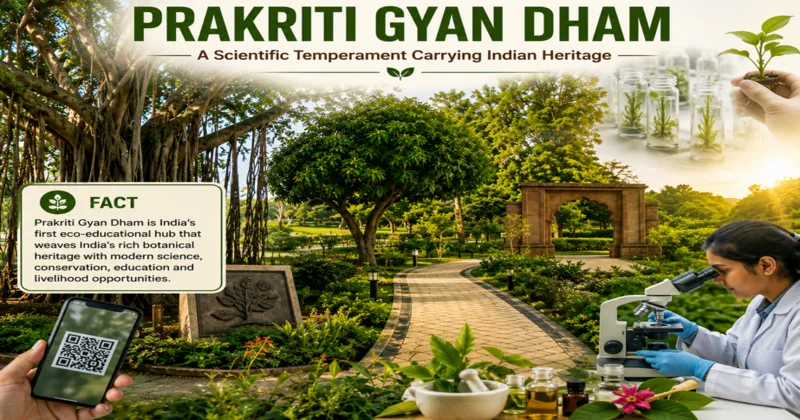
Described officially as a “living repository of India rich botanical and cultural legacy,” Prakriti Gyan Dham is conceived not as a conventional botanical garden but as an open-air classroom where scientific research steps outside laboratory walls to meet students, farmers, entrepreneurs and the general public. Dr Singh, in his address, called for taking the work of scientific institutions closer to society by systematically showcasing their technologies, success stories and societal applications through greater use of digital and social media platforms so that farmers, entrepreneurs, students and industry can access scientific solutions and livelihood opportunities. He also urged greater integration of complementary projects across departments and ministries to maximise the societal impact of research and innovation.
CSIR-NBRI, a constituent laboratory of the Council of Scientific and Industrial Research, has for decades worked at the intersection of plant taxonomy, floriculture, medicinal botany and environmental research. Its Banthra campus, known until now chiefly for the Maharishi Parashar Bioresource Centre’s conservation nurseries and germplasm collections, has effectively been reimagined through Prakriti Gyan Dham as a public-facing gateway to that scientific work part of a broader shift wherein institutions once content to publish in academic journals are now translating their findings into experiences and livelihoods that ordinary citizens can see and benefit from.
A heritage trail rooted in civilisational memory
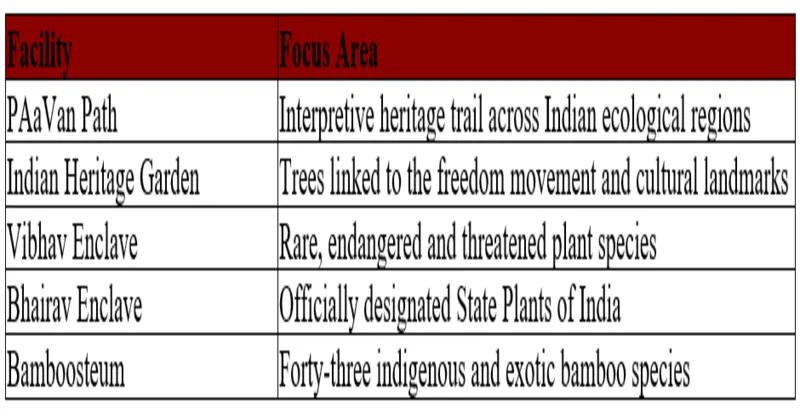
At the heart of the hub lies the PAaVan Path, Plants and Associated Vegetations for Appreciating Nature an interpretive heritage trail that forms the central experiential spine of the campus. The trail guides visitors through curated plant collections representing India’s diverse ecological regions, from the Himalayan foothills to the Deccan plateau, alongside their associated vegetation.
Nested within this trail is the Indian Heritage Garden, arguably the most evocative section of the entire complex. Here, heritage trees have been propagated from historically and civilisationally significant locations across the country. The Bawan Imli Tamarind Tree, brought from Fatehpur, commemorates the supreme sacrifice of fifty-two freedom fighters. The Mother Dussehri Mango Tree, native to Lucknow represents the horticultural legacy behind one of India most celebrated mango varieties. The Patalpuri Banyan of Prayagraj carries associations with pilgrimage and antiquity, while a mango tree planted by Mahatma Gandhi himself at Bhitiharwa in Champaran connects visitors directly to the Champaran Satyagraha. Descendants of trees that once lined the historic Dandi March route in Gujarat complete this living gallery of the freedom movement.
To bring this heritage alive for a digital-first generation, the garden employs QR-enabled audio systems visitors can scan codes with their smartphones to access historical, cultural and botanical narration about each tree, converting the landscape itself into an interactive, self-guided lesson in both plant science and nationalist history.
Conservation through the Vibhav and Bhairav enclaves
Two further sections anchor the hub’s conservation mandate. The Vibhav Enclave, styled as the Threatened Plants of India Garden, is dedicated to rare, endangered and vulnerable species and is designed to build public awareness of biodiversity loss, habitat degradation, climate change and the urgent need to conserve plant genetic resources. Complementing it is the Bhairav Enclave, or the State Plants of India Garden, which brings together the officially designated state plants of every state and union territory, presenting their ecological, cultural and symbolic significance in one unified space, a botanical map of the Republic itself.
Rounding off the campus is the Bamboosteum, housing forty-three indigenous and exotic bamboo species. Far from being a decorative addition, the facility is intended to demonstrate bamboo’s standing as a renewable bioresource with wide-ranging applications in ecological restoration, carbon sequestration, soil conservation, sustainable rural livelihoods, traditional craftsmanship and green infrastructure themes that align closely with the government’s ongoing push for climate resilience and rural entrepreneurship.
Science meets the marketplace
The inauguration has doubled the demonstration of CSIR-NBRI’s science-to-society pipeline. An herbal formulation for male reproductive health, developed in collaboration with Himalaya, was formally launched at the event. Separately, four plant-based technologies such as: a Herbal Anti-Dandruff Hair Care Oil, two fragrances marketed as Frotus (a lotus-inspired perfume and a Rudra perfume) and a Herbal Nano Serum were transferred to the Kudumbashree State Poverty Eradication Mission in Kerala, with the explicit aim of supporting women-led entrepreneurship and livelihood generation through science-based, value-added products.
In a further instance of industry-academia convergence, CSIR-NBRI transferred the design and development of a low-cost photobioreactor technology to Witwake Solutions Pvt. Ltd., a Lucknow-based firm, illustrating how laboratory-grade innovation can be routed into commercial and industrial application. Dr Singh described such transfers as more than a communication exercise, framing them instead as a practical means of connecting institutional research with entrepreneurship and economic opportunity for ordinary citizens.
Taken together, these transfers underline a pattern visible across India’s public research institutions: technology developed with public funding is being steered toward self-help groups, small manufacturers and regional entrepreneurs rather than remaining confined to patent filings. For an institute whose core mandate has historically been taxonomic and conservation research, the willingness to also incubate herbal cosmetics, wellness formulations and bioreactor engineering signals a maturing ecosystem in which fundamental botanical science and applied enterprise are treated as complementary pursuits.
During the programme, the Minister also released a documentary showcasing India’s Heritage Gardens, capturing the country’s botanical wealth alongside the cultural, historical and ecological significance woven into its plant diversity a fitting complement to the physical trail visitors can now walk through at Banthra.
Dr. Zabeer Ahmed described the Eco-Educational Hub as a living repository of India’s botanical diversity, built to let visitors engage with the nation’s plant heritage through interactive, immersive learning rather than static display. Dr Singh, for his part, reiterated the need to combine traditional knowledge with modern technology to address emerging environmental and climate challenges. Also called for deeper integration across scientific departments and ministries so that successful initiatives achieve wider reach.
The following summary captures the hub’s principal components at a glance:
 Positioned at the Maharishi Parashar Bioresource Centre, the hub is envisaged as a national destination for experiential learning, bringing together living collections, heritage trails, digital interpretation and technology-oriented outreach under a single roof. In an era when climate anxiety and ecological disconnection increasingly define young minds, Prakriti Gyan Dham offers a distinctly Indian corrective where it does not ask visitors to choose between scientific rigour and civilisational memory, but insists the two were never separate to begin with.
If the ambition articulated at its dedication is realised, Prakriti Gyan Dham could well become the template for a new generation of science parks and biodiversity centres across India spaces where conservation, education, tourism and technology converge and where the next generation learns to read the story of their nation not only from textbooks, but from the trees that have quietly witnessed it.
That is the deeper argument the Banthra campus makes without stating it outright. A civilisation that once measured time by the flowering of the palash and swore its freedom oaths beneath tamarind and banyan canopies is now asking its scientists to formalise that same reverence into taxonomy, conservation protocol and QR-coded interpretation. Prakriti Gyan Dham does not import a foreign model of the eco-museum, it recovers a native one, dressed in the vocabulary of contemporary plant science a quiet rebuttal to the notion that scientific temperament and heritage pull a nation in opposite directions.