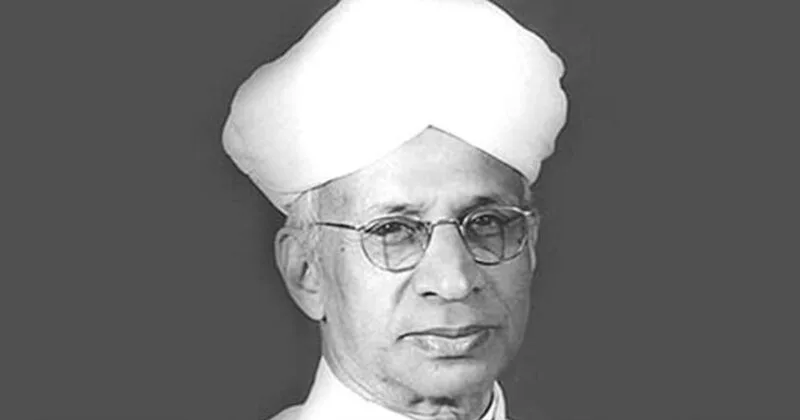
Every year on September 5, when Teachers’ Day is celebrated with grandeur across India, the sage-like, serene figure of Dr. Sarvepalli Radhakrishnan, the second President of Independent India, naturally floats before our minds. In 1962, when he assumed the highest responsibility as the President of India, his admiring students and well-wishers expressed their desire to celebrate his birthday with great pomp.
But this transcendent educationist and philosopher smiled gently and replied, “Instead of celebrating my birthday separately, if September 5 is celebrated as ‘Teachers’ Day’ to pay tribute to all the teachers of the country, I would consider myself deeply honored”.
In deference to his humble and noble wish, Teachers’ Day was auspiciously inaugurated in India. He elevated the noble profession of teaching to the heights of statesmanship, which is not only proof of his unparalleled thirst for knowledge but also a unique testament to his ultimate dedication to intellect and nation-building.
Sarvepalli Gopal, in his book Radhakrishnan: A Biography, has beautifully demonstrated how this solitary seeker stood as a bridge of intellect between the East and the West and how he sought to harmonize the spiritual values of traditional Indian culture with a modern democratic framework.
Yet, an unwritten and brutal truth of history is that behind this luminous atmosphere of Teachers’ Day lies a long, arduous and painful history of struggle in independent India for Radhakrishnan. The very same radiant wisdom that was revered by the entire world was subjected to a well-planned and defamatory propaganda war by Leftist and Communist intellectuals in his own homeland.
The theoretical and political leadership of the Indian Communist movement viewed Radhakrishnan’s idealism of Advaita Vedanta as an extreme and existential threat to their dialectical materialism. The mechanical and narrow conception of Karl Marx’s “religion is the opium of the people” nurtured by Indian Marxists made Radhakrishnan’s spiritual humanism and the Vedantic theory of universal brotherhood appear to them as a “bourgeois and reactionary” ideology.
As a result, the Communist Party of India, the Communist Party of India (Marxist) and their allied progressive cultural fronts unleashed an uninterrupted tsunami of propaganda and character assassination against Dr. Radhakrishnan for over four decades. This offensive at times descended to the level of personal slander and vulgar character assassination and at other times took the form of institutional conspiracies to systematically erase his name and work from the syllabi of universities and government institutions.
Standing at this sacred moment of Teachers’ Day, the aim of this article is to unveil the dark history of those conspiracies and propaganda campaigns conducted against Radhakrishnan through the illumination of historical archival records.
Philosophical Kurukshetra: Vedantic idealism vs. materialist ideology
The core conflict between Dr. Radhakrishnan and the Leftist intellectual camp of India was purely theoretical and philosophical. Radhakrishnan’s entire life and literary work were established on the spiritual foundations of Advaita Vedanta. His philosophy is often referred to as “Neo-Vedanta” or “Neo-Advaita Vedanta”, which describes Brahman as the ultimate spiritual consciousness and accepts the world as a play or expression of that supreme reality.
Robert Minor, in his book Radhakrishnan: A Religious Biography, has brilliantly analyzed how Radhakrishnan’s philosophy presented an alternative path of human liberation—one that emphasized spiritual self-realization instead of class struggle or the seizure of the means of production.
For the Communists, this theory of spiritual self-realization was extremely dangerous. Standing on the theoretical framework of dialectical and historical materialism, they believed that human thought and consciousness are entirely determined by their material and economic environment.
In classical Marxist texts such as Friedrich Engels’ Ludwig Feuerbach and the End of Classical German Philosophy, Vladimir Lenin’s Materialism and Empirio-Criticism and G.V. Plekhanov’s The Development of the Monist View of History, idealism is described as an illusory intellectual tool of the ruling class designed to protect its interests. Therefore, when Radhakrishnan published his landmark work An Idealist View of Life in 1932, it was perceived by Indian Communists as a direct and heavy blow.
In An Idealist View of Life, Radhakrishnan not only proved the spiritual superiority of Vedanta but also systematically exposed the theoretical limitations of contemporary materialism, behaviorism, naturalism and atheism. Various discussions published in the famous literary and philosophical mouthpiece of contemporary India, Triveni Journal, highlighted how Radhakrishnan had forged a beautiful synthesis between the rationality of modern science and human intuition.
This synthesis created a massive crisis for Marxist thinkers, because their exclusive claim to proving the scientific obsolescence of religion was pale before Radhakrishnan’s profound scientific consciousness.
First-generation Communist leaders like Shripad Amrit Dange, P.C. Joshi and E.M.S. Namboodiripad, failing to engage in peer-level intellectual debates with Radhakrishnan’s philosophical genius, chose an alternative path.
They began to label Radhakrishnan’s philosophy as a “theoretical veneer for bourgeois class interests”. In the light of Marxist theory, they claimed that the universality of Vedanta was actually a modern disguise to preserve India’s feudal social system and caste hierarchy. This propaganda was not limited to theoretical debates; essays were regularly published in Communist mouthpieces such as New Age, People’s Democracy, and the Bengali publication Swadhinata, or documents like P.C. Joshi’s Among Kisan Patriots, claiming that Radhakrishnan’s spiritualism was blocking the development of class consciousness among the rural poor and blinding them to the realities of their exploitation.
The Jadunath Sinha controversy and the leftist strategy of character assassination
The greatest blow to Dr. Radhakrishnan’s intellect and morality from the Leftist intellectuals and the progressive camp of the time came in 1929, centered around the “Jadunath Sinha controversy”. Although this controversy was not initiated by Communist theorists, the student, youth and intellectual fronts run by the Communists transformed this dispute into a permanent weapon for the character assassination of Radhakrishnan.
The historical events began in 1921 when Dr. Radhakrishnan, a Telugu-speaking professor from Madras Presidency, was appointed to the prestigious King George V Chair of Mental and Moral Science at the University of Calcutta. This appointment generated intense regional and institutional resentment among a section of the contemporary Bengali intellectual camp. The highly influential monthly magazine The Modern Review, edited by Ramananda Chatterjee, began harsh and malicious criticisms of this appointment and Radhakrishnan’s academic work in several Left-leaning reports.
In December 1928, Jadunath Sinha, a professor of philosophy at Meerut College, wrote a letter to the editor of The Modern Review alleging that Radhakrishnan, in his book Indian Philosophy: Volume II published in 1927, had copied extensively and verbatim from Sinha’s Premchand Roychand Studentship thesis “Indian Psychology of Perception,” which had been submitted to Calcutta University.
Between January and April 1929, Jadunath Sinha published parallel citations in The Modern Review to prove his allegations. On the other hand, Radhakrishnan rejected these allegations with deep indignation. He proved that he had been delivering lecture notes on this subject in Calcutta University classes since 1922, and that similarities in the English translation of original Sanskrit verses by two different translators were entirely natural.
Furthermore, Professor Muirhead, the general editor of the publisher George Allen & Unwin, submitted an affidavit to the Calcutta High Court stating that Radhakrishnan’s manuscript had been received by him in 1924, which was long before the completion of Jadunath’s thesis. The controversy reached its peak when, in August 1929, Jadunath Sinha filed a lawsuit against Radhakrishnan in the Calcutta High Court for copyright infringement, claiming Rs. 20,000 in damages. Radhakrishnan counter-sued for Rs. 100,000 for defamation.
Subsequently, in 1933, through the mediation of Dr. Syama Prasad Mookerjee and in the court of the Acting Chief Justice Phani Bhushan Chakravarti, the lawsuit was settled out of court with the consent of both parties, and both sides completely withdrew their allegations. However, systematically suppressing the actual history of this compromise, the Leftist propaganda machine and Communist writer groups have for decades painted Radhakrishnan as a “thief” or a “plagiarist”.
The Communist intellectuals of India used this controversy as an ethical tool to prove the obsolescence of Radhakrishnan’s Vedantic philosophy. Even today, on the eve of Teachers’ Day, Left-leaning and Dalit-Left web magazines such as The Wire or Round Table India publish one-sided accounts of the Jadunath Sinha controversy to diminish Radhakrishnan’s national stature. Sarvepalli Gopal, in his biography, lamented how the academic resentment of some Bengalis against Radhakrishnan was later turned into a permanent form of political malice. Barin De, in his 1982 compilation A Reported Case of Radhakrishnan’s Literary Piracy, discussed in detail the negative propaganda surrounding this event.
The Philosopher in the Court of Kremlin: The Moscow mission and the disquiet of the global communist bloc
In 1949, when Prime Minister Jawaharlal Nehru decided to appoint Dr. Sarvepalli Radhakrishnan as India’s Ambassador to the Soviet Union, the Communist Party of India (CPI) opposed the decision both secretly and publicly. For the Communists, the Soviet Union was a sacred land—the physical manifestation of a socialist paradise. They campaigned that the Nehru government was insulting the Soviet leadership by sending an uncompromising spiritual and Vedantic philosopher to Moscow.
Leftist publications of the time, such as Blitz and Mainstream, wrote that a “bourgeois idealist” like Radhakrishnan could never establish a connection with the materialist mindset of a socialist state, and that this would cause immense damage to Indo-Soviet diplomatic relations.
However, Radhakrishnan’s Moscow mission turned those apprehensions and slanders of the Indian Communists into a historical farce. Upon reaching Moscow, Radhakrishnan deeply impressed the “Iron Man” Joseph Stalin with his profound wisdom, simple lifestyle, and cultural refinement. K.P.S. Menon, in his memoir K.P.S. Menon on Dr. Radhakrishnan as Diplomat (1976), wrote about how Radhakrishnan became a legendary diplomatic figure in Moscow.
He was the only ambassador in Moscow at the time whom Stalin invited for personal audiences twice during Radhakrishnan’s two-and-a-half-year tenure. In their first meeting on January 15, 1950, Radhakrishnan fearlessly criticized the Soviet dictatorship, an exchange that was later beautifully preserved in the declassified Russian files under the title “Conversation between I.V. Stalin and S. Radhakrishnan, 15-01-1950”.
He told Stalin, “We had a great emperor in India who, after a bloody war, renounced violence and became a monk. You too have waded your way to power through force; who knows if such a transformation might happen in your life as well.” This reference to Emperor Ashoka did not anger Stalin; instead, he respected Radhakrishnan’s extraordinary honesty and courage, affectionately calling him “Professor.” During their farewell meeting on April 5, 1952, when Radhakrishnan patted Stalin’s head in a gesture of blessing, Stalin was visibly moved and said, “You are the first person to treat me as a human being and not as a monster”.
This historic diplomatic success created an extremely embarrassing situation for the Indian Communists. The very man they had tried to dismiss as a “reactionary” had successfully laid the foundation of Indo-Soviet friendship. Unable to accept this reality, the Communists began a dirty game of downplaying Radhakrishnan’s role. The CPI’s party organ New Age claimed in a 1952 article that this success was entirely due to Nehru’s personal diplomacy and that Radhakrishnan’s philosophy had no contribution to it. This ugly political misinterpretation proved that the Communists’ opposition was not based on any logical foundation but was narrow and blindly biased.
The China dispute and the historical conflict of 1963: The communist censure resolution against the President
When Dr. Radhakrishnan assumed office as the second President of India in 1962, the nation’s internal politics and international relations were undergoing an extremely tense phase. In particular, the border conflict with China and the 1962 war overturned India’s political landscape. Radhakrishnan was one of the rare statesmen of India who had recognized the aggressive nature of Communist China long before.
On November 1, 1959, a report published in The New York Times titled “Radhakrishnan Warns China” stated that Vice-President Radhakrishnan had strongly warned China on an international stage, saying that their aggressive policies were threatening the independence of smaller Asian nations.
During the 1962 Sino-Indian War, Radhakrishnan played a historic role as President. He publicly criticized the Nehru government’s policies as “naive and negligent” and emphasized building the nation’s defense systems. Radhakrishnan’s indirect role in removing Defense Minister Krishna Menon from the cabinet during the war was also highly significant. This event was a massive blow to the proletarian internationalism of the Indian Communists.
A large faction of the CPI was refused to recognize China as an aggressor, which eventually led to the party splitting in 1964. The ultimate explosion of this conflict occurred in June-July 1963. In June 1963, President Radhakrishnan completed a highly successful state visit to the United States and the United Kingdom. According to the document “Subjects Radhakrishnan Briefing Book June 3-5 1963” preserved in the US Library Archives, India’s defense preparedness was the centerpiece of his discussions.
During his speeches at various universities and public gatherings, while supporting India’s foreign policy, he sharply criticized the theoretical emptiness of communism and its suppression of individual liberties. In his bilateral discussions with US President John F. Kennedy, he made it clear that China had launched not just a military but a political and ideological offensive against India.
The Communist Party of India (CPI) could not tolerate this moral triumph of individual liberty in Radhakrishnan’s speeches. During the National Council meeting of the Communist Party held in New Delhi between June 26 and July 3, 1963, a formal censure resolution was passed against the President’s speeches abroad. This decision is preserved to this day in the publication Resolutions of the National Council of the Communist Party of India June/July 1963. In the history of modern India, this was an unprecedented and highly deplorable event where a political party passed such a resolution against the speeches of the nation’s President during a state visit.
Jawaharlal Nehru, the Prime Minister of India, himself strongly censured this scurrilous resolution. On July 4, 1963, Nehru wrote a highly important and historic letter to President Radhakrishnan, which is preserved today in the archives of the Nehru Memorial Museum and Library in New Delhi and is included in the Nehru Archive Digital Collection under the title “To S. Radhakrishnan: CPI Criticism of President”. Nehru wrote in clear terms: “The resolution of the Communist Party of India, to which you refer, was entirely misconceived and in bad taste”.
He added, “All of us greatly admired your speeches in the United States and the United Kingdom. They were not only in full keeping with our foreign and domestic policies, but were also inspiring and representative of the spirit of India”. Nehru reassured the President that he had discussed the matter in a cabinet meeting, and all members of the cabinet regretted and condemned the CPI’s behavior. The national media and intellectuals of India also condemned the narrow-mindedness of the Communists. This event proved that the Communists did not hesitate to target even the highest constitutional office of the President of India for political attacks and humiliation.
Institutional and historiographical conspiracies: The effort to erase Radhakrishnan from syllabi and academia
During the 1970s and 1980s, Communist and Leftist intellectuals established a complete hegemony over India’s higher education and academic sphere. Especially after the establishment of Jawaharlal Nehru University (JNU) in 1969 and the acquisition of control by the Left over state research institutions like the Indian Council of Historical Research (ICHR) and the Indian Council of Philosophical Research (ICPR), a new and subtle conspiracy began to marginalize Radhakrishnan’s legacy at the institutional level.
The main objective of this institutional conspiracy was to systematically exclude Radhakrishnan’s Vedantic philosophy from the philosophy curricula of Indian universities or to render it irrelevant. K. Satchidananda Murty and Ashok Vohra, in their book Radhakrishnan: His Life and Ideas, exposed this politics of academic exclusion with deep indignation.
In leading educational institutions such as JNU or Calcutta University, where Bertrand Russell’s History of Western Philosophy, A.J. Ayer’s logical positivism, or Karl Marx’s dialectical materialism were taught with immense importance, Radhakrishnan’s philosophy was relegated to a marginal and almost insignificant corner of the syllabus. An examination of Delhi University’s 2016 MA Philosophy syllabus reveals how Indian philosophy was systematically divided into two camps—one of which was labeled by the Left as “Brahminical theory” in a pejorative sense, with Radhakrishnan and Hiriyanna branded as its main proponents.
The main protagonist of this historiographical war was the Communist theorist and Marxist philosopher Debiprasad Chattopadhyaya. Despite being one of Radhakrishnan’s favorite students at Calcutta University, Debiprasad dedicated his entire academic life to demolishing his guru’s idealist worldview. In his famous book Lokayata: A Study in Ancient Indian Materialism published in 1959 and the massive 666-page volume What is Living and What is Dead in Indian Philosophy published in 1976 (the title of which was a cruel and deliberate parody of his guru Radhakrishnan’s words), he performed a ruthless and one-sided Marxist dissection of Radhakrishnan’s history of Indian philosophy.
Debiprasad claimed that Indian philosophy was fundamentally materialist and scientific, symbolized by the Carvaka or Lokayata traditions. According to him, idealist academics like Radhakrishnan or Surendranath Dasgupta had killed the scientific and secular history of Indian thought by presenting the Vedanta philosophy of Shankara or Ramanuja as the only true philosophy of India. Debiprasad labeled Vedanta and idealism as “dead” and an “intellectual conspiracy” of the ruling exploiters, declaring materialist physicalism to be the only “living” tradition of India.
Behind this intellectual offensive lay not just philosophical debates but a deep political objective. Just as Marxist historians like Damodar Dharmanand Kosambi, in his Myth and Reality (1962) or An Introduction to the Study of Indian History (1956), explained the Indian spiritual tradition as an economic reflection of the transition from prehistoric tribal societies to feudalism, E.M.S. Namboodiripad, in his The Mahatma and the Ism (1958) and his 1973 document “On Questions of Philosophy and Revolutionary Practice”, described Indian idealism as a bourgeois conspiracy to destroy the potential for a proletarian revolution among the masses.
Consequently, a deep division was created in the academic world where Radhakrishnan was branded as a “feudal and bourgeois apologist” and a “theorist of upper-caste hegemony”.
Propaganda by leftist mass media and cultural fronts
To diminish Dr. Radhakrishnan’s global intellectual reputation, the Communists resorted to media propaganda at both national and international levels. Radhakrishnan, during his long life, was nominated a record 16 times for the Nobel Prize in Literature and 11 times for the Nobel Peace Prize. For any Indian intellectual of the twentieth century, this was an unprecedented international recognition. However, the Communist intellectuals of India and progressive writer fronts never supported his candidacy on the international stage. French philosopher and researcher Frances Stonor Saunders, in her famous book The Cultural Cold War and Giles Scott-Smith, in The Politics of Apolitical Culture, have shown in detail how Soviet cultural agencies (such as VOKS) lobbied behind the scenes regarding international cultural and literary awards during the Cold War.
The Communist intellectual camp of India, acting under Soviet influence, tried to tarnish Radhakrishnan’s image in the international literary world because his Vedantic humanism was diametrically opposed to Soviet socialist realism. The All India Progressive Writers’ Association (AIPWA) and the Indian People’s Theatre Association (IPTA) used folk plays and theatrical performances to mock and caricature Radhakrishnan’s “spiritual sage” persona as an agent of the bourgeoisie.
During the tenure of Kerala’s first Communist Chief Minister E.M.S. Namboodiripad (1957–1959) and subsequently, the CPI(M)-supported mouth-piece Deshabhimani regularly published cartoons and scurrilous reports targeting Radhakrishnan. In Andhra Pradesh, the CPI-aligned Telugu daily Visalandhra (edited by Communist leader Vemulapalli Srikrishna) and in Bengal, the CPI(M) mouth-pieces Ganashakti and Desh Hitaishi regularly launched attacks on Radhakrishnan, labeling him an “intellectual agent of Hindu communalism” or a “theoretical proponent of Brahminical hegemony”. These media attacks were extremely toxic, completely ignoring his vast scholarship and universal peace efforts to focus solely on his caste and religious identity.
The inevitable verdict of history and a timeless legacy
The ultimate irony of history is that the very Communist ideology that deployed such massive force during Radhakrishnan’s lifetime to undermine him is itself discarded in the dustbin of history today. The collapse of the Soviet Union in 1991 and the crushing defeat of Marxist-Leninist dictatorships worldwide proved the absolute truth of Radhakrishnan’s prophetic philosophical foresight, which he had written in his 1955 book Recovery of Faith.
Radhakrishnan had warned that any ideology that denies human spiritual freedom and the uniqueness of the individual, treating the state machinery and material forces as supreme, is bound to collapse. The fall of Soviet Russia, the collapse of the socialist bloc in Eastern Europe, and China’s transformation into state capitalism have shown that human spiritual needs cannot be suppressed forever through bullets or theoretical dogmatism.
As documented in Stéphane Courtois and his co-researchers’ volume The Black Book of Communism: Crimes, Terror, Repression, the ruthless atrocities of Communist regimes have validated the real-world necessity of Radhakrishnan’s philosophical warnings.
On the other hand, the legacy of Dr. Sarvepalli Radhakrishnan is established in a new light today, not just in India but across the globe. Paul Arthur Schilpp’s edited volume The Philosophy of Sarvepalli Radhakrishnan or contemporary researcher Anindita Niyogi Balslev’s Radhakrishnan and Integral Experience (1999) prove that in the face of the multidimensional crises of the modern world, Radhakrishnan’s Vedantic universalism and spiritual humanism remain the only guiding path for the survival of human civilization.
In the court of history, the Communists’ slanders, conspiracies and strategies of institutional exclusion have been completely defeated. The lamp of Indian philosophy that Sarvepalli Radhakrishnan kept burning throughout his life is shining even brighter today, while his Communist detractors have found their place in the pages of history only as a dark and narrow chapter of malice.