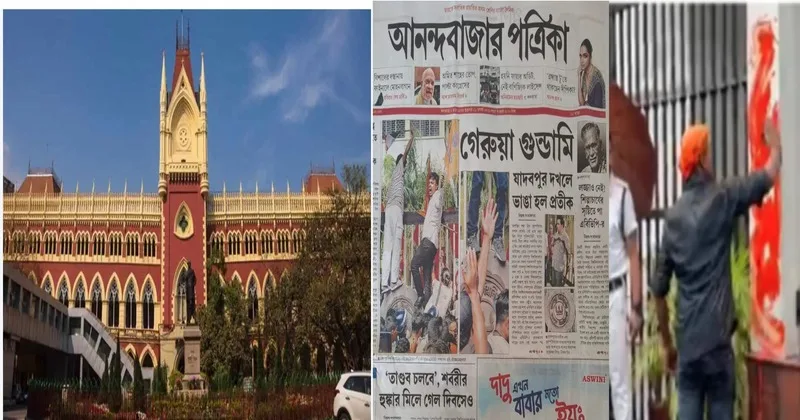
KOLKATA: Journalists of Anandabazar Patrika who are facing criminal cases over the newspaper’s use of the expression “Gerua Gundagiri”, or “saffron hooliganism”, did not get an urgent hearing from the Calcutta High Court on Wednesday.
Senior Advocate SN Mookherjee mentioned the matter before Justice Saugata Bhattacharya, seeking immediate intervention against multiple FIRs arising from the publication’s coverage of violence at Jadavpur University. The journalists propose to seek quashing of the criminal cases.
The Court was not persuaded to specially fix the matter.
Justice Bhattacharya indicated that the quashing petition should first be filed in the regular course and would then come up according to the applicable listing procedure. “I cannot start fixing matter. It will come,” the Court observed. When counsel pressed the urgency and referred to the situation faced by two senior women journalists, the Bench still declined special listing, while indicating that an attempt could be made to reach the matter after filing. In other words, the Court refused preferential listing; it did not refuse judicial review.
That procedural detail matters. The High Court has not upheld the FIRs or ruled on whether the phrase “Gerua Gundagiri” constitutes an offence. It has only declined, at this stage, to grant the matter an exceptional urgent hearing.
The controversy nevertheless raises a question beyond the FIRs.
“Saffron” is not merely a political colour. For Hindus, it is sacred, associated with renunciation, sacrifice and the spiritual traditions of Hindu civilisation. The expression “saffron terror” was itself first coined by journalist Praveen Swami and has since been used as a political label rather than a precise description of criminal conduct. A newspaper is free to criticise violence allegedly committed by members of a political or student organisation. But attaching “saffron” to “hooliganism” or “terror” inevitably casts suspicion beyond the alleged perpetrators and onto a religious-cultural symbol.
The inconsistency is difficult to ignore. When terrorism is associated with Muslims, the repeated and correct proposition is that terrorism has no religion. Yet that principle appears to disappear when allegations involve Hindus or organisations identified with Hindu causes. The same standard must apply in both directions: criminality should be attributed to individuals or organisations responsible for it, not to an entire faith or its sacred symbols.
That is precisely why editorial language deserves scrutiny, even while freedom of the press remains protected.