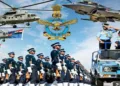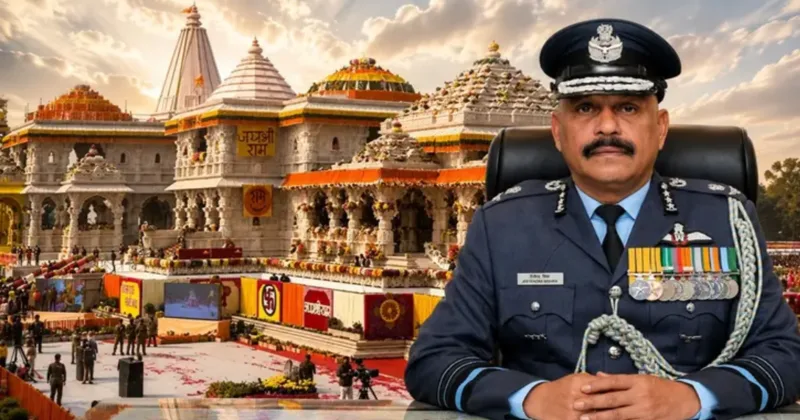
In the early hours of May 7, 2025, when Indian aircraft struck nine terror facilities across the western border in answer to the Pahalgam massacre, the campaign was directed from the operations rooms of the Indian Air Force’s Western Air Command. At the head of that command stood Air Marshal Jeetendra Mishra, the officer on whose judgement every sortie of Operation Sindoor finally rested.
For the four days between the first strikes of May 7 and the silence of May 10, his command was the sharp edge of India’s response. Western Air Command faces Pakistan across the most sensitive frontier in the subcontinent, and through those days its aircraft, its radars and its decisions were the country’s shield and its sword. Some 45,000 air warriors looked to one man for direction.
This week, the Shri Ram Janmbhoomi Teerth Kshetra Trust announced that the same man will be the first Chief Executive Officer of the Ram Mandir at Ayodhya. And tucked into the honorifics after his name is a decoration that explains why: the Sarvottam Yudh Seva Medal.
Some medals are given for a moment. A soldier holds a bridge, storms a post, shields his men, and the nation remembers the act forever. The Param Vir Chakra belongs to that family of honours. The Sarvottam Yudh Seva Medal is a different kind of decoration. It is not given for a single act of courage. It is given for running a war.
Instituted on January 26, 1980, it is the country’s highest award for distinguished service during conflict. It goes only to officers who carry the highest operational responsibility when hostilities begin, and only when their service has been, in the words of the statute, of the most exceptional order. The bar sits so high that in 46 years it has been awarded just ten times. Six of those ten medals came on a single morning, Independence Day 2025, when the President decorated the commanders of Operation Sindoor. Air Marshal Mishra’s was among them.
Now consider what he takes charge of, because the scale is not smaller. It is arguably larger.
Since the Pran Pratishtha of Ram Lala in January 2024, Ayodhya has become one of the great pilgrimage destinations of the world. Tens of thousands of devotees pass through the temple’s darshan lines on an ordinary day. On Ram Navami and other festivals, that number multiplies until the town itself becomes an extension of the temple. Every one of those devotees must be received, moved, protected and sent home with the darshan they came for. Behind them stands an institution that must manage security in coordination with state and central agencies, steward offerings that arrive in crores with total transparency, maintain a vast complex that is still growing, host dignitaries from across the world, and do all of it every single day, without a holiday, without a bad day, in the full glare of national attention.
That is not a temple administration problem in the old sense. It is one of the most demanding institutional management challenges in the country. It is why the Trust created the office of Chief Executive Officer, and why its search committee spent two months sifting 5,585 applications undergone multiple rounds of screening, verification and interviews; through secretariat lead by Shri Sameer Panda using AI, Information Technology, personal interactions and verifications through a team of dedicated volunteers like Nitesh Mishra, Nippon Dash, Nikhil Srivastava, Gyana Ranjan Panda, Vaibhav Jape and others; before placing a panel of three names before the Trust.
Seen against that job description, the medal reads differently. A wartime service decoration measures planning, logistics, judgement under pressure, coordination across agencies, and the ability to hold an enormous organisation steady while the world watches. Strip away the uniform and those are precisely the capacities the Mandir requires. The Trust did not go looking for a war hero. It went looking for a proven administrator of vast, high-stakes institutions, and found a man whose competence had been certified in the hardest audit there is.
Medals are usually the end of a story. In Ayodhya this week, one turned out to be a beginning.