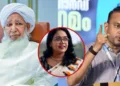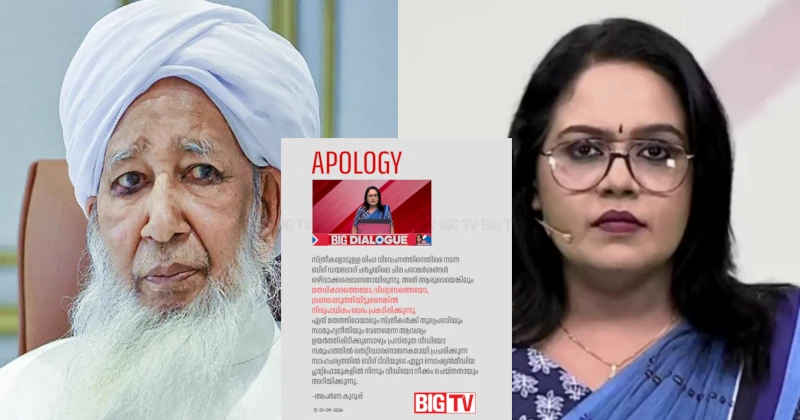
When influential Islamic scholar Kanthapuram A.P. Aboobacker Musliyar declared that women must stay confined to their homes and that putting them on public platforms causes “great destruction,” a Kerala TV anchor pushed back hard. She cited Colonel Sofiya Qureshi as an example—a Muslim woman officer of the Indian Army who publicly represented India during Operation Sindoor, addressing the nation and the international audience —as living proof that women from the community already command public stages with distinction, competence, and national pride. “We have Sofia Qureshi,” the challenge rang out.Then the voice vanished. The episode was deleted. An unconditional apology followed. The question that remains is not whether the misogyny was real—it was on record—but why the one who named it was forced to go mute.
A disturbing controversy in Keralam has once again raised a fundamental question about freedom of expression: Does press freedom remain sacred when a journalist questions regressive religious views or does it suddenly become negotiable when the criticism touches powerful religious establishments?
The controversy erupted after senior Sunni cleric Kanthapuram A P Aboobacker Musliyar, popularly known as Kanthapuram, made strong remarks about women’s place in public life. Speaking at the Hubbul Rasool conference in Kochi, he said women should remain within their homes and should not enter the public sphere, presenting purdah as a means of protecting women.
His comments did not come in isolation. Days earlier, the Kanthapuram faction of the Samastha Keralam Jamiyyathul Ulama had issued a directive concerning women’s participation in public programmes. The circular urged Mahall committees, mosques, madrasas and other institutions to ensure that young women were not present among unrelated men on public roads and stages, describing such participation as impermissible.
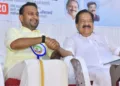
That directive itself triggered criticism, including from CPI(M) leader and former minister P.K. Sreemathy, who questioned the derogatory use of the word “display” in reference to women. But the more disturbing question emerged when a journalist challenged such thinking.
This Is the Real “Kerala Story”
A journalist in Keralam questioned a statement that women should stay at home and not appear in public.
Instead of questioning that regressive statement, the journalist who spoke against it was forced to apologise, while the channel removed the… pic.twitter.com/0cG45KpQcv
— Midhun Babu / മിഥുൻ ബാബു🇮🇳 (@MidhunBabu_X) September 1, 2026
The crime? Questioning misogyny
Television journalist Aparna Kurup, associated with BIG TV 24×7, questioned the logic behind such remarks and the restrictions being advocated in the name of religion. Her professional profile identifies her as a television journalist with more than two decades of broadcast-news experience.
What followed, according to the apology issued by BIG TV and circulated in connection with the controversy, was a remarkable retreat.
The channel expressed regret for remarks made during a Big Dialogue discussion on gender discrimination, stating that some remarks should have been omitted and that the video had been removed from its social-media platforms because of what it described as the “misleading nature” of the video being circulated.
Apology from a TV journalist in Keralam.
Her crime…She called out the dangerous misogynistic actions prevalent in Keralam in the name of religion.
All hell broke loose. How can she say that???
Now, people in Keralam knows the true meaning of "suppression of dissent". pic.twitter.com/QH7yqG1EUh
— Colonel S Dinny (Retd) (@sdinny14) September 1, 2026
The episode raises a deeply uncomfortable question: Why was the journalist required to apologise for questioning a restrictive view of women, instead of the restrictive view itself becoming the subject of serious scrutiny?
That is where the issue moves beyond one journalist, one channel or one religious organisation. It becomes a question about the health of public discourse in Keralamm.
The contradiction at the heart of the controversy, Kanthapuram did not merely make an abstract theological observation.
He reportedly argued that women should remain confined to their homes and invoked the Quran to support his position. He compared women with gold jewellery, arguing that just as a valuable necklace is kept safely inside a box to preserve its beauty and value, women should be protected from the public sphere. He also warned that bringing women into public life could lead to “great destruction.”
These are precisely the kinds of statements that should invite vigorous questioning in a democratic society. Instead, the controversy appears to have shifted toward the journalist who questioned them.
A journalist challenging a political leader is routinely described as performing her democratic duty. A journalist challenging a government is celebrated for asking uncomfortable questions. A journalist questioning powerful institutions is often praised for speaking truth to power.
Religious freedom cannot mean immunity from criticism
There is an important distinction that must not be lost in the debate. Every religious community has the right to practise its faith. Religious scholars have the right to interpret their scriptures. Individuals have the right to voluntarily follow religious practices.
But the right to express a religious opinion cannot automatically create a right to immunity from criticism. If a cleric says women should remain inside their homes, journalists have every right to ask what that means for women’s education, employment, political participation, social mobility and constitutional equality.
If a religious organisation tells its institutions to prevent women from appearing alongside unrelated men in public programmes, society has every right to debate whether such prescriptions reinforce gender discrimination.
That is not an attack on a religion. It is journalism. And journalism loses its meaning if the journalist must first calculate whether questioning a particular religious authority will trigger outrage, pressure or demands for an apology.
The controversy comes at a time when the Samastha directive itself has generated substantial public criticism.
The organisation’s statement specifically objected to young women being present among unrelated men on public roads and stages and called on community institutions to ensure that programmes remained within what it described as Islamic norms.
The issue has already drawn criticism from political figures and women’s-rights voices. P.K. Sreemathy, for instance, questioned the language used by the organisation and sought a clear response from IUML MLA Fathima Thahiliya.
Who will defend the journalist?
The most important question now is not whether Kanthapuram has the right to hold his views. He does. The question is whether Aparna Kurup had the right to challenge them. She did.
And if a journalist can be pushed into apologising for questioning a statement about women’s place in society, then Keralam’s much-celebrated culture of debate needs some serious introspection. Freedom of speech cannot be reserved for opinions that nobody finds uncomfortable.
Press freedom cannot depend on the religious identity of the person being questioned.
Meanwhile, BJP Alappuzha South District President Sandeep Vachaspati has come out in support of Aparna, alleging that she is being targeted by religious extremists. Vachaspati said reports had emerged of attacks on some Big TV offices in the Malabar region, but accused the channel’s management of allegedly capitulating to Islamist pressure by neither reporting the incidents nor pursuing legal action.
He also criticised the channel for publishing an apology in Aparna’s name, alleging that the decision reflected pressure from religious extremists rather than support for the journalist.