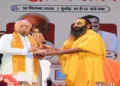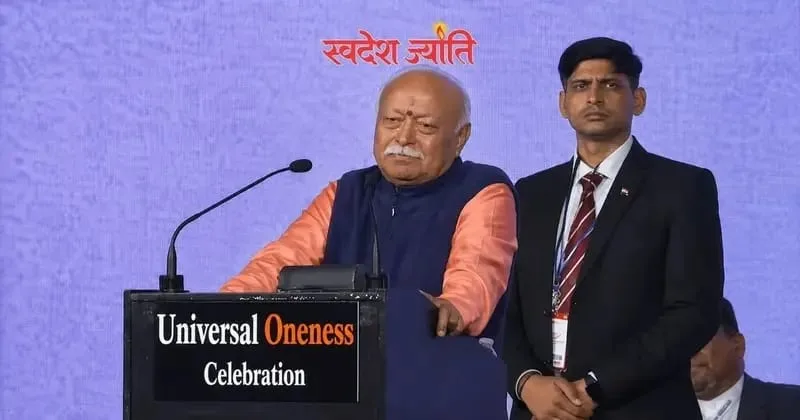
New York: The RSS Sarsanghchalak’s Madison Square Garden address was more than a diaspora event – it was a civilisational translation for a global audience. When Rashtriya Swayamsevak Sangh (RSS) Sarsanghchalak Dr Mohan Bhagwat walked onto the stage at Madison Square Garden on August 29 for the ‘Universal Oneness Celebration’, it was more than a diaspora event. It was the RSS attempting to translate its civilisational vocabulary for a global audience.
Organised by the AHEAD Forum—American Hindus for Engagement and Dialogue—in association with over 135 Hindu-American organisations, the event brought together more than 5,000 Indian-Americans, 180 religious leaders from 30 countries, and community groups from across the US northeast. The timing was deliberate: the RSS centenary year, Raksha Bandhan festival reimagined as a day of universal kinship, and a theme drawn straight from Sanskrit—Vasudhaiva Kutumbakam—the world is one family.
In a 42-minute keynote, Bhagwat ji avoided political talking points and focused on a philosophical distinction between two models of handling diversity. “When we say America, one word is often discussed—pluralism. When we say Bharat, another phrase is discussed—unity in diversity. For Bharat, this unity and diversity, both are in its DNA,” he said. Quoting Swami Vivekananda, he argued that nations are not merely geographical entities but have a civilisational duty: “Every nation has a message to give. Every nation has a mission to accomplish. Every nation has a destiny to fulfil.” According to him, India’s mission is to demonstrate that diversity and oneness can co-exist without one cancelling the other. The event also saw a five-point resolution where global religious leaders rejected the use of religion to justify hatred and called for standing up for the dignity of any community threatened with humiliation or violence under the banner of ‘One World One Humanity’.
The conglomeration is a great manifestation of the growing significance of RSS as a cultural movement. The following three reasons make it important for the USA at this time. Firstly, for decades, RSS has been seen through the angle of political nationalism, especially amongst Western scholarship and the community. In New York, the packaging was different—service, civic responsibility, interfaith dialogue and global harmony.
The event, as per the official version, is seen as an “inclusive interfaith gathering where Bhagwat will communicate with a diverse, multicultural, multi-faith audience”. This is not just optics, and RSS has been consciously reaching out to minorities, Gen Z, and overseas intellectuals to correct what it calls ‘misconceptions about the organisation’. The US tour, which also includes Canada and the UK, is part of that outreach. Secondly, the event did not go unopposed. The US Commission on International Religious Freedom (USCIRF) reportedly sought visa revocation, and New York City Mayor Zohran Mamdani—the city’s first Muslim and Indian-American mayor—publicly opposed the rally, calling RSS vision exclusionary. The RSS response was impressive. Prachar Pramukh Sunil Ambekar ji called it an open platform for dialogue and invited even the critics to join. Organisers kept the focus on Raksha Bandhan, civic participation and seva. In a way, the controversy highlighted exactly why a concept like universal oneness needs articulation in America today – a society already fraught with its own questions of social cohesion, pluralism and identity.
Bhagwat ji messaged the diaspora to be loyal to their Karma Bhumi, while being rooted in deep-rooted cultural values and ethos. For second- and third-generation Hindu-Americans, who often feel split between assimilation and identity, the idea of oneness offers a great guiding path-integration without destruction. By bringing together several linguistic and cultural organisations like Telugu associations, Gujarati mandirs, yoga groups, and interfaith leaders on one platform, AHEAD demonstrated how a pluralistic community can unite around common values while preserving diversity.
The Universal Oneness Celebration in the USA is significant for three reasons. It places Indian thought in the global ethics perspective. At the present juncture, the US is debating DEI, i.e Diversity, Equity, and Inclusion, a social framework prevalent in the US in offices, educational institutions and governance with a view to ensuring fair treatment of all people. Mohan Bhagwat ji also referred to the same debate when he raised the issue: How do you manage diversity? While the American model has been pluralism through DEI, the Bharatiya model is ‘unity in diversity through openness’. The Bharatiya idea of oneness—which accepts difference as natural and unity as underlying – offers an alternative to both forced homogenisation and endless fragmentation.
The event manifests the evolution of India’s soft power. So far, our soft power was Bollywood and yoga, but now dharma, danda and nyaya as frameworks for public ethics may help Bharat to earn its legitimate hegemony in the galaxy of nations. Bhagwat’s speech linking unity in diversity to contemporary public life resonates with the Indian Knowledge System. Above all, it tests whether a 100-year-old organisation can voice a global language. Can it move from being seen as a domestic cultural organisation to a global civilisational movement? The Madison Square Garden stage, where Vivekananda once defined and defended the Asian perspective and Hinduism for the West, was symbolically powerful.
The significance of the Universal Oneness Program lies in the fact it has compelled a new narrative – one where the question is not whether the world is or should be “one family”, but how we practice that oneness though we have disagreements. For nations like India and the USA, two political societies that pride themselves on diversity, the message from New York is simple and straight: diversity should be celebrated, but oneness must be realised.