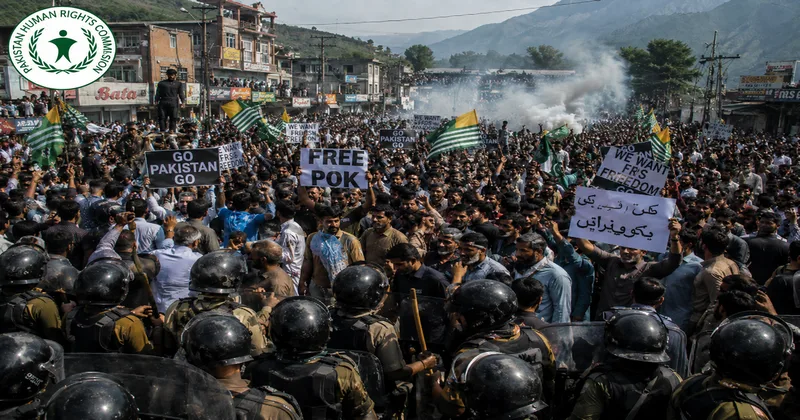
A report by the Human Rights Commission of Pakistan (HRCP) has attributed the unrest in Pakistan-occupied Jammu Kashmir (PoJK) to longstanding political and socio economic grievances, institutional distrust and governance deficits. The security forces resorting to coercive measures in place of sustained dialogue appears to have deepened polarisation and eroded public trust, it said its report released on Saturday in Islamabad.
“An increasingly confrontational state response, including the disproportionate use of force, has further deepened polarisation and eroded public trust”, the HRCP said. The commission added its mission received sharply conflicting accounts about the scale of violence and the conduct of security forces. Its members were keen to meet the officials in Rawalakot which has seen the worst violence since early June. However, despite initially agreeing to meet them, senior officials like Deputy Commissioner and Assistant Deputy Commissioner cancelled the meetings. The complete report has been posted online.
The crisis has had implications for a wide range of rights and freedoms beyond the elections, including the rights to life, liberty and security of person; freedom of expression, peaceful assembly and association; freedom of movement; access to information; and participation in public affairs, the report said pointedly.
Lethal, excessive use of force against protesters
The mission said it is particularly concerned about allegations of lethal and excessive use of force against protesters. It received multiple accounts alleging that protesters had been killed or seriously injured by security forces but was denied access to Rawalakot to independently verify these claims.
The use of anti-terrorism legislation against persons engaged in political dissent raise serious questions regarding necessity and proportionality, it said. Restrictions on access to information further constrained civic space. Arrests and legal action against journalists, restrictions on access to affected areas, special security requirements and the prolonged communications shutdown severely limited independent reporting, the commission said.
The communications shutdown also disrupted banking, education, commerce, transport, public administration and healthcare. Its duration and geographical scope raise questions concerning its legality, necessity and proportionality. Restrictions imposed on communications for public-order or security purposes should have a clear legal basis and be strictly necessary and proportionate to a legitimate objective, the commission stressed.
Constrained environment leads to doubts about credibility
Overall, this strained the credibility of elections as these were conducted within this severely constrained civic environment, it pointed out. The credibility of elections depends on the wider environment in which voters, candidates, political parties, journalists and civil society can exercise their rights. The 2026 electoral process must therefore be assessed in the context of the restrictions and alleged violations that preceded and accompanied it, the commission has concluded.
An independent assessment of the electoral process, including the effects of the boycott, security restrictions etc should be made, it recommended. Elections to 45 out of 53 seats to the PoJK legislative assembly were held in three phases from July 27 to August 10. The elections to rest of seven seats have been postponed indefinitely with these seats lying in Poonch and Sudhnoti districts.
The banned Joint Awami Action Committee (JAAC) has been holding protests for long demanding scrapping of 12 refugee seats. It has alleged that the establishment manipulates these seats to install a Prime Minister of its choosing.
After negotiations between the government and JAAC failed on May 30, the government proscribed the organisation on June 5 under an anti-terrorism act. Overnight, those who were talking to the government in a bid to resolve the issues were declared terrorists at the whims and fancies of the government.
JAAC claims 400 people killed since early June
According to the JAAC, over 40 people were killed during the first phase of polls held on July 27. Besides, it claims that some 400 protesters have been killed since the first week of June, a claim refuted by the Federal government.
The HRCP expressed particular concern at the allegations of “lethal and excessive” use of force against protesters. It said it received multiple accounts from families, alleging that a number of protesters had been killed or seriously injured by the security forces. The provincial police chief had reported around 38 security personnel killed since June, it added. However, he provided no details of any civilians killed and did not cooperate with the commission.
“We could not independently establish the full scale or circumstances of civilian casualties, particularly because the team was unable to access Rawalakot, one of the main centres of violence”, the commission said and called for an independent and impartial investigation into all deaths and serious injuries since June, including “whether the use of force was lawful, necessary and proportionate”.
The report also raised concerns at the government’s use of anti-terrorism and preventive-detention provisions against political activists. “Heavy deployment of security personnel, prolonged communications restrictions, boycott by major political actors, phased polling and postponement of seven constituencies raised wider questions about the credibility of the electoral process,” the HRCP report said about the PoJK polls.
Illegal, forcible occupation of PoJK areas
India maintains that the entire Union Territories of Jammu & Kashmir and Ladakh are its integral and inalienable parts. New Delhi also asserts that Pakistan has been in “illegal and forcible occupation” of parts of these Uts. On August 4, India had described the so-called local body elections in PoJK a “complete farce,” asserting that such “hollow” exercises cannot hide the ground reality in the region.
The Ministry of External Affairs (MEA) strongly criticised Pakistan’s crackdown on protesters in PoJK and said the international community should see through the “flimsy veneer” of Islamabad’s “hypocritical lecturing” on human rights.
“This so-called local election in PoJK is a complete farce. The real happening is that of public protests and wanton killings by Pakistani forces. Such hollow exercises cannot hide reality”, MEA spokesperson Randhir Jaiswal said at a regular media briefing.
The HRCP report called for independent review of cases against protesters, activists, journalists and political workers, with cases withdrawn where individuals had been detained or prosecuted solely for peaceful political activity or lawful assembly.
It also chided restrictions on journalism and access to information, saying journalists had faced arrests, legal action, restrictions on access to affected areas and special security requirements while the prolonged communications shutdown severely constrained independent reporting and verification of deaths, injuries, arrests and alleged electoral irregularities.
“The communications shutdown went far beyond political activity, disrupting banking, education, commerce, transport, public administration and healthcare”, it said.
Report recommends all encompassing political dialogue
HRCP concluded that the crisis could not be adequately explained through a single narrative. The government and security authorities characterised the situation as an organised armed challenge requiring extensive security measures, while JAAC supporters and several political actors regarded it primarily as a political movement whose grievances had been met with excessive force.
The commission nevertheless found broad recognition among stakeholders that the underlying grievances required a political response, warning that the resort to coercive measures instead of sustained dialogue had deepened polarisation and eroded public trust.
It has therefore recommended an inclusive and structured political dialogue involving JAAC representatives, political parties, elected representatives, lawyers, civil society, journalists and other stakeholders.