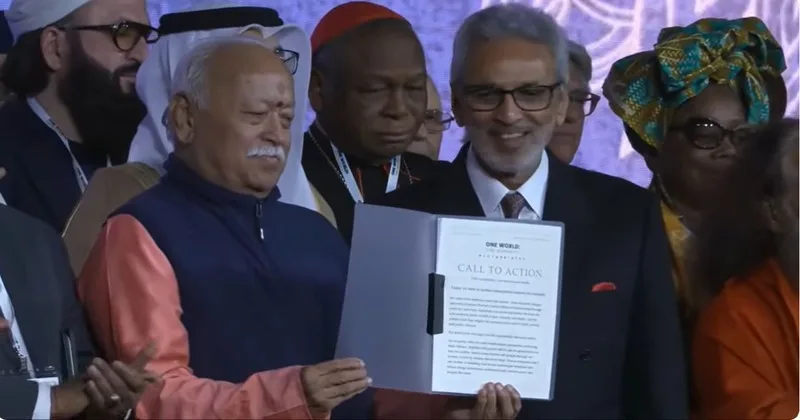
NEW YORK: Recognising a “consequential moment for humanity,” spiritual leaders representing centuries-old traditions gathered under the banner of The World Council of Religious Leaders in New York City to issue an urgent appeal for moral accountability and collective action. on August 29
The declaration—published as part of the “One World: One Humanity Summit”—acknowledges both the healing power of faith and the painful reality that religious dogmas have frequently been exploited to incite violence, exclude marginalized groups, and deepen social divides.
Highlighting ongoing wars, the breakdown of public trust, and the rapid spread of digital hatred across borders, the assembly stressed that governments and tech institutions cannot carry the burden of peace alone. Religious leaders, the text asserts, possess a unique moral responsibility to bridge fractured communities.
#UniversalOneness | RSS (@RSSorg) Sarsanghchalak Dr Mohan Bhagwat (@DrMohanBhagwat) presented call for action resolution of 200 religious leaders. pic.twitter.com/3KLvJvdesV
— Organiser Weekly (@eOrganiser) August 29, 2026
“Every human being has dignity, no community is less human than another, and the suffering of another cannot be irrelevant simply because it is not our own,” the declaration states, reinforcing that defending the humanity of others does not diminish one’s own faith convictions.
The Five Core Commitments
To translate shared values into tangible social outcomes, the summit outlined five foundational commitments for religious institutions worldwide:
Beginning with Themselves: Leaders pledged to examine their own internal practices, words, and teachings, explicitly rejecting any attempt to use religion to justify humiliation, hatred, or violence.
Standing for One Another: The declaration binds participating communities to speak out whenever any group is dehumanized or targeted, regardless of geographic distance or religious identity.
Building Relationships Before Crisis: The initiative calls for proactive cross-cultural and interfaith connections—particularly among youth—to dismantle stereotypes before conflicts arise.
Serving Together: Emphasizing shared labor over competitive recognition, communities are urged to collaborate directly on humanitarian relief for the hungry, sick, displaced, and persecuted.
Taking Responsibility for the Future: Faith leaders committed to exercising moral oversight on critical global challenges, including war, poverty, environmental stewardship, and emerging technologies such as Artificial Intelligence, insisting that tech progress must serve human dignity rather than undermine it.
A Mandate for Local Implementation
Rejecting passive agreements, the summit called on every attending leader to execute at least one specific, localised action item—such as creating interfaith platforms for youth, supporting targeted communities, or initiating difficult dialogues.
“A global declaration matters only if it becomes local action,” the document notes, acknowledging that while faith leaders alone cannot eliminate all injustice, every act of courage makes another possible. “One World. One Humanity. Not because we are all the same. Not because we agree on everything. But because our dignity is shared, our futures are connected, and the world we leave behind will be shaped by what we choose to do now.”