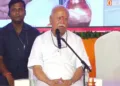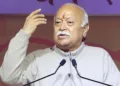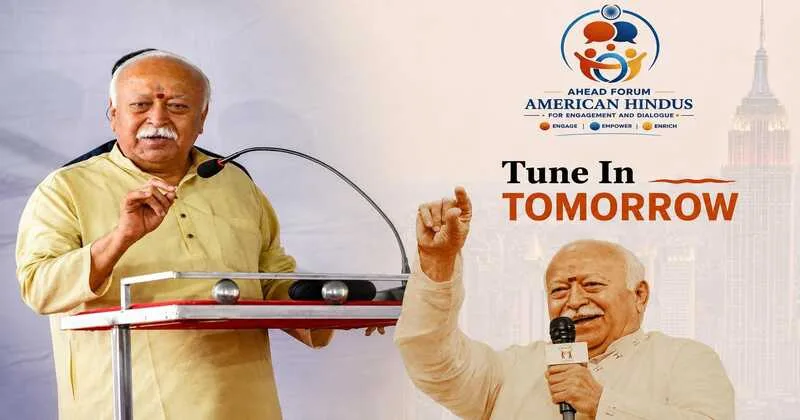
The Rashtriya Swayamsevak Sangh chief Dr. Mohan Bhagwat’s tour of the United States, Canada, and the United Kingdom is not merely a schedule of meetings and public speeches, it is also an opportunity for a comprehensive dialogue regarding India’s cultural heritage, intellectual traditions, and contemporary aspirations. At a time when India is establishing a strong presence on the global stage, this tour provides a significant platform to articulate the ideas, institutions, and social philosophies that have shaped one of the world’s oldest continuous civilizations. Therefore, the proposed interactions and discussions by the RSS chief in these countries should be viewed within the broader context of India’s cultural tradition of Samvad (dialogue). Indian intellectual tradition has consistently emphasized debate, discussion, inquiry, and the pursuit of truth through diverse perspectives. The tradition of the Upanishads, Buddhist philosophical debates, the practice of Shastrartha (scholarly discourse), and the intellectual exchanges among various schools of Indian philosophy bear witness to a culture where knowledge was not merely hoarded but was subject to constant discussion, scrutiny, and dissemination. It is in this context that the tour assumes significance. It offers people in Western nations an opportunity to engage directly with the organization that has played a major role in shaping aspects of contemporary Indian public life, rather than relying solely on the interpretations of others to understand it.
For decades, the world’s perception of India has largely been shaped by perspectives developed outside the country. While Western universities have conducted extensive research on India, greatly aiding our understanding of its history and society, this scholarship was often accompanied by colonial viewpoints that fostered enduring stereotypes. One such distorted image portrayed India merely as a land of snake charmers, superstition, poverty, and bizarre religious rituals, thereby overshadowing the intellectual, scientific, technological, and philosophical achievements of Indian civilization. The contributions of Indian mathematicians to the decimal system and complex mathematical concepts, the astronomical traditions demonstrated by personalities like Aryabhata, the philosophical depth of the Upanishads and the Nyaya school of thought, and rich traditions in medicine, metallurgy, architecture, and linguistics, all attest to India’s possession of highly advanced systems of knowledge. During the colonial era, India was frequently viewed through a lens that equated progress with European modernity while regarding indigenous traditions as signs of backwardness. Although historical research has since moved far beyond such simplistic and one-sided thinking, its intellectual imprint has not entirely vanished. Therefore, the challenge today lies not in rejecting Western knowledge, but in fostering a genuine and reciprocal intellectual engagement between India and the rest of the world. There is now a growing confidence within India that it can make meaningful contributions to global discourse. The visit by sarsanghchalak Dr. Mohan Bhagwat can be understood in the context of this emerging civilizational self-confidence.
The concept of Indian knowledge cannot be confined merely to a collection of ancient texts or religious rituals. The Indian knowledge tradition is a comprehensive intellectual system encompassing philosophy, mathematics, astronomy, medicine, linguistics, ethics, statecraft, environmental science, architecture, education, and social thought. A distinctive feature of this tradition was the connection between knowledge and life, knowledge was not viewed merely as an isolated academic pursuit but was deeply intertwined with ethics, social responsibility, personal conduct, and the broader purpose of human existence. Indian philosophical traditions developed profound and complex arguments regarding knowledge. Various schools of thought debated the nature and sources of true knowledge, the relationship between direct experience and inference, the nature of consciousness, the connection between the individual and the universe, and the meaning of liberation. While acknowledging the significance of these traditions in today’s world, we must be careful not to exaggerate their importance to the point where every ancient Indian idea is equated with modern science. At the same time, India’s intellectual heritage should not be presented in an overly idealized or sentimental manner. Civilizations should be studied with a critical eye, yet critical inquiry need not entail the rejection of one’s own civilization. There is a growing need to re-examine Indian intellectual traditions through rigorous study and to integrate them with contemporary knowledge systems. Perhaps this is one of the most significant aspects of India’s current cultural awakening.
RSS and the question of social engagement
Rather than viewing the Rashtriya Swayamsevak Sangh solely through a political lens, it is essential to understand it from historical and institutional perspectives. Established in 1925 by Keshav Baliram Hedgewar, the organization developed a unique model of social organization rooted in discipline, volunteerism, community participation, and a sense of social responsibility. Over the decades, its activities have spanned various domains of social service and community work. Supporters highlight its efforts in promoting education, relief work, rural development, social service, disaster management, and social unity. Conversely, critics have raised questions regarding its ideology and its influence on Indian public life. These differing perspectives are part of democratic discourse. However, given that the RSS has become a significant social institution, it should be understood through direct engagement, study, and dialogue rather than through preconceived notions. Therefore, a public dialogue between the RSS chief and people from the US, Canada, and the UK could prove to be a valuable initiative. This would offer those unfamiliar with the organisation a direct opportunity to learn how its leadership views its history, philosophy, social objectives, and vision for India. Those who disagree with the RSS should also have the opportunity to participate in this dialogue, after all, dialogue is meaningful precisely because the participants need not share the same opinions.
When a prominent figure or organization travels abroad, they may encounter both support and opposition. Peaceful criticism and democratic dissent are legitimate and no institution should be considered beyond scrutiny. However, there is a distinction between criticism rooted in informed disagreement and opposition based on preconceived notions. If an organization or individual has objections regarding the RSS, the best approach is to engage with its ideas, examine its history, question its leadership, and present counter-arguments. Attempts to completely shut down dialogue can sometimes yield results contrary to the critic’s intentions, such actions often spark public curiosity. Those with no direct exposure to the RSS might naturally wonder why the organization is facing such vehement opposition. In this sense, the visit itself can serve as a learning opportunity. Many people in Western societies have limited knowledge of India’s contemporary social organizations and intellectual traditions. Hearing the RSS chief speak directly could inspire them to ask questions and gain an independent understanding of the subject. This is how healthy intellectual discourse should unfold.
This visit is highly significant in the context of India’s evolving relationship with the world. For centuries, India’s intellectual ties with the outside world were shaped by unequal political circumstances. The medieval period witnessed repeated political upheavals, while colonial rule imposed a new hierarchy that accorded undue authority to European political and intellectual categories. British colonialism not only exercised political control but also influenced the ways in which India was portrayed, classified, and studied. Colonial knowledge systems often served administrative purposes, interpreting Indian society through categories that reflected European perceptions. Yet, India never remained intellectually passive, Indian scholars, philosophers, scientists, artisans, mathematicians, physicians, and artists nurtured and advanced traditions of knowledge even under extremely challenging conditions. Although political independence was achieved in 1947, the process of intellectual decolonization has been far more protracted and complex. Today, however, India’s position is different. It stands as one of the world’s major economies, a significant technological power, a key diplomatic player, and a nation with growing global influence. Its diaspora has also established extensive networks across North America, Europe, and other parts of the world. Consequently, India’s engagement with the world is no longer primarily about proving why it deserves respect, rather, it is increasingly about contributing to the global conversation.
There was a time when knowledge was believed to flow primarily from the West to India. Today, India is consistently challenging this one-sided model. This does not imply a rejection of Western science, philosophy, or institutions, India has benefited greatly, and will continue to benefit from global intellectual exchange. The crucial point is that this exchange must be reciprocal. India can both learn from the world and share its own intellectual resources with it. This becomes even more vital as we grapple with issues such as social divisions, environmental crises, mental health, technological shifts, ethical dilemmas, and the relationship between material progress and human well-being. Indian philosophical traditions embody centuries of reflection on self-discipline, interconnectedness, duty, restraint, compassion, and the relationship between humanity and nature. While these ideas should not be presented as simple solutions to complex modern problems, neither should they be dismissed merely because they differ from prevailing Western thought. The global intellectual community should have the opportunity to critically analyze them.
The Indian diaspora as a bridge
The RSS chief’s visit to the US, Canada, and the UK is significant because these countries are home to a large and influential diaspora of Indian origin. People of Indian origin have emerged as a vital link between India and the rest of the world, making substantial contributions to medicine, technology, education, business, administration, and cultural life in the countries they now call home. However, the question of cultural identity can be complex for young people born or raised outside India, they often wish to understand India not merely as the land of their parents or grandparents, but as a vibrant and rapidly evolving civilization. Connecting with Indian knowledge traditions can offer a pathway in this quest. Consequently, the significance of the dialogue with the RSS chief extends far beyond the confines of the organization itself, it can contribute to a broader conversation about what it means to remain connected to India’s cultural heritage in today’s globalized world. It is natural for there to be varied reactions to the international recognition being accorded to Indian institutions, ideas, and cultural traditions. While some may welcome this with enthusiasm, others might view it with skepticism. There may also be those who fear that the robust worldview rooted in Indian civilization could challenge established notions regarding India’s history and identity. Such diverse opinions are to be expected. India should neither respond to criticism from a place of insecurity nor succumb to the arrogance of triumph upon gaining international recognition. A prudent approach is one that combines self-confidence with openness. If the RSS believes its ideology and social initiatives can contribute to global discourse, it should be prepared to articulate its views publicly. Conversely, if critics perceive flaws in these ideas, they should feel free to voice their objections openly. Dialogue or samvad serves as the appropriate platform for this exchange. It is here that India’s ancient tradition of samvad becomes relevant to the contemporary world.
Rediscovering India’s intellectual heritage is part of the broader process of “decolonization” (liberation from colonial mindset). Decolonization should not merely entail replacing one set of ideas or beliefs with another, rather, its aim should be to expand the intellectual horizon sufficiently to allow for serious engagement with Indian categories, concepts, texts, and experiences alongside global traditions. This endeavor is particularly crucial in the field of education. Through in-depth study, Indian students should come to understand both the achievements and the shortcomings of their civilization. They should study the history of mathematics, astronomy, medicine, philosophy, literature, technology, architecture, and statecraft in India. At the same time, they should be comfortable engaging with and understanding Greek, Chinese, Islamic, European, African, and other intellectual traditions. True civilizational understanding and self-confidence do not fear other civilizations, instead, they engage with them. Therefore, the objective should not be to establish a hierarchy in which Indian civilization is deemed superior to all others. Such a perspective would merely replicate the intellectual arrogance that India has historically opposed. The goal should be to create a diverse intellectual environment where no civilization is compelled to view itself solely through the lens or categories of another. Therefore, the Sarsanghchalak’s visit to Western nations should be viewed as part of the significant shift occurring in India’s relations with the international community. India is now more prepared to articulate its own perspective. This perspective need not be monolithic, India possesses immense diversity in terms of language, religion, philosophical traditions, political ideas, and social experiences. Yet, underlying this diversity is a long civilizational history of debate, coexistence, assimilation, and intellectual exchange. Thus, the most meaningful message India can convey to the world is not that its civilization is superior, but rather that it has cultivated ideas and experiences worthy of full participation in humanity’s shared intellectual discourse. As a prominent social organization in India, the RSS has every right to present its understanding of that civilization, just as its critics have an equal right to question it. However, such dialogue strengthens both processes rather than weakening them.
The real test is what follows the visit
Ultimately, the significance of this tour should not be measured merely by audience numbers, speeches delivered, or controversies sparked. Its true importance will be determined by what follows. Will universities conduct deeper research into Indian knowledge traditions? Will scholars from India and the West engage in sustained intellectual dialogue? Will the younger generation of the Indian diaspora become eager to learn more about India’s intellectual history? Will the discourse surrounding the Rashtriya Swayamsevak Sangh move beyond hackneyed stereotypes toward evidence-based, scholarly discussion? Will this tour foster a culture of dialogue among people holding divergent views? If the answer to these questions is “yes,” then this tour will have achieved something far more significant than merely garnering public attention, it will have contributed to a major intellectual movement. For centuries, others have narrated the story of India and RSS. The time has now come for RSS to participate in articulating its own story with full confidence, not by stifling criticism, but by fostering scholarship, not by disengaging from the world, but by connecting with it, and not by asserting absolute perfection, but by presenting its civilizational experience for serious examination. The world does not need another civilization claiming superiority, it needs civilizations that engage in dialogue with one another. Therein lies the profound meaning of Samvad. Therefore, the Sarsanghchalak’s tour of the United States, Canada, and the United Kingdom could be far more than just a series of speeches. It could become an opportunity for a dialogue between India’s cultural heritage and the contemporary global intellectual order. For a country once frequently viewed through the narrow lens of colonial stereotypes, this marks a significant moment of self-confidence. India is no longer merely adopting ideas from the rest of the world, it is rapidly preparing to share its own ideas as well. And instead of fearing this dialogue, the world should listen to it, question it, debate it, and above all engage with it.