India’s unorganised workforce is vast and diverse. It includes agricultural labourers, construction workers, domestic workers, street vendors, migrant workers, self-employed people, wage workers and, increasingly, gig and platform workers.
For many of these workers, access to government schemes can be complicated by the absence of a formal employment record or a common system through which their eligibility can be established.
The e-Shram Portal was designed to address this gap.
Launched by the Ministry of Labour and Employment in 2021, the portal created India’s first Aadhaar-authenticated National Database of Unorganised Workers (NDUW). It gives every registered worker a unique 12-digit Universal Account Number (UAN), creating a common digital identity that can be used to connect workers with social security and welfare services.
Developed by the National Informatics Centre (NIC), the platform was initially conceived primarily as a database. Its larger objective, however, was to create the digital foundation for better coordination between government schemes and the workers who need them.
That role has expanded significantly over the past five years.
As of August 18, 2026, e-Shram had recorded 31.89 crore registrations, making it one of India’s largest digital platforms focused on the unorganised workforce.
What is the e-Shram Portal?
The e-Shram system covers workers who operate outside the conventional formal employment structure.
An unorganised worker under the system can be a home-based worker, self-employed person or wage worker in the unorganised sector. The broader eligibility framework also covers workers in the organised sector who are not members of the Employees’ Provident Fund Organisation (EPFO), Employees’ State Insurance Corporation (ESIC) or government employees.
The objective is not simply to count workers.
The database is intended to help government departments identify workers, understand their occupational and demographic profiles and connect eligible beneficiaries with welfare programmes.
It also seeks to facilitate convergence between different ministries and departments by enabling secure data sharing through APIs.
This becomes particularly important for workers whose circumstances change frequently. A construction worker or migrant worker, for instance, may move from one State to another in search of employment. A national database can potentially make welfare access less dependent on a worker remaining in one location.
31.89 crore workers registered in five years
The growth of e-Shram is reflected in the scale of its registrations.
By August 18, 2026, 31.89 crore workers had registered on the platform.
Women account for 54.28 per cent of registered workers, while men account for 45.72 per cent.
The age profile shows that the platform has reached a large working-age population. Workers between 18 and 40 years constitute 55.21 per cent of registrations. Those between 40 and 50 years account for 24.18 per cent, while workers above 50 make up 20.53 per cent. The 16-18 age group accounts for 0.08 per cent.
The registrations also cover a wide range of occupations. Agriculture, domestic and household work, construction and apparel are among the occupational categories with the largest numbers of registered workers.
The five States with the highest number of registrations are Uttar Pradesh, Bihar, West Bengal, Madhya Pradesh and Maharashtra, highlighting the platform’s reach across some of India’s largest labour markets.
Why the database matters for welfare delivery
For workers in the informal economy, access to social security has historically been fragmented across different schemes, departments and administrative systems.
A worker may qualify for more than one government programme but may not necessarily know which schemes are available or how to access them.
e-Shram seeks to address this fragmentation by creating a common digital platform.
Its objectives include bringing greater convergence between welfare schemes, facilitating access to benefits, improving portability for migrant workers and helping governments use worker data for policy planning.
The database can also play a role during emergencies and crises by providing governments with information about different categories of workers and their locations and occupations.
In this sense, the platform is intended to function as more than a registration system. It is designed as a digital infrastructure layer for labour welfare.
The major shift: e-Shram One-Stop Solution
A significant change in the platform’s evolution came on October 21, 2024, with the launch of the e-Shram One-Stop Solution.
The initiative moved e-Shram beyond its original role as a worker registry and brought multiple social security and welfare services together.
The platform now integrates 15 social security and welfare schemes, allowing registered workers to access eligible schemes and view benefits they have already received.
The move was aligned with the Union Budget 2024-25 vision of providing a broad range of labour-related services through a single digital platform.
Among the schemes integrated into e-Shram are:
Pradhan Mantri Shram Yogi Maan-Dhan Yojana (PM-SYM)
Pradhan Mantri Suraksha Bima Yojana (PMSBY)
Pradhan Mantri Jeevan Jyoti Bima Yojana (PMJJBY)
National Social Assistance Programme (NSAP)
One Nation One Ration Card (ONORC)
Pradhan Mantri Awaas Yojana-Gramin (PMAY-G)
The platform also allows e-Shram registrants to enrol in PMSBY and PMJJBY.
Insurance and pension benefits through the platform
The integration of welfare schemes gives the e-Shram database a more direct connection with social protection.
Under PMSBY, eligible workers receive accidental insurance coverage of Rs 2 lakh in case of accidental death or permanent disability and Rs 1 lakh for partial disability.
The PMJJBY provides Rs 2 lakh life insurance cover in case of death due to any cause, subject to the scheme’s eligibility conditions.
For workers looking for pension support, e-Shram facilitates enrolment in PM-SYM.
The scheme provides an assured minimum pension of Rs 3,000 per month after the subscriber reaches 60 years of age, subject to eligibility.
Bringing these schemes into the same digital ecosystem is intended to reduce the need for workers to navigate multiple systems separately.
Connecting workers with jobs and skills
The evolution of e-Shram is not limited to welfare and insurance.
The portal is also connected with the National Career Service (NCS), providing workers with access to employment opportunities.
For those seeking to improve their skills or enter apprenticeships, e-Shram provides access to the Skill India Digital Hub.
The platform is also connected with myScheme, allowing workers to identify government schemes for which they may be eligible.
This creates a wider link between social security and economic opportunity.
For an unorganised worker, social protection is not limited to insurance or pension. Access to employment, training and apprenticeships can also influence long-term economic security.
The integration of these services therefore represents a broader understanding of what a digital labour welfare platform can provide.
Bringing migrant workers into a portable system
Migration is a major characteristic of India’s unorganised workforce.
Workers frequently move between States for construction, agriculture, domestic work, manufacturing and other forms of employment. This movement can make access to locally administered welfare programmes more difficult.
e-Shram includes provisions aimed at improving portability.
The portal captures family details of migrant workers. It also facilitates the sharing of construction workers’ data with States and Union Territories, which can help in their registration with the respective Building and Other Construction Workers (BOCW) Welfare Boards.
The underlying idea is to ensure that a worker’s connection with the welfare system does not disappear simply because the worker changes location.
This is particularly relevant for construction workers and other mobile workers whose employment may span several States over the course of a year.
Gig and platform workers added to the national database
Another important development has been the inclusion of gig and platform workers.
The nature of work in India is changing, with delivery workers, app-based service providers and other platform workers becoming an increasingly visible part of the labour market.
Traditional social security systems were largely designed around conventional employer-employee relationships. Gig and platform work does not always fit neatly into that model.
e-Shram’s inclusion of this category is therefore significant from a policy perspective.
Around 11.5 lakh gig and platform workers have registered on the portal so far.
The database is expected to provide a foundation for developing and implementing appropriate welfare and social security measures for this growing category of workers.
Registration is free
One of the important features of e-Shram is that registration is designed as a one-time and free process.
Workers aged 16 years and above who are engaged in the unorganised sector can register, provided they are not income-tax payers and are not members of EPFO or ESIC.
Registration can be completed through:
The e-Shram Portal
Common Service Centres (CSCs)
State Seva Kendras
State government field officers at district and sub-district levels
The process requires the worker’s Aadhaar number for e-KYC and a mobile number, preferably one linked to Aadhaar.
Workers are not required to pay any registration fee to an agency or service provider.
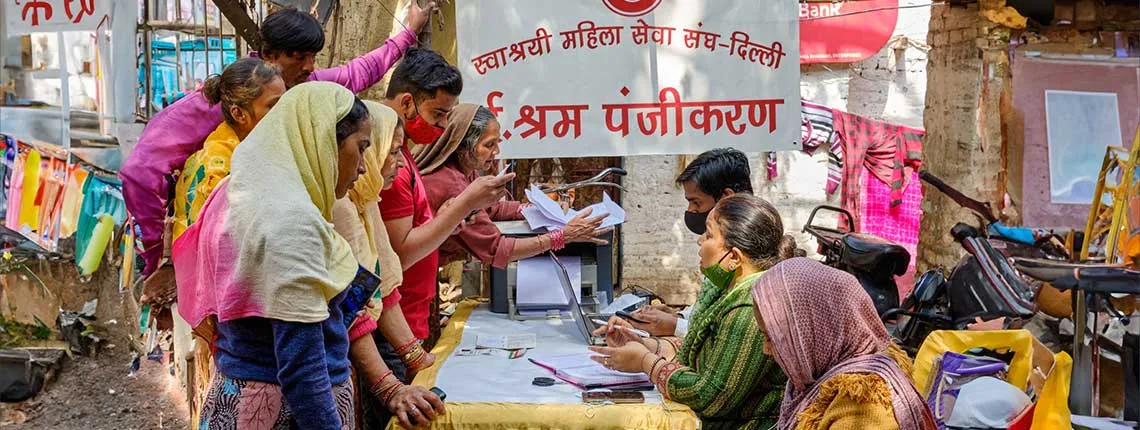
The availability of assisted registration is particularly important because not every worker in the unorganised sector has the digital skills, devices or connectivity required to independently complete an online government registration.
Common Service Centres remain important
Although e-Shram is a digital platform, its reach has depended significantly on physical assistance.
Common Service Centres (CSCs) have emerged as the principal channel for registration, followed by self-registration.
This reflects an important reality of digital inclusion: putting a service online does not automatically mean that every potential beneficiary can access it independently.
Assisted digital services can help workers who may have limited digital literacy or access to smartphones and reliable internet connectivity.
The combination of online self-registration and assisted registration therefore allows the system to reach a wider section of the workforce.
Making the platform multilingual
Another step towards accessibility came in 2025, when multilingual functionality in 22 languages was introduced through the Bhashini platform.
Language can be a significant barrier when government services are primarily accessed through digital interfaces.
Providing the platform in multiple Indian languages is intended to make it easier for workers from different linguistic backgrounds to understand and use the services available through e-Shram.
For a platform intended to cover workers across the country, multilingual access is particularly relevant given India’s linguistic diversity.
Technology as an instrument of inclusion
The five-year evolution of e-Shram reflects a broader shift in how governments can use digital infrastructure to deliver welfare.
The central idea is to establish a common identity for workers and use that identity to connect them with multiple services.
Instead of asking a worker to independently navigate several government systems, the one-stop approach attempts to bring different welfare, employment and social security services into a common ecosystem.
The database can also provide policymakers with a broader understanding of the unorganised workforce.
Information on occupations, age groups, gender and geographical distribution can potentially help governments design policies based on a more detailed picture of India’s informal workforce.
The system is therefore both a service-delivery mechanism and a source of information for labour policy.
Five years, and a changing role
When e-Shram was launched in August 2021, its central purpose was straightforward: create a national database of unorganised workers.
Five years later, its role is considerably broader.
The platform now combines worker registration with access to social security schemes, employment services, skilling, apprenticeships and pensions.
Its coverage of migrant workers and construction workers addresses the challenge of portability, while its inclusion of gig and platform workers recognises the emergence of new forms of employment.
The addition of 22-language functionality further seeks to make the system accessible to a broader population.
The scale of registrations also provides the platform with a nationwide footprint. With 31.89 crore registrations, it has created a substantial digital foundation for reaching workers across different occupations, age groups, States and social-security needs.
A digital pillar for India’s unorganised workforce
The significance of e-Shram lies ultimately in the problem it is attempting to solve.
India’s unorganised workforce is too large and diverse to be effectively served through fragmented systems alone. Workers may change employers, occupations and locations, while many do not have the conventional employment documentation associated with the formal economy.
A national digital identity and database can provide a common foundation for connecting these workers to government support.
The transformation of e-Shram from a database into a one-stop solution is therefore an important part of its five-year journey.
Its focus has expanded from identification to access, and from registration to convergence.
With 31.89 crore registrations, including approximately 11.5 lakh gig and platform workers, the platform now has a substantial reach among India’s unorganised workforce.
Its next phase will depend on how effectively that digital infrastructure translates into actual access to welfare, insurance, pensions, employment and skills.
For the government, the larger objective is clear: build a social security system that keeps pace with India’s changing workforce and ensures that economic growth is accompanied by greater protection for workers who remain outside the traditional formal employment structure.
Five years after its launch, e-Shram stands as a significant digital pillar in that effort.