New Delhi: UGC NET June 2026 scorecard is available and it is not the end of the journey for candidates. In fact, it is the point where they need to decide what they want to do next. Depending on their qualification category, candidates can move towards Junior Research Fellowship (JRF), PhD admission or Assistant Professor opportunities. However, simply clearing the UGC NET 2026 exam does not mean that a candidate will automatically get a job, JRF or a PhD seat. Each option has a separate process, and candidates need to apply to universities, colleges or research institutions as required.
The UGC NET cutoff 2026 is the minimum cutoff level used for determining candidates who qualify under the different result categories. It is an important detail for candidates who appeared for the June 2026 examination. The National Testing Agency (NTA) releases the UGC NET subject-wise and category-wise cutoff along with the result. Candidates can use the cutoff to check whether their marks meet the level required for JRF, Assistant Professor or PhD admission, depending on their qualification category. This means that a candidate’s UGC NET score alone does not tell the complete story. Their subject, category and qualification category also matter.
It is important to understand that there is no single UGC NET cutoff 2026 applicable to everyone. The cutoff varies by subject and category. The official cutoff list provides separate marks for JRF, Assistant Professor and PhD Only.
UGC NET Cutoff vs Qualifying Marks: What is the Difference?
Candidates often confuse UGC NET qualifying marks with the final cutoff. The first thing they should know is the difference between minimum qualifying marks and the final UGC NET cutoff. As per the UGC NET examination rules, candidates in the General category need to secure at least 40 per cent aggregate marks in both papers taken together, while candidates belonging to reserved categories need at least 35 per cent aggregate marks. However, meeting these minimum marks does not automatically mean that a candidate has qualified for JRF or Assistant Professor. The final UGC NET cutoff 2026 is prepared subject-wise and category-wise. Candidates therefore need to check the cutoff for their particular subject and category.
What Should You Do After the UGC NET Result?
Once the result is released, candidates can take a few simple steps.
Step 1: Check your qualification category – First, download the UGC NET scorecard and check whether you have qualified for JRF and Assistant Professor, Assistant Professor and PhD admission, or the applicable PhD admission category.
Step 2: Decide your career goal – Ask yourself what you want to do next. If you enjoy research and want to pursue a PhD, JRF can be a good route. If teaching is your main goal, start looking for Assistant Professor recruitment notifications.
Step 3: Check university notifications – Candidates planning to pursue a PhD should check the websites of universities they are interested in. Do not assume that every university follows exactly the same admission process.
Step 4: Start applying – UGC NET JRF qualified candidates can look for suitable PhD and research opportunities. Other eligible candidates can apply for PhD admissions or Assistant Professor vacancies according to the applicable rules.
Step 5: Keep your documents ready – Keep your UGC NET scorecard, certificate, degree certificates, marksheets and other academic documents safely.
UGC NET JRF 2026: What Happens Next?
If a candidate qualifies for UGC NET JRF 2026, they become eligible for the Junior Research Fellowship, subject to the applicable rules and conditions. JRF is particularly useful for students who want to continue their studies and build a career in research. A candidate can look for a suitable PhD programme in their subject and use the fellowship as financial support during their research, subject to the fellowship rules.
One important point is that UGC NET JRF qualification does not automatically give admission to a PhD programme. Candidates still have to apply to the university and complete its admission process.
UGC NET 2026 for PhD Admission
Candidates who qualify under the category applicable for PhD admission can also explore doctoral programmes. This can be useful for candidates who want to continue in academics but have not qualified for JRF. They can check universities offering PhD admission in their UGC NET subject and see whether their NET qualification can be used as part of the admission process. The rules may vary from one university to another. Some institutions may have additional requirements such as an interview, research proposal or other selection criteria.
UGC NET 2026 Assistant Professor: What Does It Mean?
Another major option after clearing UGC NET 2026 is an academic career as an Assistant Professor. If a candidate has qualified for the Assistant Professor category, they can apply for relevant Assistant Professor recruitment when universities and colleges announce vacancies. But there is an important difference between NET qualification and getting an Assistant Professor job. Clearing UGC NET makes a candidate eligible to apply for relevant teaching positions. It does not mean that the candidate gets an Assistant Professor appointment automatically. Candidates still have to apply for vacancies and go through the selection process prescribed by the concerned university or institution.
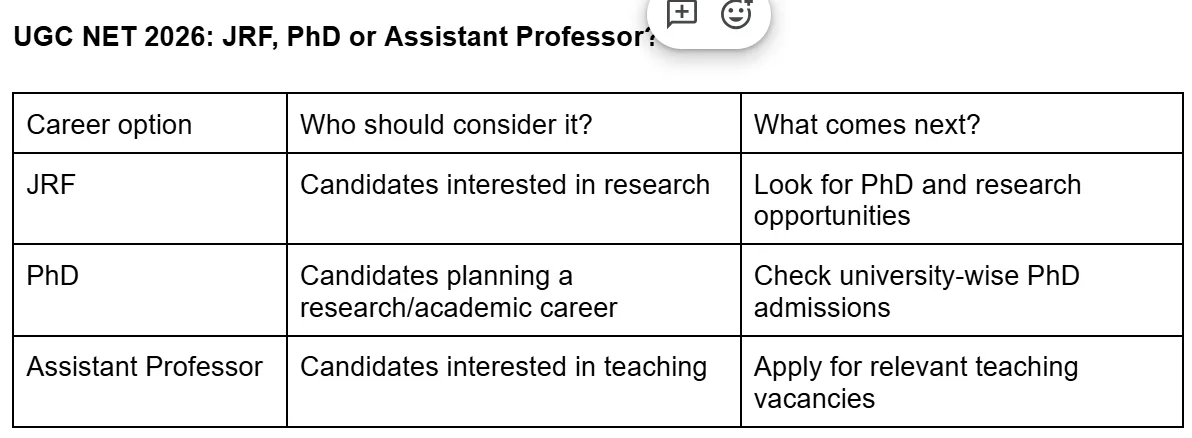
Which Option Should You Choose After UGC NET?
There is no single answer to this question. If you want to spend the next few years doing research, JRF and PhD may be the more suitable route. If you want to teach at the college or university level, you can focus on Assistant Professor recruitment. Some candidates may also combine both goals by pursuing a PhD and later applying for teaching positions.
For candidates, the UGC NET result 2026 should be treated as a starting point rather than the final destination. After qualifying, check your result category, decide between JRF, PhD and Assistant Professor pathways, and start tracking the relevant university and recruitment notifications.
In short, UGC NET qualification can open the door to research, PhD and teaching opportunities, but candidates have to take the next step themselves.