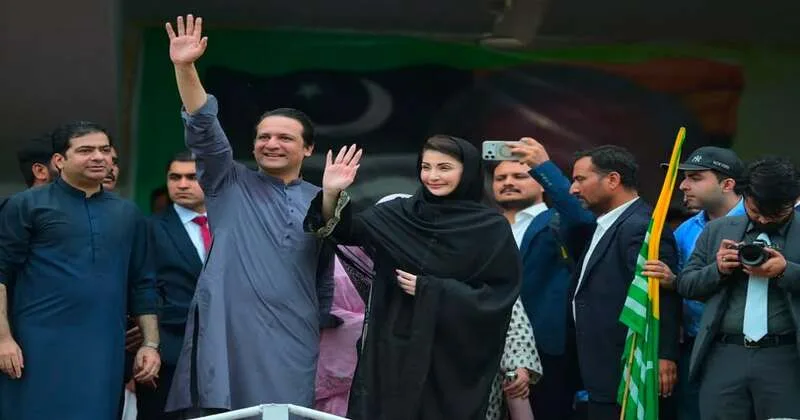
Barrister Syed Iftikhar Ali Gillani of Pakistan Muslim League-N (PML-N) was elected Prime Minister of Pakistan Occupied Jammu and Kashmir (POJK) in Muzaffarabad on August 28. He got 30 votes as against 14 bagged by his Pakistan Peoples Party (PPP) rival Sardar Mukhtar Ahmed Abbasi out of the 44 votes polled in the legislative assembly.
There are at present 46 members in the assembly but two members did not exercise their vote on this occasion. In all, there are 53 members in the House but elections to seven seats are yet to be held. PML-N and its allies have 32 members and PPP 14.
The seven seats for which elections could not be held are in Poonch and Sudhnoti districts. But with the PML-N having a clear majority of 32 in a House of 53, the elections to these seats, whenever held, are of bare academic interest as they will not impact the government much.
Speaker, one member do not cast their votes
The Speaker did not cast his vote and PML-N provincial president Shah Ghulam Qadir did not attend the proceedings. Qadir, along with former premier Raja Farooq Haider had earlier opposed Gillani’s nomination for the post. However, when assembly proceedings began on Friday, Haider entered the House alongside Gillani, according to a Dawn report.
Gillani has been rather lucky in getting the backing of Mian Nawaz Sharif as he had first lost in direct elections. However, he was later elected on a reserved seat as a technocrat. He would thus become PM after losing direct election and due to backing of PML-N leadership.
After the votes were counted, Speaker Chaudhry Tariq Farooq announced the result, declaring Gillani as the winner amid clapping and slogans from the galleries. Gillani has succeeded PPP’s Rathore, who was elected as the PM in November 2025 and his tenure was very brief. Rathore had managed to win over several legislators of Imran Khan’s Pakistan Tehreek Insaf (PTI) before he became the PM.
Gillani’s nomination leads to angry voices
PML-N’s decision to nominate Gillani was announced by Prime Minister Shehbaz Sharif at a meeting with four senior PML-N leaders in Islamabad, late on Wednesday night. The meeting, which took place at the PM House, was attended by PML-N provincial president Shah Ghulam Qadir, his predecessor and former premier Raja Farooq Haider, the party’s regional secretary general and assembly speaker, Chaudhry Tariq Farooq, and Deputy Speaker Ahmed Raza Qadri.
The PM was accompanied by his aide, Rana Sanaullah, and senior PML-N leader Saad Rafique. Gillani had also been invited to the PM House but did not join the meeting. PM Shehbaz informed the visiting leaders that party supremo Nawaz Sharif had decided to nominate Gillani as the party’s candidate for the premiership.
The decision, however, triggered a sharp reaction from Qadir and Haider, who reportedly expressed their disagreement and announced that they would not participate in Friday’s election process. However, only Qadir did not participate in the election.
Nawaz Sharif’s backing ensures smooth sailing
Speculation that Gillani could be chosen for the premiership had been rife since he was elected to the assembly on a reserved seat on August 24. However, the party’s regional leadership believed that the formula followed in 2016, when Haider was elevated as PM, would be repeated this time as well.
Following the reaction of the two senior leaders, Sanaullah and Rafique held another meeting with them, but it remained inconclusive. In a post on X, Qadir assured the “self-respecting people’’that he would not compromise on their honour and dignity. “Nawaz Sharif’s slogan of giving respect to the vote will be ensured,” he added.
On Thursday afternoon, however, PML-N central information secretary and Punjab senior minister Marriyum Aurangzeb posted on X that PM Shehbaz had finalised Gillani as the party’s candidate. Gillani had also directed him to submit his nomination papers for election as PM.
Staggered PoJK polls in many phases
The elections in the region, originally scheduled for July 27, were later divided into several phases over security concerns amid unrest in the region. The unrest in the province had started on a large scale on June 5 in Rawalakot and over 80 people were subsequently killed in the violence.
The first phase was held on July 27, the second on August 2 and the third on August 10. The third phase was originally meant to cover all of Poonch Division, which comprises 11 constituencies, including three in Bagh, one in Haveli, five in Poonch district and two in Sudhnoti district. However, the Election Commission announced that polling would only go ahead as scheduled in Bagh and Haveli because of concerns over the law-and-order situation.
So far, in the direct elections to 38 constituencies, the PML-N has secured 25 seats while the PPP has won 12. The lone MLA-elect of the Awami Dast-o-Bazu party has also joined hands with the ruling PML-N.
As for the reserved seats, the PML-N has bagged six and the PPP two. The PPP has alleged widespread rigging and irregularities in the elections with PPP chief Bilawal Bhutto Zardari repeatedly making these allegations.
Past record, political innings of PM
When the PML-N formally launched its PoJK chapter in December 2010, few people in the gathering knew the young man whose striking portrait adorned the hoardings placed around the stage. His name, prominently displayed beneath his photograph, was Barrister Syed Iftikhar Ali Gillani.
His journey from the smiling face on those PML-N flexes in 2010 to the PM’s office is more than a conventional story of political ambition. It is also a story of timing and extraordinary circumstances: an unexpected by-election victory, a cabinet berth, two electoral defeats, a return to assembly through a reserved seat and, finally, a decision made at the very top.
In that sense, Gillani’s political career has been shaped as much by perseverance as by an extraordinary element of fortune.