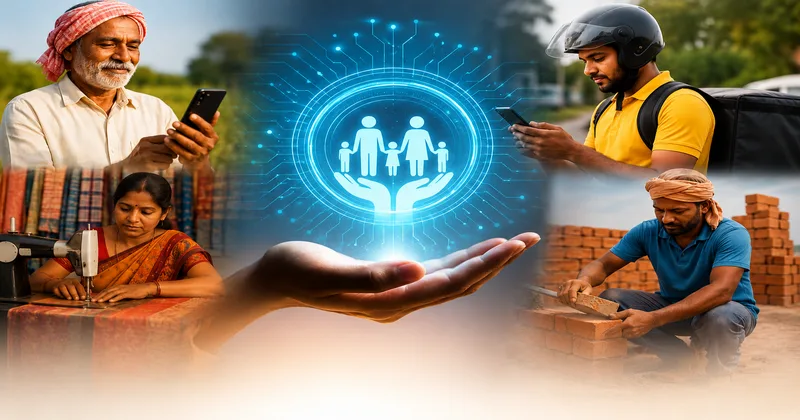
On August 26, 2026, the e-Shram portal crossed a threshold of digital governance projects that reaches five years of continuous operation and 31.89 crore registrations. Nearly 11.5 lakh gig and platform workers have enrolled, also 15 central welfare schemes now sit behind a single login. What began in 2021 as an urgent fix for the invisibility of Indian informal workforce, in the own words of Ministry of Labour and Employment, the foundation of an inclusive, technology-driven social security ecosystem. The anniversary is a useful moment to ask why the Modi government built this portal at all and what five years of data say about the choice.
From invisibility to identity
India’s unorganised sector employs the overwhelming majority of its workforce, yet for decades it existed largely outside government records. Construction labourers, domestic workers, street vendors, and agricultural hands moved across states and employers with no continuous documentation of who they were or what protections they were owed. The gap was not statistical only, it became painfully visible when the 2020 pandemic lockdowns stranded migrant workers with no employer record, no local address proof and no clear welfare channel to fall back on.
This absence of data was not a technicality, it meant welfare schemes could not reliably find their intended beneficiaries. The Ministry of Labour and Employment launched e-Shram on August 26, 2021, as an Aadhaar-seeded National Database of Unorganised Workers, open to those aged 16 to 59, free of cost issuing every registrant a Universal Account Number (UAN) as a portable proof of identity.
Five Years, 31.89 crore stories
The growth curve tells its own story of expanding reach. Registrations crossed 30 crore by March 2025, touched 30.98 crore by August 2025, reached 31.48 crore by Republic Day 2026 and stood at 31.78 crore by mid-July 2026 before closing the fifth year at 31.89 crore.
The demographic profile inside those numbers is striking where women account for 54.28 per cent of all registrations against 45.72 per cent for men, while 55.21 per cent of registered workers are aged 18 to 40, 24.18 per cent fall between 40%, 50% and 20.53% are above 50%. Agriculture, domestic and household work, construction and apparel remain the leading occupational categories.
Most workers signed up through Common Service Centres, with self-registration as the second-largest channel evidence of a deliberate last-mile outreach strategy rather than a portal left to find its own audience.
One number, One nation
The UAN is the architectural core of the system. Aadhaar-based eKYC authentication, with data fetched directly from UIDAI, curbs duplication and impersonation, while the twelve-digit number itself travels with the worker across states and employers.
For a migrant construction worker who moves from Varanasi to Surat for six months of the year, this portability converts what was once a series of disconnected, undocumented jobs into a single continuous employment identity the precondition for any social security claim. Without such a number, portability of benefits across state lines is simply not possible with it, a worker’s contribution history and eligibility travel wherever the work takes them.
From database to delivery
A database of workers is only half the task, the harder half is connecting that database to actual benefits. The government addressed this with the e-Shram One-Stop Solution, launched on October 21, 2024, followed by State and Union Territory microsites from January 29, 2025. Fifteen central schemes now sit on this single platform, letting a registered worker both discover what they are eligible for and track what they have already received.
These include the Pradhan Mantri Suraksha Bima Yojana and Pradhan Mantri Jeevan Jyoti Bima Yojana for insurance, the Pradhan Mantri Shram Yogi Maan-dhan pension scheme, Ayushman Bharat–PMJAY health cover of five lakh rupees per family and links to the National Career Service, the Skill India Digital Hub, PM-SVANidhi, PM-KISAN, PMMSY and PMAY-Gramin
A parallel integration with the myScheme portal lets a worker cross-check eligibility against state-level schemes as well, so a single UAN becomes the entry point into both central and state welfare architecture. Convergence of this kind rather than 15 separate applications on 15 separate portals is itself the policy achievement.
Nari Shakti in the margins
Behind the aggregate numbers is a quieter but significant fact that women make up the majority of e-Shram’s registered workforce. In Uttar Pradesh alone, 4.41 crore women have registered and in Rajasthan women account for 53.33 per cent of the state’s 1.54 crore registrations. Domestic and household work an occupation dominated by women and historically undocumented sits among the portal’s top categories.
For millions of women who cooked, cleaned, stitched, or laboured in fields without any formal record of their work, a UAN is the first official acknowledgment that their labour exists in the eyes of the state. This is not a side effect of e-Shram women’s disproportionate presence in the database reflects an outreach effort layered onto existing government platforms for financial and social inclusion.
Widening the net to the gig economy
The most consequential expansion of e-Shram’s scope came through law rather than software. The Code on Social Security, 2020, which came into force on November 21, 2025 alongside India’s three other labour codes, gave gig and platform workers formal legal recognition for the first time, entitling them to accident insurance, health and maternity cover and old-age protection.
The Union Budget 2025-26 translated this into administrative action of identity cards and e-Shram registration for platform workers and healthcare coverage under Ayushman Bharat-PMJAY. An aggregator module now allows platforms such as Urban Company, Zomato, Blinkit and Uncle Delivery to register their workers directly and roughly 11.5 lakh gig and platform workers are on the portal as of the fifth anniversary up from 3.37 lakh in August 2025.
India’s gig workforce is estimated at close to one crore today and projected to reach 2.35 crore by 2029-30, which is why the labour ministry is finalising a per-transaction contribution model to fund a dedicated Social Security Fund for this segment, overseen by a National Social Security Board. States have moved in parallel, Rajasthan passed India’s first gig worker welfare law in 2023, Karnataka followed with a more comprehensive tripartite framework in May 2025. Bihar and Jharkhand enacted their own laws in August 2025.
The states carrying Indian formalisation drive
Registration density varies sharply across India, reflecting both population size and the intensity of state-level outreach campaigns.
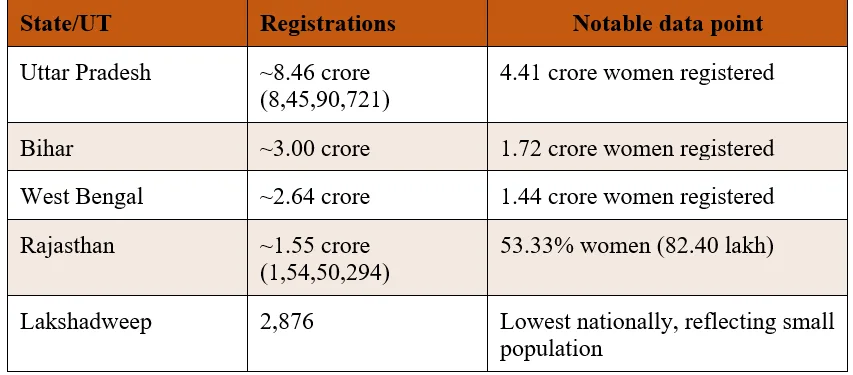
Uttar Pradesh leads by a wide margin with more than 8.45 crore registrations, followed by Bihar, West Bengal, Madhya Pradesh and Maharashtra among the top five. Rajasthan has recorded over 1.54 crore registrations, while Lakshadweep, reflecting its small population, has the lowest count nationally at 2,876. This spread illustrates that formalisation is not confined to India’s industrial states, it runs deepest precisely where informal, low-income labour is most concentrated, making the portal as much a rural and semi-urban instrument as an urban one.
Measuring the gap that remains
No claim about e-Shram is complete without acknowledging where implementation is still catching up. NITI Aayog’s own estimates placed India’s gig workforce at roughly 1.5 crore in 2025, yet only 3.37 lakh platform and gig workers are about 3 to 4 per cent of that base that had registered on e-Shram by August that year.
The gap was structural rather than one of intent aggregator-side registration modules, identity cards and the AB-PMJAY linkage for gig workers were all still being operationalised through the Budget 2025-26 announcements. The rise to 11.5 lakh gig registrations by the fifth anniversary shows the gap narrowing, but the government’s own Social Security Fund and National Social Security Board remain, as of August 2026, mechanisms in the process of being finalised rather than fully disbursing benefits. An honest reading of the data treats this as unfinished construction on a foundation that is otherwise sound, not as a failure of the underlying architecture.
Aatmanirbharata through recognition
Antyodaya, the upliftment of the person standing last in the queue has long been a stated organising principle of governance in this mould and e-Shram operationalises that idea in the most literal sense that it puts a name, a number and a claim to welfare behind India’s least visible workers. Dignity of labour, an idea with deep roots in Indian civilisational thought, finds concrete expression here not as rhetoric but as a UAN, a health cover entry and a pension account.
Five years and 31.89 crore registrations in, the portal’s unfinished business is also clear extending the same depth of coverage achieved for agricultural and construction workers to India’s fast-growing gig economy and turning the Social Security Fund from a proposal into disbursed benefits before 2029-30. That, more than the registration count itself, will determine whether e-Shram second five years match the ambition of its first. For now, on its fifth anniversary, e-Shram stands less as a finished monument than as working infrastructure a civilisational commitment to Antyodaya.