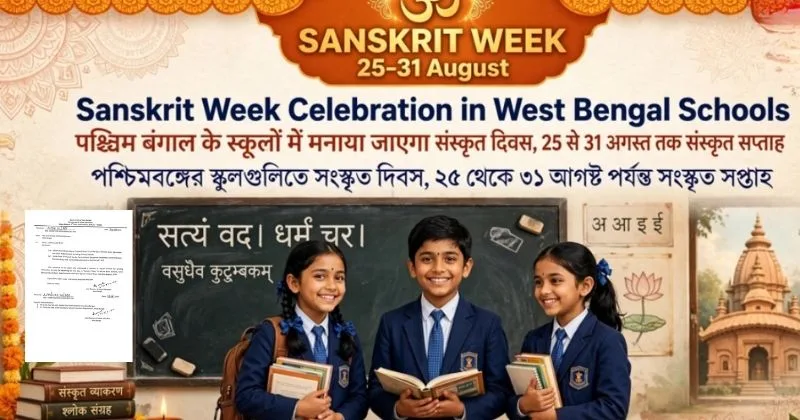
KOLKATA: The West Bengal Government’s School Education Department has issued a notice directing schools to observe one day as “Sanskrit Divas” during Sanskrit Week, from 25th to 31st August. On August 25 2026, the Joint Director of School Education, Government of West Bengal, issued a memorandum addressed to the District Inspectors (DI) of Schools across the state. The directive calls for the observance of Sanskrit Week from August 25-31, 2026.
As part of the initiative, all government, government-sponsored and government-aided schools across West Bengal, including primary schools, have been instructed to designate any one day during this week as “Sanskrit Day” and observe it accordingly. Importantly, the directive was issued in response to a letter dated August 13, 2026 addressed to the Hon’ble Education Minister by Pranab Nanda, Organising Secretary of the Eastern Region of Sanskrit Bharati. What may appear to be a routine administrative instruction is, in fact, significant: it places Sanskrit—one of the foundational languages of India’s intellectual and cultural traditions—within the formal educational space of schools across West Bengal.
As Pranab Nanda, Eastern Zonal Organisation Secretary of Sanskrit Bharati, explains, the organisation has played an important role in promoting Sanskrit in India and across the world. He notes that the Government of India’s Ministry of Education first announced the observance of World Sanskrit Day in 1969. The day is celebrated annually on the full moon of the month of Shravan according to the Hindu calendar, which coincides with the traditional festival of Raksha Bandhan or Shravani Purnima. The choice of this day has deep civilisational significance. In ancient India, Shravani Purnima was associated with the Upanayana ceremony, when students formally began their study of the Vedas and other branches of knowledge under the guidance of their gurus. By choosing this auspicious day to commemorate Sanskrit, the tradition seeks to reconnect the language with its historical role as a vehicle of learning, knowledge and the guru-shishya tradition.
Those so-called modern people, for whom modernity means rejecting their own language, culture, and civilisation, never give Sanskrit the value it deserves. They even describe it as a dead language. But what do modern Western thinkers actually think about this language? This is evident from Stephen Cross’s writings. Anquetil-Duperron, a French Orientalist and Indologist, had tried to learn Sanskrit. One of the earliest and most notable conduits for this Indo-Western philosophical transmission was Anquetil-Duperron, who translated the Upanishads from Persian into Latin under the title Oupnek’hat. What Cross has quoted is even more interesting. Cross writes, “Even so, he brought Sanskrit texts back with him to France and remained keenly interested in the Hindu scriptures. ‘Let us study the Indians,’ he says in one of his books, ‘as we study the Greeks and the Romans.’ What he meant by this was that they should be studied seriously, as a civilisation from which we might learn, and not simply as an Oriental curiosity.” This is how Western thinkers used to value and prioritise our languages.
So, the observance of World Sanskrit Day at the school level holds particular significance. Sanskrit is one of the world’s oldest languages and is often described as the “mother” of several Indian languages. The primary purpose of observing this day is to create greater awareness about this ancient and classical language and encourage its study and practice. Sanskrit is not merely a language; it is a repository of India’s ancient literary, philosophical and scientific traditions, carrying the knowledge contained in the Vedas, Upanishads, Ayurveda and numerous other classical texts. Celebrating the day in schools can therefore help students develop a deeper understanding of India’s rich civilisational heritage and foster greater appreciation for its intellectual and cultural traditions.
What was Swami Vivekananda’s observation on Sanskrit? In a lecture delivered at the Shakespeare Club, Pasadena, California, on February 2, 1900, he said, “God spoke once. He spoke in Sanskrit, and that is the divine language.” Again, he said, “This Sanskrit language is so intricate, the Sanskrit of the Vedas is so ancient, and the Sanskrit philology so perfect, that any amount of discussion can be carried on for ages in regard to the meaning of one word. If a Pandit takes it into his head, he can render anybody’s prattle into correct Sanskrit by force of argument and quotation of texts and rules.” Now, it is a matter of pride that the children and students of Swamiji’s own state would learn Sanskrit with due importance and learn to respect this language.
As Dr Vivek Karmakar, Assistant Professor and Head of the Department of Sanskrit at Scottish Church College, Kolkata, observes, “Celebrating the Sanskrit language means celebrating Bharat. If our objective is unity in diversity, then Sanskrit is the language that can connect the diverse linguistic traditions of India. Even in the Constituent Assembly, the demand to make Sanskrit the national language was raised, and Dr. B. R. Ambedkar supported this demand. In West Bengal too, there were voices advocating Sanskrit as the national language, one of them being Nasiruddin Ahmed. Therefore, Sanskrit is a truly pan-Indian and widely inclusive language, and there should be no confusion about its civilisational significance. The Sanskrit Commission Report of 1956 is also highly significant in this regard.” He further stated, “Today, when we speak of building a Viksit Bharat, the first thing we need is an understanding of Bharat itself—its history and civilisational heritage. In this context, the decision taken by the Chief Minister of West Bengal, Suvendu Adhikari, is like watering the roots of a tree; by strengthening the roots, we ultimately strengthen the entire tree.”