
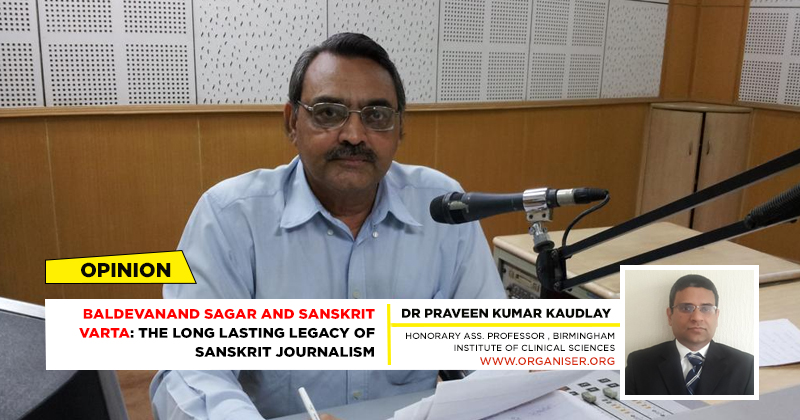
On the momentous morning of June 30, 1974, at 9 AM, history was made by Delhi Akaashavani (AIR) as it delivered a 5-minute news broadcast in Sanskrit. This remarkable event shattered the misconception that Sanskrit could not be colloquial and technical at the same time.
Now, after 49 years since that historical day and us entering the Golden Jubilee year of the occasion, the opening line “Iyam Akaashavani Samprati VaartaaH Shrooyantaam PravaachakaH Baldevananda SagaraH” still resonates with all those who grew up listening to Baldevananda’s news readings, first on AIR and later Doordarshan’s Delhi Kendra (DDK). He became the pioneer Sanskrit news anchor on television and the third person to deliver news for the All India Radio.
Hailing from a small village in Gujarat’s Bhavnagar district, Sagar’s remarkable journey to this esteemed position, where he continues to promote Sanskrit culture and modern Sanskrit journalism even today, is an extraordinary achievement acknowledged by his long-time associate, Dr Gautam Patel, a Sanskrit scholar himself.
Influenced by his Kulguru Swami Shivoham Sagar from the Shaankara Paramparaa, the young Baldevananda found inspiration to study Sanskrit. He pursued further studies in Sanskrit at Sampurnanand Sanskrit University Varanasi, followed by post-graduation at Delhi University. His research on the significance of hymns in Shodasha Samskaraas from LBS Kendriya Sanskrit Vidyapeeth in Delhi earned him a PhD in Sanskrit.
The promotion of Sanskrit in the broadcasting medium was advocated by Sarojini Mahishi, Dr Karna Singh, etc. The morning news was introduced at 9 AM for a 5-minute duration at Akaashavani’s New Delhi station.
Encouraged by the positive feedback from the audience, the then director of AIR, SC Bhat, made provisions for an evening bulletin at 6.10 PM for another 5 minutes.
Modern Sanskrit journalism dates back 157 years. The very first magazine produced by Kashi Government Sanskrit College, “Kashi Vidya Sudhaanidhih” or “Pandit Patrika”, marks the inception of modern Sanskrit journalism. The influence of Sanskrit is evident in the famous Shloka from Pandit Jagannatha’s “Bhamini-Vilasa” which graced the homepage of the renowned “Kesari”, a linguistic journalism publication launched by Lokamaanya Balgangadhar Tilak in 1881.
Writers of regional linguistic journalism were either scholars of Sanskrit literature or held unwavering loyalty to the language, finding refuge in its rich literature for their dedicated journalistic work, as opined by Baldevananda Sagar. Modern Sanskrit journalism played a pivotal role in fostering innovative ideas and a sense of nationality. The Asiatic Society of Bengal published a bilingual journal in 1832, featuring Sanskrit literature accompanied by English, awakening a sense of pride in the nation, language, and literature.
Every part of Bharata contributed to the growth of Modern Sanskrit journalism. Magazines such as “Vidyodayah” from Lahore in 1872, Bihar’s first Sanskrit magazine “Vidyaarthi”, and “Vijnaana-Chintamani” from Kerala in 1884, all played a vital role. The establishment of Bihar Sanskrit Sanjivan Samaj in 1887 aimed to enrich the Sanskrit education system.
Baldevanand Sagar highlights the Swadeshi movement at the beginning of the twentieth century as the golden era for Modern Sanskrit journalism, during which numerous Sanskrit periodicals were published across different parts of India. Notably, the efforts of Pandit Varadaraja Iyengar from Mysore, who established “Sudharma”, a daily Sanskrit newspaper in 1970, played a significant role in unfurling modern Sanskrit journalism on the global journalism map.
Another significant historical event that accelerated Modern Sanskrit journalism was the promotion of Sanskrit as a spoken language by organizations like “Vishwa-Sanskrita-Pratisthanam”, “Samskruta-Bharati”, and “Lokabhasha-pra char-samiti” etc. These initiatives played a crucial role in popularising the basic form of Modern Sanskrit journalism. Notably, the publication of “Sambhashana-SandeshaH” from Bengaluru gained immense popularity both within and outside India since 1999.
In his book, “Sanskrit Journalism: Its History and Modern Forms”, Baldevanand Sagar delves into the challenges faced by the Sanskrit media today. Among these challenges are financial aspects, circulation, advertising, readership, availability of writers, and trained media personnel. Sagar’s close professional colleague, Prof. Vijay Kumar CG, the current Vice-Chancellor of Maharishi Panini Sanskrit and Vaidik University at Ujjain recalls the initial obstacles faced by Sagar in finding Sanskrit equivalents for words used in news broadcasting.
Words like “Railways” (रेलयानम्), “Bank” (बैङ्कम्), “CCTV camera” (निगूढ-छायाङ्ककः), “Double decker bus” (द्वितलीय-बसयानम्), “Smart card” (स्मार्तपत्रम्), “Sim” (स्मृतिपुटकम्), “Email” (अणुप्रैष:), and “Cut off” (व्यवकलनम्) had to be developed for the purpose of the bulletin. During election results, Sagar recalls that this was done even extempore.
The dedication and passion for running these bulletins were so intense that on a particular day when he and his two children met with a road accident, Sagar admitted his kids to the hospital and still managed to go straight to the evening live bulletin.
Prof. Vijay Kumar also advises new newsreaders to learn the nuances of pronunciation, using Sagar as a benchmark.
Sagar’s efforts have made the monthly “Man Ki Baat” from PM Modi available in Sanskrit. When the program started in May’2017, AIR sought a person who could translate and read it, and Sagar was the obvious choice, recalls Sri Thapliyal Parthasarathy, a former senior officer of AIR. Since May’2017, he has been producing the Sanskrit MKB version, which continues to date.
In a fast-changing world, it is essential to embrace new technological advances.
Sagar has been producing the series “Learn Sanskrit, Be Modern”, with 105 episodes done so for focusing on Sanskrit language learning.
Doordarshan’s initiative, “Vaartavali”, a weekly Sanskrit program, along with Janam TV from Thiruvananthapuram airing daily 15-minute Sanskrit news, and “Samprati Vaartah” another effort has successfully involved young students to anchor Sanskrit news on TV. These efforts mark a growth in promoting Sanskrit news from the times of AIR and DD news. These initiatives reflect a commendable effort to revive and popularize the use of Sanskrit in contemporary media platforms, feels Sagar.
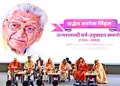
He has received numerous accolades and recognitions for his exceptional contributions. Notably, the Government of India honoured him with the prestigious “Award of Certificate of Honour” presented by the President of India in 2018, acknowledging his outstanding achievements and dedication to Sanskrit journalism and language preservation.
During his tenure as a visiting faculty at the National School of Drama, Sagar has been actively involved in scripting, directing, and acting in numerous Sanskrit dramas produced for AIR and DD, even for the stage. Additionally, he has lent his voice to various educational programs. With an extensive career, he has authored and edited numerous books and delivered lectures on various subjects.
Prof. Suman Kumar Jha, a Sahitya Professor at Shri Lal Bahadur Shastri Rashtriya Samskruta Vidhyapeeta, and Dr Patel acknowledge Sagar’s remarkable efforts in revitalizing Sanskrit, comparing it to Eliezer Ben-Yehuda’s impact on Hebrew. They believe future generations will find it challenging to comprehend the extent of a single individual’s accomplishments.
(Dr. Praveen Kumar Kaudlay is a Consultant Haematologist, at Newcross Hospital and Honorary Associate Professor at the Birmingham Institute of Clinical Sciences)