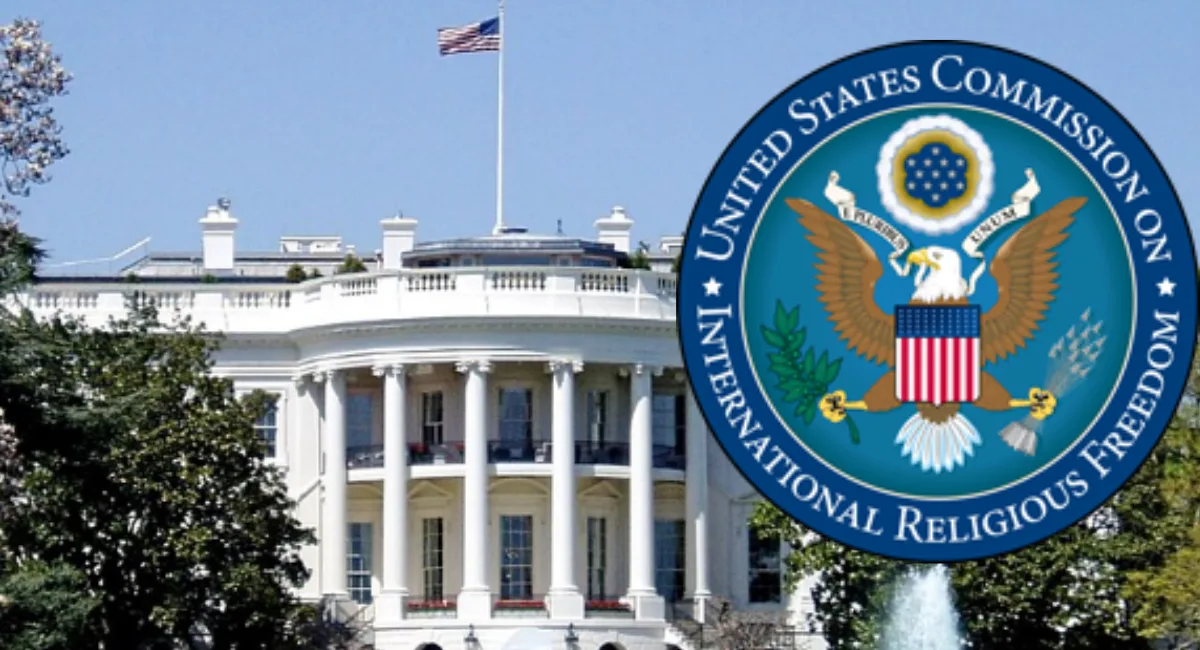
The U.S. Commission on International Religious Freedom (USCIRF) has once again made statements concerning India and the Rashtriya Swayamsevak Sangh (RSS), prompting some elements in the Indian media to react with alarm: “USCIRF targets RSS!” But before such statements are turned into breaking news, it is worth examining USCIRF’s record, its approach to India and the questions that have been raised over its apparent bias, along with a little context, history and scepticism.
USCIRF has repeatedly recommended that the U.S. Government designate India as a “Country of Particular Concern” (CPC). Its 2026 recommendations once again recommend India for CPC designation and call for various measures concerning India and certain Indian entities. But here is the important part that often gets lost in the headlines: USCIRF does not itself have the authority to designate India as a CPC. It makes recommendations to the U.S. Government, while the actual designation is made by the U.S. Secretary of State under U.S. law.
And the Secretary of State has not accepted USCIRF’s recommendation concerning India. In an October 8, 2024 State Department briefing, State Department spokesperson Matthew Miller explicitly explained that USCIRF is independent of the State Department. He also stated that, following the relevant review, the Secretary of State had determined that India did not meet the threshold for CPC designation. That is a rather important fact when some headlines suggest that USCIRF has delivered some kind of authoritative international judgment on India.
USCIRF itself has repeatedly complained that the U.S. Government has not followed its recommendation concerning India. Its annual reports have continued to recommend CPC designation despite the absence of such a designation by the U.S. executive branch. In simple terms, USCIRF can keep recommending, but Washington is under no obligation to accept its recommendations. That distinction should be made clear whenever its reports are presented to Indian audiences as though they represent the official position of the United States Government.
An American Commission, Not an International Authority
According to its official “About Us” page, USCIRF is an independent, bipartisan legislative branch agency established by the U.S. Congress. Its role is to monitor religious-freedom conditions abroad and make policy recommendations to the President, Secretary of State and Congress. Its Frequently Asked Questions similarly explain the distinction between USCIRF and the State Department.
In other words, USCIRF is an American policy advisory body. It is not an international authority on India.
USCIRF is not an international court, not a United Nations body and not an international human-rights tribunal. It has no jurisdiction over the Government of India, the Indian Parliament, Indian courts, the RSS or any other Indian organisation. Its reports cannot impose obligations on India, pass judgments on Indian citizens or organisations, or determine whether an Indian institution has violated Indian law. Yet the manner in which some elements in the Indian media report USCIRF’s statements can sometimes create precisely that impression.
India’s Official Position on USCIRF
There is also a long and well-documented history of the Government of India rejecting USCIRF’s credibility. In July 2022, MEA spokesperson Arindam Bagchi described USCIRF’s comments on India as “biased and inaccurate”, saying that the commission’s repeated misrepresentation of facts reflected a severe lack of understanding of India’s constitutional framework, plurality and democratic ethos. He further said that such actions raised concerns about the organisation’s credibility and objectivity. The contemporary Indian Express report records the statement.
The Government of India went even further in Parliament in December 2024. In a formal Rajya Sabha answer dated December 19, 2024, the Ministry of External Affairs was asked specifically about USCIRF’s recommendation that India be designated a CPC. The Government stated that such reports are often subjective, misinformed and biased, and said that it “attaches no credibility” to USCIRF reports, describing the organisation as having a political agenda and accusing it of misrepresenting facts and promoting a motivated narrative about India.
The Ministry of Minority Affairs expressed an even stronger position in another Rajya Sabha answer dated December 16, 2024. The Government described USCIRF as an organisation with “a political agenda and absolutely no credibility”, and said that its commissioners, staffers and analysts were biased and lacked an understanding of India’s constitutional framework, plurality and democratic ethos. These are not merely objections raised by political commentators or social-media users. They are positions formally recorded by the Government of India before Parliament.
What About the Information Behind USCIRF Reports?
But there is another episode that deserves attention because it exposes questions about the information ecosystem behind international narratives concerning India. In 2020, the Hyderabad-based Legal Rights Protection Forum (LRPF) exposed a network of advocacy and reporting practices involving the Christian organisation Persecution Relief. LRPF brought to light the manner in which routine criminal incidents, including murders and suicides, were being given a communal colour and portrayed as cases of Christian persecution. LRPF also highlighted links between Persecution Relief and the U.S.-based Federation of Indian American Christian Organizations (FIACONA), and questioned the subsequent use of such material in international religious-freedom advocacy and USCIRF reporting.
The significance of this episode lies in what it exposed about the information pipeline behind international narratives on religious persecution in India. When ordinary criminal incidents can be collected, selectively presented, given a communal interpretation and circulated through advocacy networks, they can eventually become part of a much larger narrative about systematic persecution. Once such narratives reach international institutions, they can acquire an entirely different level of perceived authority simply because they appear in an official report.
There is also evidence that advocacy organisations have supplied information used in U.S. Government religious-freedom reporting. For example, the 2019 U.S. International Religious Freedom Report on India cited reporting from Persecution Relief concerning incidents involving Christians. This makes the provenance and verification of such information an important issue. If advocacy-generated material becomes part of government or commission reports, readers have every right to ask how the original incidents were verified, how they were classified, what context was included or omitted, and whether alternative explanations were examined.
From Individual Incidents to Sweeping Narratives
This is particularly important when isolated criminal incidents are transformed into sweeping claims about an entire country. A murder is a crime. A suicide is a tragedy. A property dispute is a dispute. A local clash is a local clash. None automatically becomes evidence of systematic religious persecution merely because the people involved belong to different religious communities.
The classification of an incident matters, the evidence matters, the context matters, and the methodology matters.
That is precisely where USCIRF deserves much greater scrutiny. What sources does it rely upon? How does it verify information supplied by advocacy organisations? Does it distinguish between allegations and established facts? Does it examine contradictory evidence? Does it apply comparable standards across countries? And how does it move from individual incidents to sweeping conclusions about the religious-freedom situation of a country as large and diverse as India?
These questions become even more important when USCIRF repeatedly recommends punitive measures against India while the U.S. executive branch itself declines to adopt its principal recommendation. If Washington can scrutinize USCIRF’s conclusions before deciding U.S. policy, why should some elements in the Indian media simply reproduce those conclusions without comparable scrutiny?
The Responsibility of Some Elements in Indian Media
This is precisely where some elements in the Indian media have a responsibility. When USCIRF criticizes India or the RSS, the statement may be newsworthy, but journalism should not become a relay mechanism in which an American commission issues a statement, Indian outlets reproduce it, and the statement is then presented to the public with the implied authority of an international tribunal.
Reporting what USCIRF says is journalism. Treating what USCIRF says as unquestionable authority is not.
A responsible report should tell readers what USCIRF actually is, what its statutory role is, what evidence it has presented, what the U.S. Government has actually done with its recommendations, and how the Government of India has responded. Most importantly, it should distinguish between an American policy recommendation and an international legal determination. That distinction is particularly important when reporting on the RSS or any other Indian organisation.
The Irony: Washington Does Not Necessarily Agree
The irony is difficult to miss. Washington has repeatedly declined to accept USCIRF’s recommendation to designate India as a Country of Particular Concern. India has repeatedly rejected USCIRF’s assessments and formally questioned its credibility. Yet some elements in the Indian media appear determined to treat USCIRF’s statements as though they were international judgments against India.
So when the headline says “USCIRF targets RSS,” perhaps Indian readers should ask a few basic questions. Who is USCIRF? What legal authority does it possess over India? Has an international court ruled against the RSS? No. Has the United Nations designated the RSS as an organisation responsible for religious persecution? No. Has the U.S. Government adopted USCIRF’s repeated recommendation to designate India as a CPC? No. Has the Government of India accepted USCIRF’s assessment? Quite the opposite.
The question, therefore, is not whether USCIRF is entitled to speak. Of course it is. The question is why some elements in the Indian media give such disproportionate importance to what it says, particularly when its most consequential recommendation concerning India has repeatedly not been accepted by the U.S. executive authority itself and when the Government of India has repeatedly rejected the commission’s credibility and methodology.
The Real Question
Perhaps the real headline is not “USCIRF targets RSS.” Perhaps it should be: “Washington Has Not Accepted USCIRF’s India Recommendation. Why Is Some Indian Media Treating It Like an International Verdict?”
USCIRF can make recommendations. Washington can accept or reject them. India can accept or reject them. Some elements in the Indian media can report them. But no amount of media amplification can transform an American advisory commission’s recommendation into an international judicial judgment.