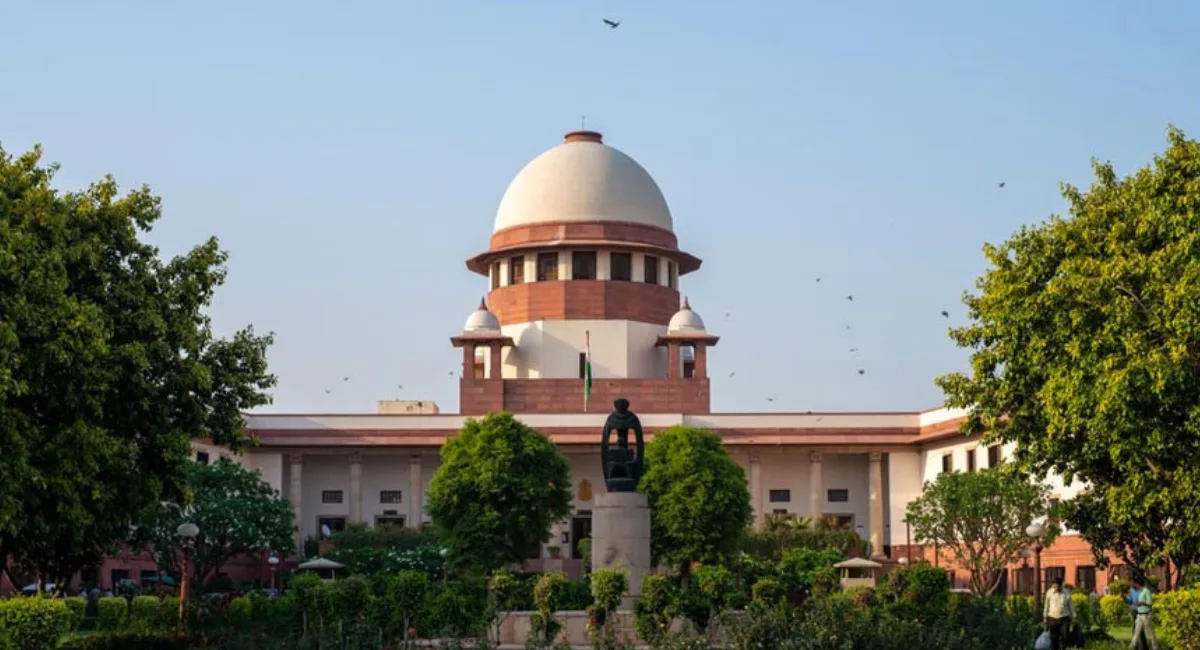
The Supreme Court has raised important legal questions over the Trinamool Congress’ challenge concerning voter deletions during the Special Intensive Revision of electoral rolls in West Bengal.
A bench comprising Chief Justice of India Surya Kant, Justice Joymalya Bagchi and Justice V Mohana considered an application moved by senior advocate Kalyan Bandhopadhyay on behalf of a TMC member. At the centre of the hearing was the contention that voter deletions in a number of constituencies were greater than the eventual victory margins recorded in the Assembly elections.
The TMC has argued that the scale of deletions could have had a direct bearing on electoral outcomes, particularly in constituencies where winning margins were comparatively narrow. The party’s submission identified 31 Assembly constituencies where the victory margin of winning BJP candidates was smaller than the total number of voters deleted during the SIR exercise.
The Supreme Court, however, appeared to focus on the legal mechanism through which such concerns could translate into a direction for fresh elections.
‘Can the court direct fresh elections like this?’
During the hearing, Chief Justice Surya Kant asked whether the court could direct fresh elections solely on the basis of the figures presented before it.
“You can file the application on this, but can the court direct fresh elections like this?” the Chief Justice orally observed, according to the material submitted in the case.
The question assumes significance because the TMC’s argument is based on a comparison between the number of voters deleted during the SIR exercise and the margins by which candidates won their respective constituencies.
The Chief Justice also asked whether candidates affected by the alleged deletions had approached the appropriate legal forum through formal election petitions in all 31 constituencies. The counsel appearing for the petitioner indicated that election petitions had been filed in some constituencies, but not in all of them.
This distinction became an important part of the court’s examination of the plea. The proceedings indicate that the bench was assessing not merely the numerical difference between deleted voters and electoral margins, but also whether there was a legally established basis for reopening the election results.
TMC points to 31 constituencies
Representing the TMC petitioner, senior advocate Kalyan Bandhopadhyay presented what the petition described as an arithmetical discrepancy across 31 Assembly constituencies.
According to the submission, these were constituencies where the winning BJP candidate’s victory margin was lower than the total number of voters deleted during the SIR process. The TMC has used this comparison to argue that voter exclusions could have materially affected the final electoral outcome.
The petitioners contend that the deletion of large numbers of voters in constituencies with narrow victory margins raises questions about whether all eligible citizens were able to exercise their franchise.
The material placed before the court gives the example of Assembly Constituency 145, where the losing margin was only 401 votes while 8,785 voters were deleted. Another constituency was cited where a candidate lost by 316 votes amid a substantially larger number of SIR exclusions.
The TMC’s broader contention is that when the number of deleted voters is significantly higher than the winning margin, the possibility that voter deletions influenced the outcome cannot simply be ignored.
Why the number of appeals matters
The Supreme Court also examined a separate but closely connected question: how many of the voters whose names were deleted actually challenged their exclusion from the electoral rolls.
Justice Joymalya Bagchi stressed the importance of determining how many excluded voters had filed appeals against the deletion of their names.
The court indicated that the mere fact that a large number of voters were deleted would not, by itself, establish that the election result was affected.
The distinction can be illustrated through the example discussed during the proceedings. If 100 voters were deleted from a constituency where the winning candidate’s margin was 50 votes, but none of the deleted voters challenged their exclusion, a claim based on those deletions could become largely academic. On the other hand, if 60 or 70 of those 100 voters had filed appeals that were still pending, the issue would become considerably more significant.
In other words, the court appeared interested in establishing a direct connection between the deletion of voters, their attempts to restore their names to the rolls and the eventual election result.
TMC flags lack of assembly-wise appeal data
Another issue raised during the hearing concerned the availability of constituency-wise information on appeals against voter deletions.
The TMC counsel told the Supreme Court that it remained difficult to quantify the number of appeals filed from each Assembly constituency because the Election Commission of India had not made the relevant assembly-wise figures available in the public domain.
The absence of such publicly available data adds another layer to the legal dispute. While the TMC has presented figures showing that voter deletions exceeded victory margins in 31 constituencies, determining how many affected voters actually contested their deletion could be important in assessing the electoral impact.
The court’s questions suggest that establishing this connection could be central to determining whether the claims warrant further judicial intervention.
The legal question before the court
At the heart of the proceedings is the question of whether the numerical comparison between voter deletions and election margins can itself justify an order for fresh elections.
The TMC’s case focuses on the possibility that legitimate voters were removed from electoral rolls and consequently prevented from voting. Its submission points to constituencies where the number of deleted voters was several times larger than the winning margin.
The Supreme Court, however, is examining whether such a situation can be addressed by ordering a fresh election without the affected candidates following the established election-petition process.
The Chief Justice’s question about whether the court can “direct fresh elections like this” reflects the broader procedural issue before the bench.
The court’s inquiry into election petitions filed in the 31 constituencies is therefore significant. While petitions have reportedly been filed in some seats, the TMC counsel acknowledged that this has not happened in every constituency cited in the plea.
What the court is looking for
The proceedings indicate that the Supreme Court is examining several connected factors rather than relying on voter-deletion figures alone.
First, the bench is considering whether the affected candidates have formally challenged the election results. Second, it wants to know how many deleted voters actually appealed against the deletion of their names. Third, the court is examining whether those pending appeals can establish a meaningful connection between the SIR exercise and the electoral outcome.
This approach places emphasis on evidence of actual electoral impact rather than simply comparing two numbers.
For the TMC, the argument remains that a substantial number of deletions in constituencies decided by narrow margins warrants judicial scrutiny. The petitioners maintain that such deletions could have denied legitimate citizens their right to vote and, in turn, materially influenced the results.
Broader significance of the Bengal SIR dispute
The proceedings assume significance because electoral-roll revisions directly affect who is eligible to participate in elections. The Bengal SIR dispute has brought into focus the consequences of voter deletions, the process for challenging such deletions and the relationship between electoral-roll disputes and election-result challenges.
The Supreme Court’s questions indicate that it is attempting to examine these issues within the existing legal framework rather than automatically accepting the numerical comparison put forward by the petitioner.
For the TMC, the central concern is whether voter deletions affected the outcome in constituencies where the winning margins were smaller than the number of excluded voters. For the court, the immediate issue is whether there is sufficient legal and factual material to connect those deletions with the election results and whether fresh polls can be ordered through the present proceedings.
The hearing therefore leaves the question of fresh elections open while placing greater emphasis on constituency-specific evidence, election petitions and appeals filed by deleted voters.