
“If we wish to maintain democracy not merely in form, but also in fact, what must we do? The first thing in my judgment we must do is to hold fast to constitutional methods of achieving our social and economic objectives. It means we must abandon the bloody methods of revolution. It means that we must abandon the method of civil disobedience, non-cooperation and satyagraha. When there was no way left for constitutional methods for achieving economic and social objectives, there was a great deal of justification for unconstitutional methods. But where constitutional methods are open, there can be no justification for these unconstitutional methods. These methods are nothing but the Grammar of Anarchy and the sooner they are abandoned, the better for us”
– Dr Babasaheb B R Ambedkar, Constituent Assembly Debates, Vol 11, November 25, 1949
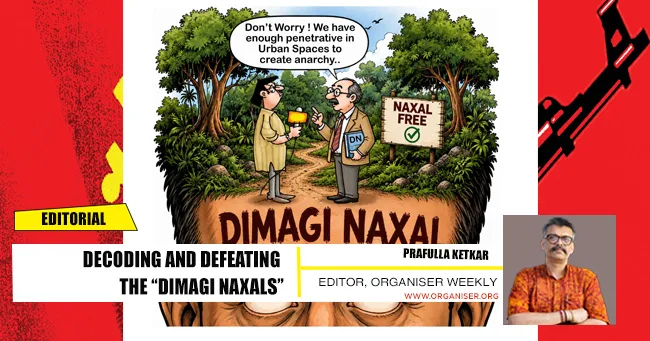
As PM Narendra Modi used the term Dimagi Naxals, some people got rattled and started questioning the term as anti-intellectual, while usual suspects turned it into a badge of honour by turning it into another mode of ‘resistance’ in the form of Dimagi Naxal Party. Instead of getting trapped in the theatrics of these anarchists, we need to decode who the Dimagi Naxals are, what their characteristics are, and how to fight against them to save democracy from this dangerous ideology.
Actually, the term Dimagi Naxal is not new or derogatory for the believers of the violent, destructive ideology called Naxalism or Maoism. It is truly a badge of honour. They themselves have elaborated on their ideology and strategy for revolution in their documents. Their stated aim is to “seize the Political Power of India through Armed War & to solve this issue by war. The main task of the Maoist organisation is to destroy the Indian army, police and the entire bureaucratic system, by war”. They have launched an ideological war against Bharat and have not accepted the Bharatiya Constitution since its inception. What they have been aiming is to establish a violent authoritarian regime in Bharat by destroying the whole Constitutional framework. So, using Babasaheb Ambedkar and the Constitution is just ‘Al-Taqiyya’ of Communist variety.
As the armed rebellion has failed miserably, the Dimagi variant has taken charge. As per the Maoist documents, these are the people who work secretly in the cities and create multiple frontal organisations in the name of students, women, labour class, farmers, Scheduled Castes, Scheduled Tribes and so-called minorities. Where they do not have space for ‘fractional work’ with their own platform, they would infiltrate other organisations and shape the agenda in the most clandestine, secret ways. The National Advisory Council of the Sonia Gandhi-led UPA Government was a classic takeover of the Dimagi Naxals of governance. Their idea of penetrating the bureaucracy, policy machinery, legal system, academia, media, and NGOs is part of the ‘revolutionary strategy’. They don’t carry guns but use labels like eminent historians or intellectuals, award-winning literary figures, legal luminaries, human rights activists, independent journalists, celebrity actors or actresses, and environmentalists. Civil society is their tool of resistance to Constitutional Democracy. Hence, Yogendra Yadav says, ‘the decision will be taken on roads and not in the Parliament; policies will be decided through resistance and not elections’. Subversion of democracy through democratic means is their classic style.
Dimagi Naxals are educated but use their brains in the wrong direction for destructive purposes. Agenda-driven individuals and organisations control minds through ideas planted in social media spaces and use them against the nation. Algorithms run by their handlers and funders in big-tech companies favour them, helping them influence large masses. Not that the issues they raise are not genuine. From education to climate change, they pick up some issue of systemic failure to build an agitation. The problem is that they offer no credible solution or alternative. Their alternative is hijacking power for an authoritarian regime – what they call people’s democracy.
Here Gene Sharp and his 198 Methods of Non-violent Action become helpful for these Dimagis. Again, non-violence is a camouflage they use to cover their utterly violent activities. Gandhiji and his ideas of non-violence and Satyagraha were cleverly mixed up with the communist objectives in this strategy. Dimagi Naxals love deaths as they want to use dead bodies to instigate masses. Honouring the dead, in political mournings, mock funerals, demonstrative funerals and homage at burial places are stated methods, is their favourite way of resistance. Using any accusation as a badge of honour and turning it into a weapon is again a guided strategy by Gene Sharp, the Boston-based Dimagi. He articulates it as From Dictatorship to Democracy, but both dictatorships and democracies are defined and identified by demagogues, not by constitutional norms. Discrediting elections, questioning all policies or legislative processes, pitching one group against another, proving elected Government as illegitimate and hegemonic, ultimately eroding the legitimacy of electoral politics are key steps in this strategy. Now connect the dots from the Awards wapasi drama to the Dimagi Naxal Party, and one will get to see
a more clear picture.
In a large country like Bharat, systemic issues will always be there. Education, healthcare, and overall development model need a drastic overhaul. However, these issues neither emerged in the last twelve years nor exist only in BJP-ruled States. For them, targeting Hindutva as the hegemony and pitching each peripheral, constructed identity as non-Hindu is the larger game. In this, they create the Quadriga nexus formation, in which a car or a chariot is drawn by four horses abreast. The collaboration of radical Islamists, Maoists and evangelical missionaries, with the set of select intellectuals, legal professionals, NGOs, Bollywood stars, other cultural groups and media platforms is visible in every agitation that is happening around; it is a pattern and not an accident. This precisely is the reason why agitations ranging from farmers to students eventually turn against Hindu civilisational identity, oppose integration of Jammu-Kashmir, come out in support of Sharjil Imam or Omar Khalid who dreamt of breaking Bharat into pieces and oppose Vande Mataram – the nationalist slogan of the freedom struggle.
Not all agitators or groups seeking reforms are Dimagi Naxals. They are often on the periphery of the entire Chakravyuha and used as Abhimanyu in cognitive warfare, controlled by the ‘core’ of Dimagis. When national security is not limited to military strategies and enlarged to mind games in society through various tools, citizens should be vigilant against the Dimagi Naxals. In collaboration with the security forces, we need to win this urban frontier against the Maoists who are manipulating both Babasaheb Ambedkar and Gandhiji to realise Marxist and Maoist objectives. Making the entire system dysfunctional through multiple agitation and paving the way for revolution via anarchy is the standard operating procedure of Dimagi Naxals.
Understanding the dangers posed by these Dimagis and collaborating with agencies and security forces to identify and expose them is our national duty. Social organisations and activists must study this subject and then educate the masses about this eminent danger. Prime Minister Modi, in his Independence Day speech, tried to sensitise the citizens about this duty, after the end of armed Naxals. Decode, identify and expose Dimagi Naxals’ who want to fool the masses by exploiting their sentiments and genuine concerns; they cannot be the real change-makers but are dangerous agents of violent authoritarianism where decisions will be taken on the roads and through resistance without any democratic participation. Dimagi Naxals are the Grammarians of Anarchy, as Dr Ambedkar had warned.