The present global financial systems are in a state of massive flux because the world economy has reached a critical inflection point. Over the last 55 years, the capitalist model of financial architectures—built upon paper fiat currencies printed at will and dominated by a single hegemony, the U.S. Dollar—has created a global politico-economic environment that is unnatural, inorganic and fundamentally unsustainable. Recent structural crises have brought these systemic failure points into sharp relief.
The cyclical perspective of sustainable economics
Human civilization has existed for millions of years, far outlasting the narrow timelines hypothesized by conventional modern anthropology. While contemporary geology dates the physical Earth at approximately 4.54 billion years, ancient Vedic cosmic scriptures calculate the precise age of our current planetary order at 1.96 billion years, mapping time as an eternal, cyclical entity divided into vast eons (Yugas).
Because advanced human communities have flourished across these massive time horizons under the guidance of the Vedas and their derivative texts, humanity has already developed and tested political and economic paradigms that encourage organic growth and long-term sustainability. The core pillars of these timeless paradigms are straightforward:
- Hard intrinsic value as the anchor for monetary currency
- Self-sustaining, closed rural economies that insulate local communities from external macroeconomic shocks
The flaw of paper currency and debt accumulation
Recorded historical texts and multi-generational traditional mores reveal that viable currency historically relied on the intrinsic worth of the currency unit itself—whether standard weights of gold, silver, copper coins or naturally extracted gemstones. An interchangeable global medium of exchange requires an immutable, globally respected anchor.
Conversely, paper currency possesses zero intrinsic value. For example, a $100 U.S. bill costs a mere 11.3 cents to manufacture, yet it commands artificial global purchasing power because it is backed by state decree.
This modern imbalance traces back to 1971, when U.S. President Richard Nixon unilaterally severed the U.S. Dollar’s link to gold, abandoning the Bretton Woods architecture. Prior to this “Nixon Shock,” the U.S. could not legally print currency disproportionate to its physical bullion reserves.
Post-1971, a one-way transfer of wealth began: the rest of the world exported physical, high-value goods and services to the United States in exchange for paper notes printed at will. This mechanism artificially inflated Western per capita incomes without triggering domestic hyperinflation, as the excess dollars were absorbed globally.
However, heavily capitalized Western banking networks aggressively disbursed debt across global entities, leading to unprecedented sovereign deficits. By mid-2026, the U.S. national debt rapidly approached $40 trillion, pushing its debt-to-GDP ratio to an alarming 121 per cent.
Other advanced nations mirror this vulnerability; for instance, Japan’s gross government debt-to-GDP ratio sits at roughly 200.8%. High external debts leave nations highly vulnerable to asset liquidation or systemic acquisition. Currently, only nations holding massive trade surpluses or dominant military prowess can offset this underlying financial fragility.
Structural failures of the capitalist model
The global capitalist apparatus is governed by massive financial conglomerates—consolidated commercial banks, institutional investors, and wealth managers. These institutions control the flow of capital, and the repayment of their loans is dependent entirely on global liquidity.
Advanced economies possess a structural advantage by borrowing heavily in their own fiat denominations (U.S. Dollars, Euros, British Pounds, or Yen), allowing them to cushion internal fiscal crises by printing more money. Conversely, developing nations face severe geopolitical and economic friction during debt restructuring. This dynamic heavily penalizes developing countries like India, which must spend vast amounts of foreign exchange reserves to import the bulk of its crude oil—the primary energy lifeline of its expanding economy.
The financial system’s reliance on paper currency has generated six primary adverse effects:
Widening wealth disparities: The modern framework concentrates capital at the top. According to the World Inequality Report 2026, the global top 10 per cent now controls nearly 75 per cent of total global wealth, while the bottom 50 per cent holds a mere 2 per cent. Investible resources remain highly accessible to the rich, while the impoverished face steep barriers to entry.
Erosion of purchasing power: The relentless printing of fiat money systematically outpaces the real growth of global goods and services. This structural inflation acts as a hidden tax, destroying the purchasing power of everyday savers.
Fragile and corruptible political systems: Stock exchanges and global markets are heavily manipulated by major financial institutions, creating fragile economic models easily warped by concentrated institutional capital.
Institutionalized loan defaults: The loose credit environment has normalized large-scale corporate defaults and economic offenses, leaving taxpayers to bail out bankrupt financial entities.
Environmental degradation: The relentless demand for short-term corporate profits accelerates the destruction of global natural resources, forcing the adoption of cheap, environment-unfriendly technologies.
The scourge of counterfeiting: The reliance on paper notes has created a massive, uncontrollable global shadow economy fuelled by high-tech currency counterfeiting and illicit duplication.
A Strategic framework for radical transformation
To become truly organic and sustainable, the international financial architecture requires four major, structural shifts:
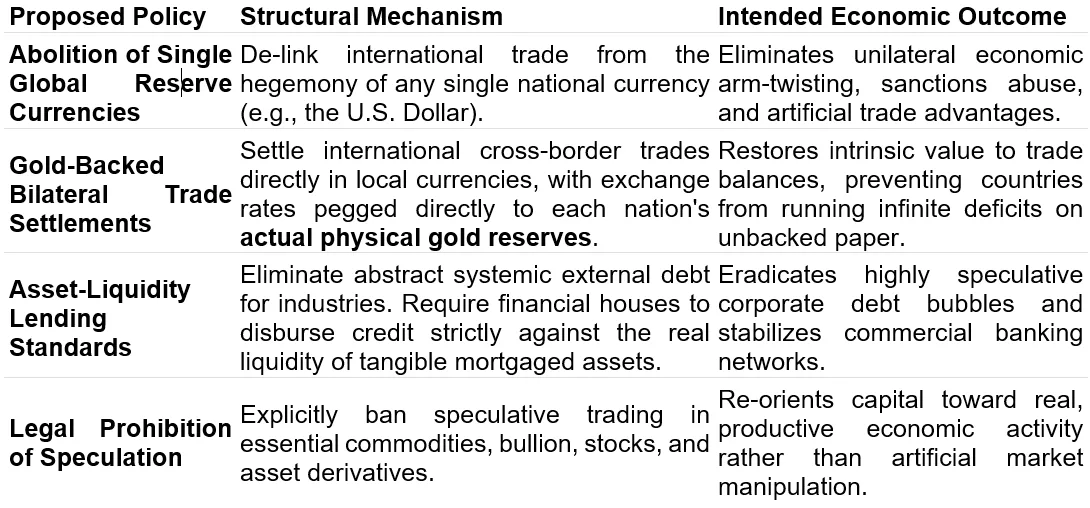 Implementing the fundamental reforms in global financial system, would systematically eradicate some of the world’s most deep-seated economic challenges, including corporate speculation, price manipulation and geopolitical hegemony. While a shift away from paper currency will not immediately wipe out money laundering or illicit counterfeiting overnight, grounding global finance in real, intrinsic assets will build an equitable, balanced and sustainable global economy for generations to come.