
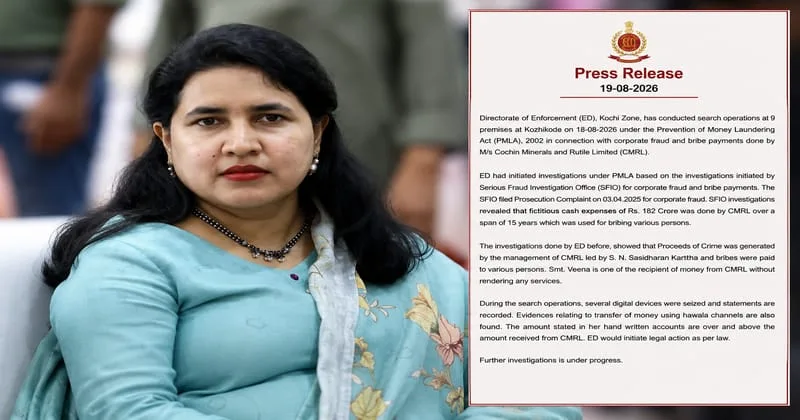
In Kerala’s political and business circles, a paper trail has brought T. Veena, daughter of former Chief Minister and current Leader of the Opposition Pinarayi Vijayan, under the scanner of a money-laundering investigation that allegedly extends to a Dubai hawala link.
According to Enforcement Directorate (ED) officials, handwritten notes recovered from premises linked to Veena allegedly record transactions far exceeding her known sources of income. The notes reportedly mention transfers to Dubai and point to possible hawala channels, adding a new dimension to the investigation.
The latest chapter unfolded on 18 August 2026, when the ED’s Kochi Zone searched nine premises in Kozhikode under the Prevention of Money Laundering Act (PMLA). The operation followed an earlier round of searches on 27 May 2026 at locations connected to Veena and promoters of Cochin Minerals and Rutile Limited (CMRL). Those May searches, according to the agency’s press release and subsequent reporting, yielded handwritten accounts allegedly maintained by Veena. The notes listed names of individuals, amounts handled or spent, and details of money moved to Dubai—recorded in both UAE dirhams (AED) and Indian rupees.
Hawala – Dubai Link
The Dubai-linked amount is about 3.49 lakh AED. That is roughly ₹85 lakh. The rupee-side amount is about ₹20.05 crore. Investigators say this money is separate from what Veena’s company already received. Her company was Exalogic Solutions Private Limited, a one-person firm now shut down. Exalogic received ₹2.78 crore from CMRL. This was booked as payment for IT consultancy services. The SFIO and ED allege these services were never actually provided. CMRL’s managing director, S.N. Sasidharan Kartha, is linked through another company. That company gave ₹50 lakh in loans to Exalogic. The loans reportedly had repayment issues. Separately, SFIO found about ₹182 crore in fake cash expenses at CMRL. This happened over 15 years. Investigators allege this money was used to pay bribes.
Dubai Hawala Trail Adds New Dimension to Exalogic-CMRL Money Trail
ED statements put the Dubai-linked transactions at around AED 3.49 lakh, or about ₹85 lakh. The Indian rupee transactions are estimated at around ₹20.05 crore. Investigators say this money is separate from the ₹2.78 crore received by Veena’s now-defunct one-person company, Exalogic Solutions Private Limited, from CMRL. The payments were shown as IT consultancy fees. However, the Serious Fraud Investigation Office (SFIO) and ED allege that the services were never actually provided. CMRL Managing Director S.N. Sasidharan Kartha is also linked to the matter through another entity. That entity gave Exalogic a ₹50 lakh loan, even though there were questions over repayment.
The wider SFIO investigation found around ₹182 crore in alleged fictitious cash expenses at CMRL over 15 years. Investigators allege that this money was used to pay bribes.
Details of Digital Seizure Hint at Links to Infamous Cases
Digital devices seized in the May searches reportedly contained a photograph of a SIM card obtained in another person’s name, allegedly for use in a Wi-Fi router—suspected by investigators as a means for discreet internet-based calls. In the August follow-up searches, the agency covered individuals named in the handwritten notes and the person linked to the SIM. Officials say they recovered additional digital devices, recorded statements, and found evidence pointing to money transfers through hawala channels. The ED’s assessment is that Veena was handling funds beyond her known income sources; the agency has indicated it will initiate legal action as per law while further probes continue.
Now What is Veena Vijayan’s Case?
The case traces back to Income Tax findings, an SFIO prosecution complaint, and ED registration under PMLA. CMRL’s former MD has been quoted in ED filings as acknowledging that payments to Veena and her firm occurred without services, citing personal relationships with the then Chief Minister. Political reactions have been sharp: the CPI(M) and family associates have described the investigation as politically motivated, while opposition voices argue the documented findings cannot simply be dismissed as a witch-hunt. Veena’s husband, former minister P.A. Mohamed Riyas, has maintained that transactions were legal.
Core Contradiction with Party Identity
The CPI(M) in Kerala has long projected itself as ideologically disciplined and relatively clean. However, several cases involving alleged links between party leaders and criminals, along with allegations of financial irregularities and corruption, have raised questions about that image. Additionally, the allegations against T. Veena directly and severely undermine every element of that carefully cultivated brand.
The damage is intensified by the fact that the individual involved is not a peripheral figure but the daughter of the long-time “Captain” of the Kerala unit and the spouse of a state secretariat member. It reinforces the charge that power produced privilege, that proximity to the leadership opened doors to unexplained funds, and that the party’s internal discipline stops short when it reaches the family of its strongest leader. In the eyes of many workers and supporters, the case does not merely raise questions about one individual; it exposes a systemic failure of the organisation’s claimed moral and ideological standards.
What the ED Is Investigating
At the centre of the investigation is the generation and movement of proceeds of crime through CMRL’s financial transactions. The ED has said that CMRL management, led by managing director S N Sasidharan Kartha, generated proceeds of crime through fictitious expenses and subsequently made payments to various individuals. The agency has identified the Rs 2.78-crore payment to Exalogic as one of the transactions requiring investigation. The ED is also examining the Rs 50-lakh loans extended by EICPL to Exalogic, the handwritten financial records, the Dubai-linked transactions and hawala channels.
The PMLA proceedings had earlier been challenged by CMRL before the Kerala High Court. The High Court dismissed the company’s writ petition challenging the proceedings, allowing the ED investigation to continue. The court also noted that a scheduled offence existed following the SFIO’s prosecution complaint, providing the basis for the PMLA proceedings. The ED has subsequently continued its investigation and carried out searches at multiple locations.
The August 18 searches resulted in the seizure of several digital devices and other material, according to the agency. Statements were also recorded as part of the investigation. The ED said the material recovered during its searches would be examined to establish the complete trail of the funds and the role of individuals connected with the transactions. The agency further said that legal action would be initiated in accordance with law based on the evidence gathered. The investigation remains ongoing, with the ED continuing to examine the financial transactions, records and individuals connected to the case.
Parallels with Other Cases and Leaders
Similar dynamics have played out before. Pinarayi Vijayan himself faced the long-running SNC-Lavalin case as power minister; though he was eventually acquitted at lower levels (with appeals pending in some accounts), it established a pattern of high-profile scrutiny that the party dismissed as motivated. The gold-smuggling controversy during the LDF’s earlier term also tested the leadership’s proximity to irregular networks. Nationally and historically, Left parties have suffered when corruption or family privilege narratives take hold: the West Bengal Left Front’s long decline involved accumulating perceptions of organisational decay, violence, and distance from ordinary supporters alongside policy failures. In contrast, Congress governments in Kerala (e.g., the solar scam period) faced comparable erosion when family or close associates were implicated, showing that no side is immune—but the damage is sharper for a party whose identity rests on moral and class superiority.