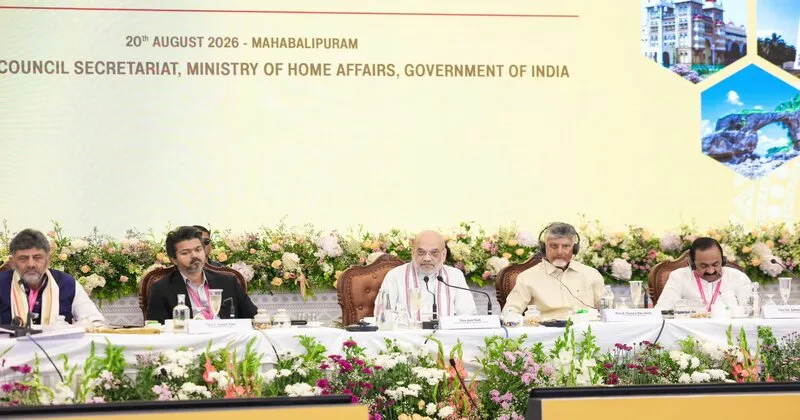
Chennai: Union Home and Cooperation Minister Amit Shah on August 20 highlighted South India’s pivotal contribution to the country’s economic and technological development while calling for faster resolution of pending inter-state water disputes through dialogue and cooperation. Chairing the 31st Southern Zonal Council meeting at Kovalam near Mahabalipuram, Shah said the region has made major contributions to sectors ranging from literature, research and development and space to IT, artificial intelligence, automobiles, pharmaceuticals, infrastructure and agriculture. The meeting also saw southern states raise concerns over parliamentary representation during the proposed delimitation exercise, water-sharing disputes, drug trafficking, fiscal issues and regional economic cooperation.
Amit Shah: South India Has Been a Major Contributor to India’s Growth
Addressing the 31st Southern Zonal Council meeting, Amit Shah said South India has emerged as an important contributor to India’s development journey. He highlighted the region’s achievements in literature, R&D, space technology, IT, AI, industrial development and agriculture, besides its major role in the automobile, pharmaceutical and infrastructure sectors.
According to Shah, the strong industrial and technological ecosystem in the southern states has also helped attract significant foreign direct investment to the region.
At the 31st Meeting of the Southern Zonal Council held today, Andhra Pradesh and Telangana agreed to resolve issues related to the division of assets and liabilities as envisaged by the MHA.
Emphasised the need for speedy investigation into crimes against women and children… pic.twitter.com/VYLvGsQnqN
— Amit Shah (@AmitShah) August 20, 2026
He identified three major pillars behind South India’s development — its high literacy rate, trained manpower and technical expertise, including in the utilisation of deep-sea resources. He said these strengths have made the region one of the biggest contributors to India’s economic progress.
Shah also pointed to the southern states’ traditions of innovation and revenue generation, saying the rest of the country could learn from the region’s experience in these areas.
Centre, States Seek Faster Resolution of Water Disputes
Inter-state water disputes emerged as another important issue at the meeting. Shah emphasised the need for early resolution of pending disputes concerning southern states through joint consultations involving the Ministry of Jal Shakti, Ministry of Home Affairs, Inter-State Council and the concerned state governments.
The participating states agreed on the need to resolve outstanding water-related disputes through dialogue and constructive solutions.
Tamil Nadu, meanwhile, reiterated its demand that the rights of lower-riparian states be protected and that Supreme Court judgments, tribunal awards and statutory mechanisms governing inter-state rivers be implemented in letter and spirit.
The state particularly highlighted the Cauvery and Mullaperiyar disputes.
Delimitation Becomes a Major Political Issue
Tamil Nadu Chief Minister C. Joseph Vijay used the meeting to seek a clear legislative assurance from the Centre that no state would suffer a reduction in its percentage share of parliamentary representation because of its success in population stabilisation.
Vijay argued that southern states have been at the forefront of population control, human development and economic growth and should not be penalised for achieving national policy objectives.
He said the proposed delimitation exercise should uphold equity, preserve the federal balance envisaged by the Constitution and strengthen the confidence of states in democratic institutions.
The demand comes less than a week after the Tamil Nadu Assembly passed a resolution seeking retention of the Lok Sabha’s existing strength of 543 seats and accommodation of the 33 per cent women’s reservation within the existing strength rather than redistributing seats primarily on the basis of population.
At the Southern Zonal Council meeting, however, Vijay broadened the demand by seeking an assurance that no state would lose its percentage share of parliamentary representation on account of population stabilisation.
Tamil Nadu Seeks ‘Fair and Equitable’ Treatment
Vijay stressed that southern states were not seeking preferential treatment but “fair and equitable treatment”. He called for fiscal autonomy and argued that performance should be rewarded alongside the principle of equity.
He also sought greater flexibility for states in determining GST rates.
According to Vijay, the southern states collectively contribute more than 30 per cent of India’s GDP and are at the forefront of manufacturing, exports, services and innovation. He said Tamil Nadu was ready to work with the Centre and other states towards the goal of a developed India.
Common Economic Clusters Proposed for Southern States
Vijay also proposed greater economic and logistical integration among southern states through common economic and logistics clusters.
He said such clusters could reduce the cost of doing business, improve export competitiveness and make the region more attractive to foreign investors. They could also help spread industrial activity to smaller towns and promote more balanced regional growth.
The Tamil Nadu Chief Minister additionally called for stronger inter-state coordination to tackle drug trafficking, particularly the movement of narcotic and psychotropic substances.
Karnataka Flags Representation and Resource Concerns
Karnataka Chief Minister DK Shivakumar also raised concerns over resources and political representation, stressing that a strong South was essential to a strong India.
He called for fairness in resource allocation, representation and respect for states that make significant contributions to national economic growth.
The delimitation issue has emerged as a major concern among southern states because of apprehensions that population-based redistribution could reduce their relative share of Lok Sabha seats after decades of successful population stabilisation.
Southern States Push Regional Cooperation
The meeting brought together political leaders and senior officials from Andhra Pradesh, Karnataka, Kerala, Tamil Nadu and Telangana, along with representatives of Puducherry, the Andaman and Nicobar Islands and Lakshadweep.
Andhra Pradesh Chief Minister N Chandrababu Naidu, Karnataka Deputy Chief Minister DK Shivakumar, Kerala Chief Minister VD Satheesan and Telangana Deputy Chief Minister Bhatti Vikramarka Mallu attended the meeting. Lieutenant Governor K. Kailashnathan of Puducherry, Andaman and Nicobar Islands Lieutenant Governor Admiral (Retd.) D.K. Joshi, Lakshadweep Administrator Praful Patel and senior officials were also present.
The Southern Zonal Council provides a platform for the Centre and states to address inter-state issues through consultation and cooperation. Discussions at the latest meeting covered regional development, economic growth, infrastructure, security and other issues requiring coordination among the participating states and Union Territories.